Squarp Hapax 3.2: Now With Poly Aftertouch – the Last Big MPE Gap Just Closed
When Sequencing Is No Longer Just Programmed but Played, and Expression Finally Becomes Part of the Workflow

 4,9 / 5,0 |
Squarp Hapax 3.2: Now With Poly Aftertouch – the Last Big MPE Gap Just Closed · Source: Squarp

Squarp Instruments just released Firmware 3.2 for the Hapax sequencer, and the headline feature closes a gap that’s been open since the MPE update landed in version 3.0: poly aftertouch finally gets its own dedicated track type. Nice! On top of that, CV clock rates got a serious bump, plus two new sync options for more stable external connections. Naturally, a bunch of bugs got squashed along the way too.
All About Squarp Hapax
Hapax 3.2: Why This Update Actually Matters
Poly aftertouch has honestly been the one blind spot in an otherwise deeply expressive Hapax workflow. With the new AFTR track type, sitting right after MPE in the track-type list, you can now fully record, play back, and edit polyphonic aftertouch, complete with its own pressure curve per note, exactly like the MPE pressure lane already works. Move or transpose a note, and its aftertouch curve tags along automatically. Let’s get into the details.
Poly Aftertouch in Detail
Unlike an MPE track, the new AFTR track keeps just a single input and output channel, so it works with any synth over DIN or USB without needing to set up a full MPE zone. Handy detail: incoming poly aftertouch now passes through on every track type, not just AFTR tracks, so Hapax no longer swallows pressure data when it’s being used purely as a MIDI router.
If your keyboard only sends channel aftertouch, meaning a single value for the whole channel, an AFTR track still records it reliably, applying that incoming value to every note currently held down. The MIDI monitor now displays poly aftertouch messages too, complete with note number and pressure value.
Higher CV Clock Rates and More Stable Sync
The second big piece here: CV clock rate now goes all the way up to 96 ppqn (48 ppqn is available too), where things used to cap out at 24 ppqn. That’s finally fast enough to sync Hapax to an audio-rate clock coming out of a DAW or a modular system.
There’s also a new Clock Timeout option: if Hapax loses its external clock signal mid-playback, whether that’s CV, MIDI, or USB, it now automatically falls back to the internal clock instead of just hanging, then re-locks the moment the signal comes back. CV Follow Tempo lets the project BPM follow an incoming CV clock too, the same way it’s already worked with MIDI clock.
So, What Actually Happened in Version 3.10?
Before 3.2 rolled around, Squarp had already put out version 3.10 back in June, which we hadn’t covered here yet. Quick rundown: the Step Drum section got expanded to support up to 16 drum lanes, alongside three new Live Drum pad layouts.
3.10 also introduced Spring, a versatile slew limiter effect with a resonant/oscillating mode, plus the option to set the Global LFO to a static “flat” waveform, handy for building custom macros through the mod matrix. The Filter effect picked up velocity min/max parameters, and effect automation recording got noticeably more direct too: turn an FX parameter knob while recording, and the automation lane now gets created for you automatically.
Quick Heads-Up Before You Go
One small but important compatibility note (heads up!): a project saved in 3.2 will no longer open in 3.10, since track serialization got updated to support the new aftertouch mode. Back up your projects before updating, just to be safe.
Are you actually using poly aftertouch in your setup, or has MPE already covered everything you needed?
You can find more information and grab the download right here.



Version 3.0: With MPE, This Sequencer Becomes a Performance Instrument
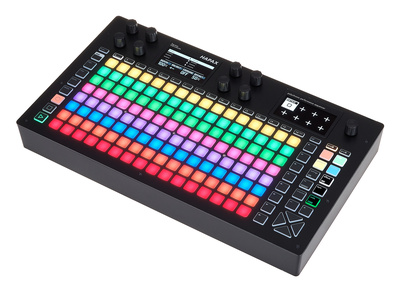
[09 April 2026] For years, Squarp Instruments has offered the Hapax as a sequencer clearly geared toward live performers. With version 3.0, the system takes a clear step forward. The new MPE integration, in particular, changes how expressive controllers are used in a noticeable way. Hapax is evolving from a classic step sequencer into a performance hub that does far more than just trigger notes.
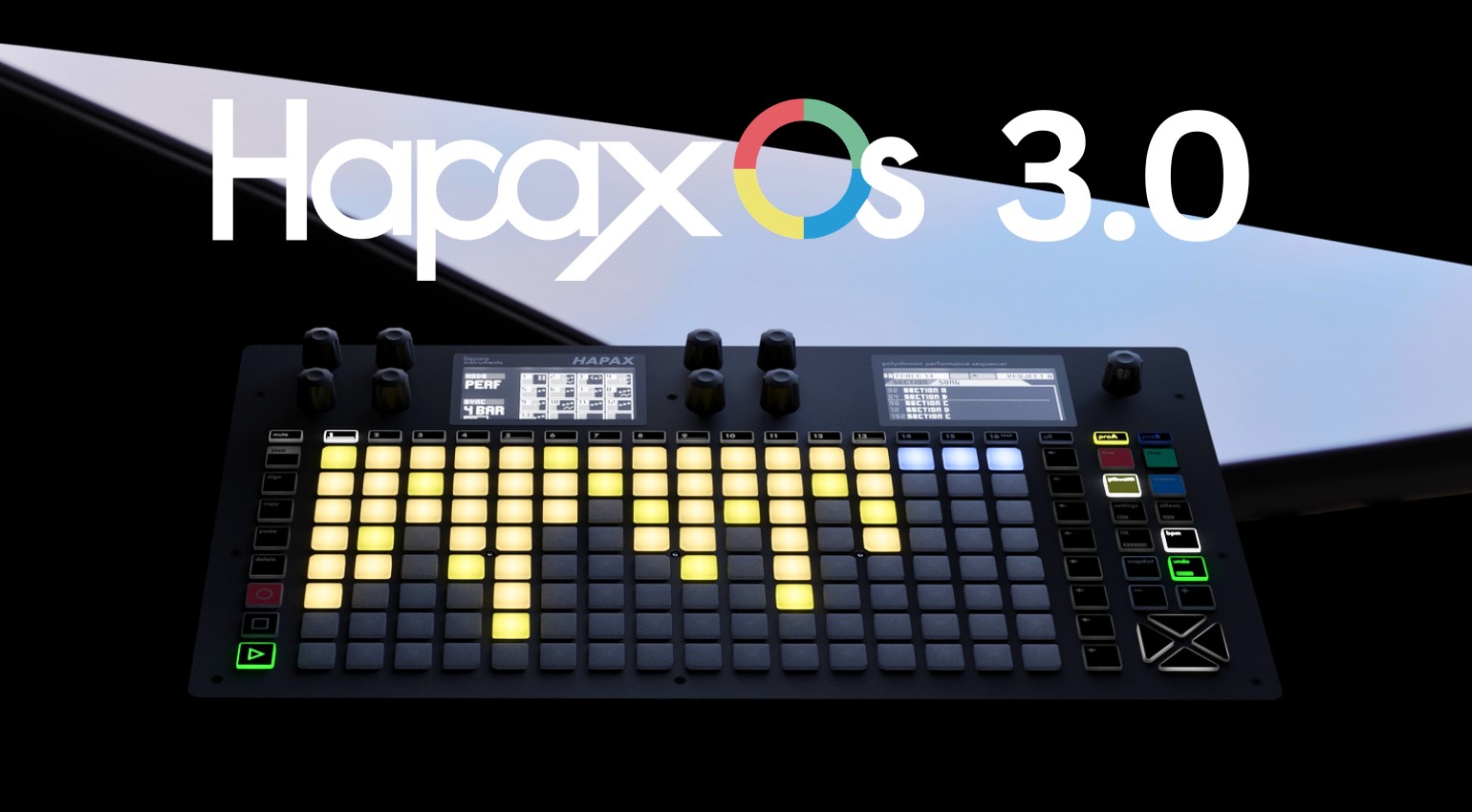
Hapax 3.0 and MPE: Why Sequencing Suddenly Comes to Life
At the core of Hapax 3.0 is a redesigned MPE implementation that is now much more deeply integrated into the workflow. Each track can be assigned its own MPE zone, allowing multiple instruments to be controlled with a high level of precision.
This becomes especially noticeable in Live mode. Hapax turns into a controller with 128 pads that transmit velocity, timbre, and pitch in real time. The result is performances that stay rhythmically tight while reacting dynamically to every input.
In Step mode, expression values can also be defined per note. This means movement is not only created during playback, but already built directly into the sequence while programming.
More Flexible Routing: Hapax Becomes the Control Center of Your Setup
Another major step forward is the expanded routing system. USB connections are now handled as multiple independent MIDI ports, making even complex setups much easier to organize.
Synchronization and transport can be assigned to specific ports. This adds a higher level of control and stability, especially in larger configurations. Pattern transitions also feel more musical, as they can be aligned more precisely with individual tracks.
For live performers, this results in a setup that stays flexible while remaining reliable.
Workflow Updates: Small Changes with a Big Impact
Hapax 3.0 also brings a series of refinements that improve everyday use. The modulation matrix can now be set up earlier in the process, making it easier to develop ideas without interruptions. Color coded patterns improve navigation within a project, while additional scales expand the musical possibilities. Timing adjustments for program changes also ensure that external devices respond more reliably.
Each of these changes may seem minor on its own, but together they make the workflow noticeably smoother and more direct.
In Practice: Why Hapax 3.0 Excels in Hybrid Setups
In real world use, Hapax 3.0 shows its strengths most clearly in hybrid setups. Hardware and software can be controlled at the same time, while expressive input is directly integrated into sequences. This creates a workflow that no longer separates studio and stage.
Ideas can be captured quickly, while still allowing enough control for detailed arrangements. Especially in more complex projects, it becomes clear how important a stable and clearly structured sequencer really is.
Hapax 3.0 as a Performance Instrument, Not Just a Sequencer
With the new MPE integration, the focus shifts significantly. Hapax is no longer just a tool for programming patterns. It becomes an instrument in its own right.
Sequences respond to playing style, expression, and dynamics. That is exactly what makes the difference in modern live setups.
More info and the download can be found here.
Version 2.10 with SH-101 mode, Arpoly and More!
[January 24, 2025] The latest 2.10 firmware for Squarp Instruments’ Hapax sequencer brings a host of new features and enhancements that make the unit even more versatile. Among them are four new MIDI effects: Arpoly, a polyphonic arpeggiator and loop designer; Register, a kind of randomizer; Mono, which converts polyphonic notes into monophonic ones; and Shaper, for non-linear modulation. These effects open up a world of creative possibilities for rhythmic and melodic structures and add some very interesting new features to this versatile sequencer!
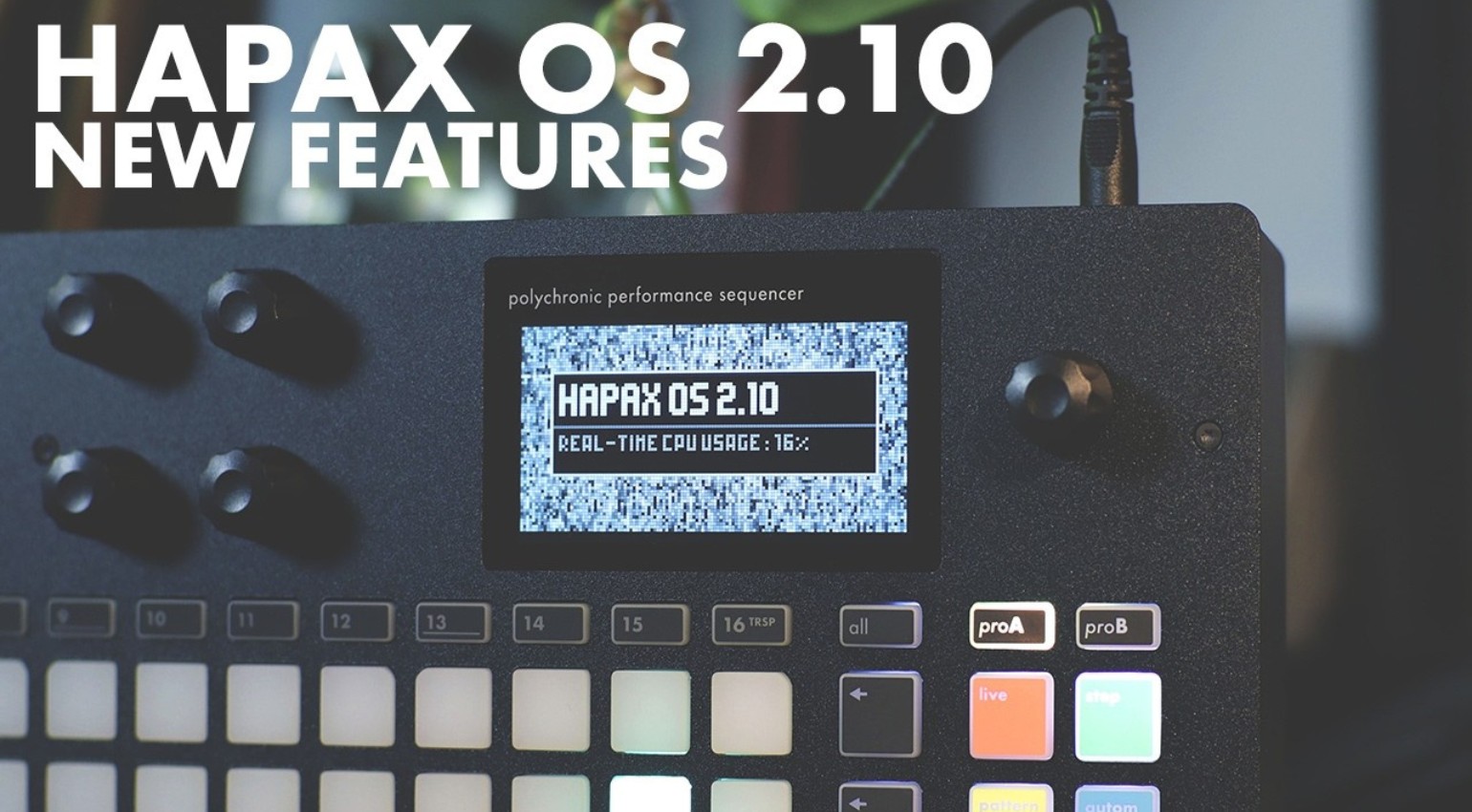
Squarp Hapax Version 2.10
Version 2.10 of the Hapax sequencer adds a shuffle algorithm that can rearrange notes in a variety of ways. Existing features such as the arpeggiator have been expanded to include a hard sync mode, while the randomizer now offers velocity-sensitive probability control. Editing tools have also been enhanced with more precise note length adjustment, transposition options and a new mono editing mode that makes working with sequences much more flexible.
In Chord mode, you can now save modifiers per track, and the new Relatch mode improves workflow. Other features include SH-101-style step recording (very cool!), adjustable auto-length for loops, and enhanced recording options with hard quantization. These innovations not only simplify operation, but also expand the possibilities for studio and live performance.
The free firmware update is now available for all Hapax users to download from the manufacturer’s website. With the many new features and adjustments, Squarp Instruments once again demonstrates how continuous updates can improve a device and expand its creative possibilities.
Squarp Instruments Hapax: Sequencer, studio hub, dawless controller
[02 March 2022] Squarp Instruments has revealed Hapax a standalone hardware sequencer with a 16×8 button array that will run your whole show.
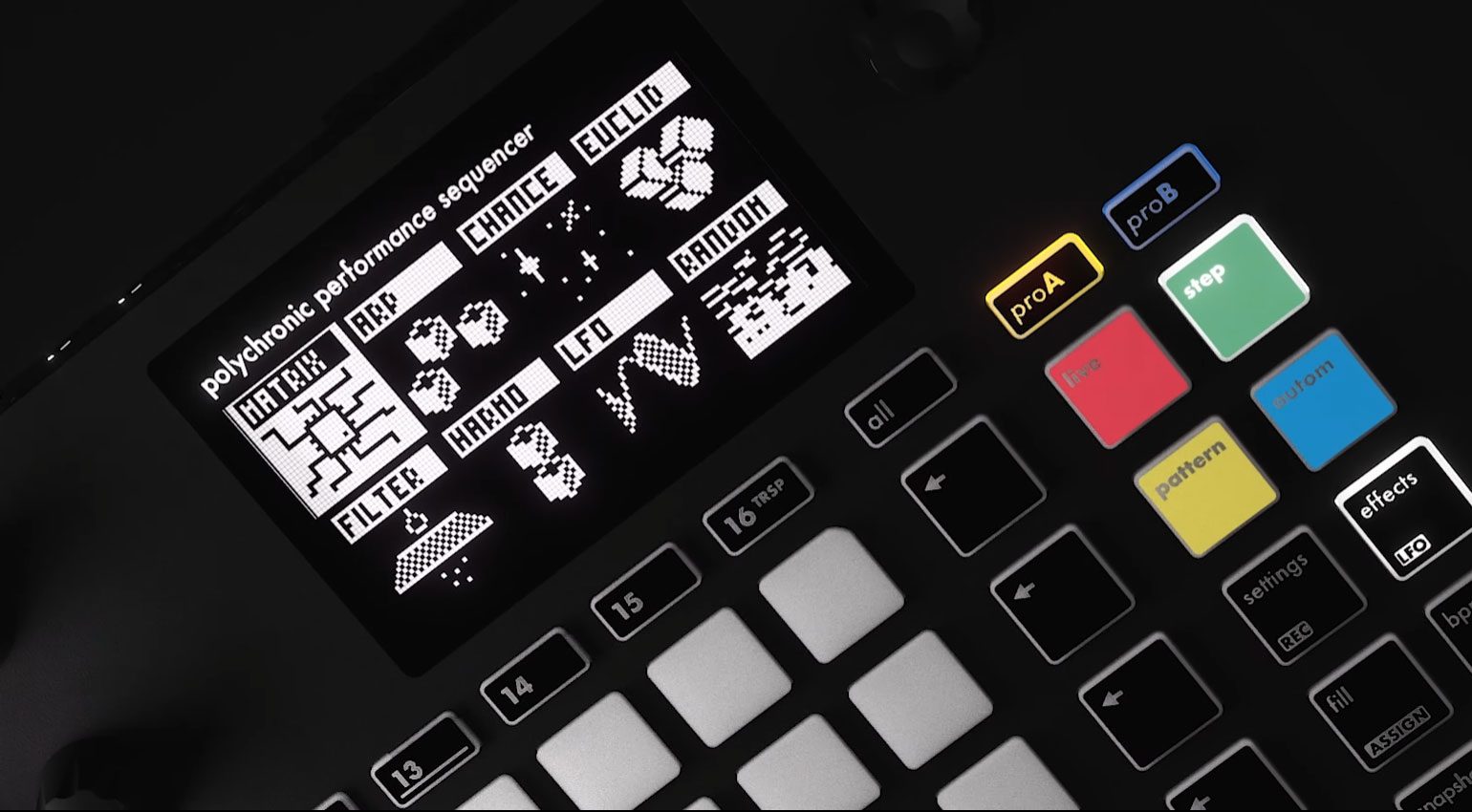
Hapax
You can tell that this is going to open up the possibilities of your hardware setup just by looking at it. The massive array of RGB button/pads is going to make sequencing delightful, colourful and easy to visualise. Of course, it’s going to become an isomorphic keyboard, it’s going to show patterns and tracks, notes and happenings. This could be a lot of fun.
The key features are that Hapax is a 16-track sequencer with 8 patterns per track. It can handle polyrhythms and polymetrics, it can run in all directions and will do step recording, live recording, CV, MIDI, mono and polyphonic and tracks of MPE. It has algorithmic composition tools and real-time MIDI effects with things like randomising, harmonising, scaling and Euclidean rhythms. You can perform live and have two projects loaded and running at the same time. So yeah, Squarp has covered it.
Connections
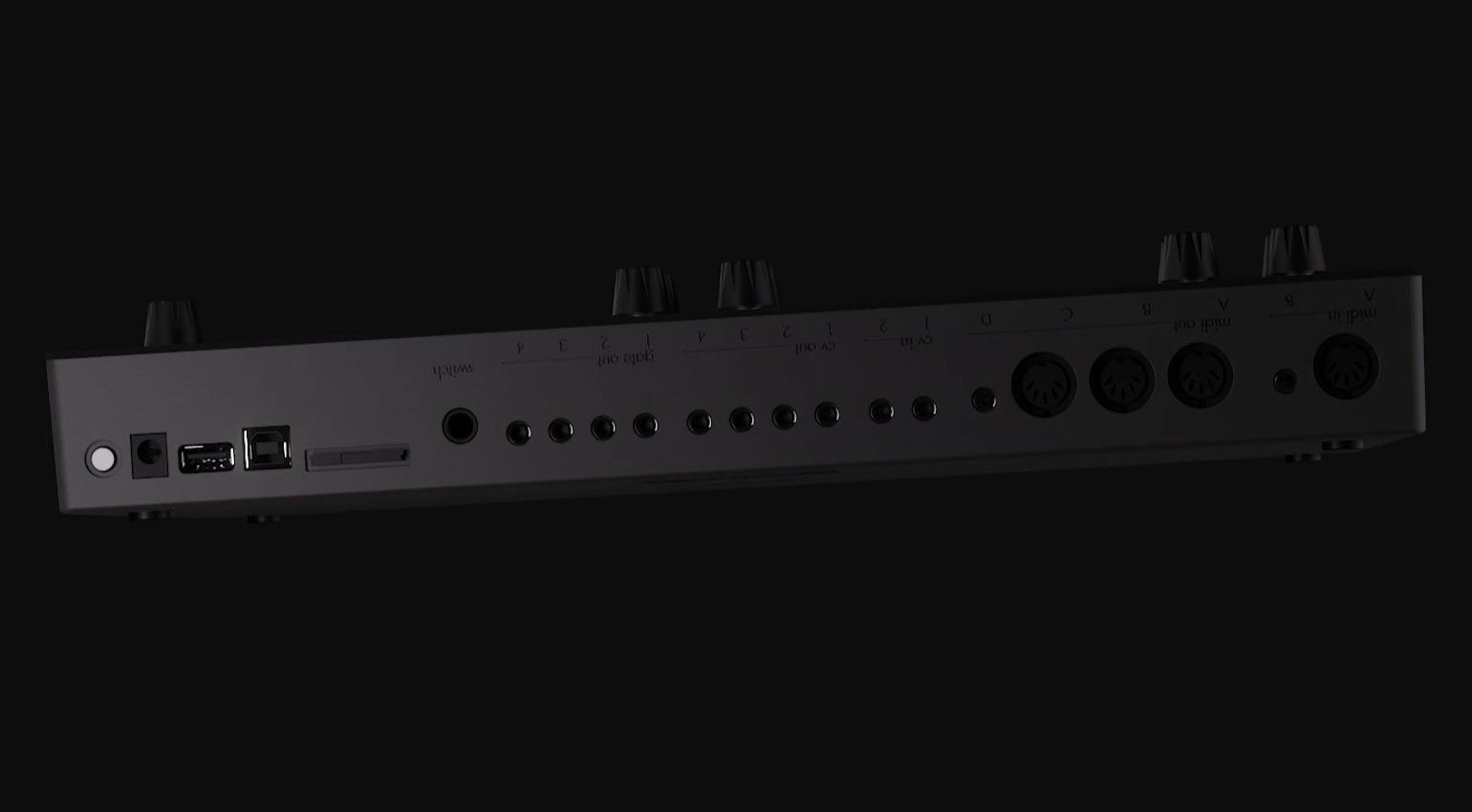
Out the back you have 4 lots of CV and Gate for running your Eurorack and analogue gear and then 4 MIDI ports for connecting to all your other gear. MIDI discipline is a bit poor on smaller synths these days where many of them lack a MIDI Thru and so having multiple ports is essential. One of the ports is on minijack which makes things nice and versatile. There are 2 MIDI Ins for controllers and a USB host port as well so you could plug another controller straight in there. You can also connect it to a computer if you wish and sequence software synths alongside. No complaints in the connections department.
Dawless
The key compromise when moving to a complex dawless solution like this is in the display of data. I have a Squarp Hermod and their menu system and screen use is not something I particularly enjoy and so I’m hoping the workflow through the screens will be smoother and less dependent.
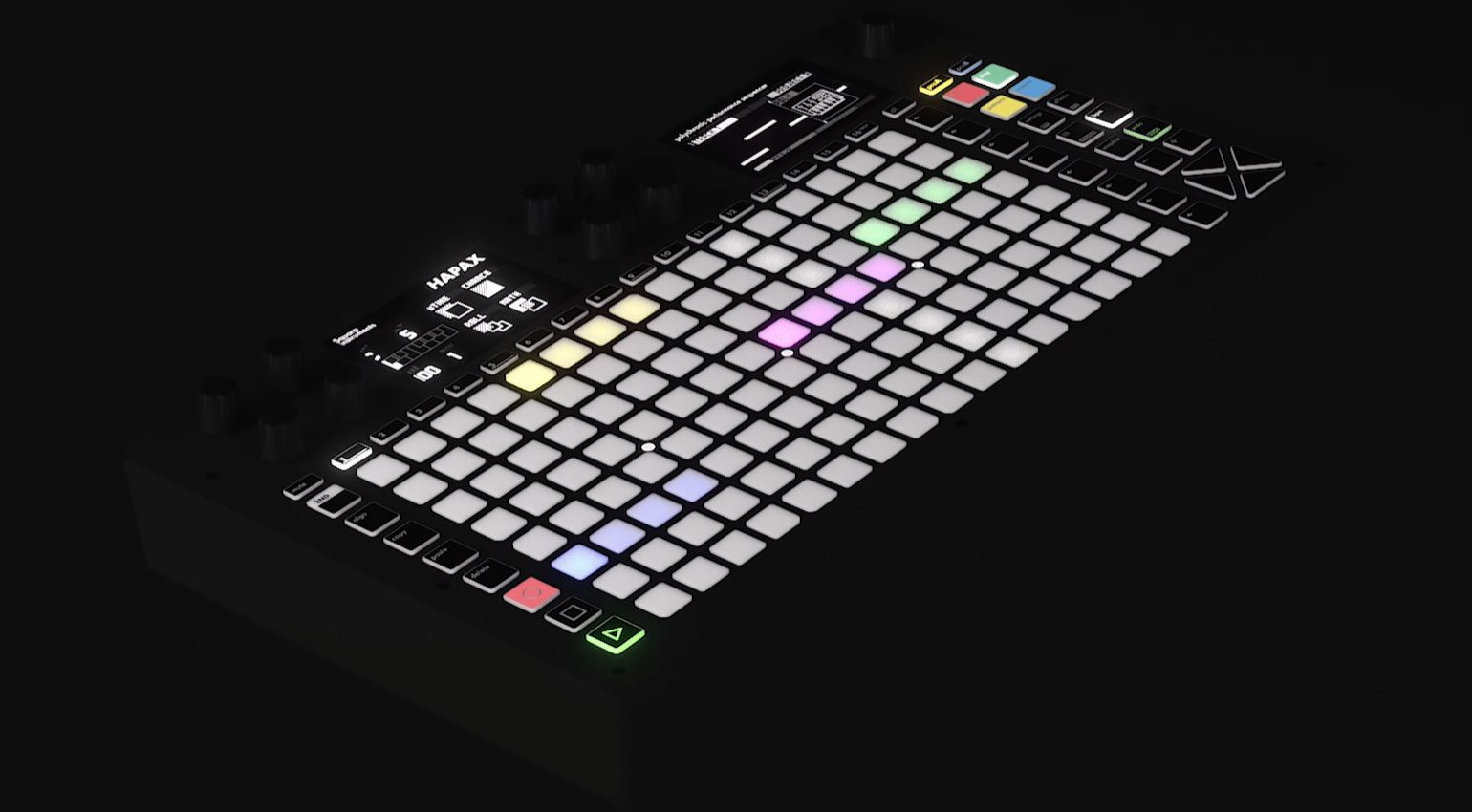
It’s going to be interesting to see more detail on how it all comes together but you can order one now for €864 if you want to jump straight in. Let us know what you think!


This might also interest you
5 responses to “Squarp Hapax 3.2: Now With Poly Aftertouch – the Last Big MPE Gap Just Closed”
You are currently viewing a placeholder content from Facebook. To access the actual content, click the button below. Please note that doing so will share data with third-party providers.
More InformationYou are currently viewing a placeholder content from Instagram. To access the actual content, click the button below. Please note that doing so will share data with third-party providers.
More InformationYou are currently viewing a placeholder content from X. To access the actual content, click the button below. Please note that doing so will share data with third-party providers.
More Information
More endless encoders and display units, 8 is really not enough, the Nektar Panorama P Series or the Ableton Push have already 8….
16 or better 32 please!
@ Robin Vincent:
Here it is thank you very much for doing an article. This looks very promising and exciting.
I would like to know when they start shipping from all the orders being placed?
It’s only major competition will be if a) AKAI releases a 32 x 32 pad controller and then allows their operating system to mount that so you do not have to scroll when you want to trigger more than eight tracks for live improvisation or however your creative set up takes you.
And whoever does that with their hardware sequencer, it’s going to be a winner.
AKAI, If you’re reading this you have too many MIDI issues on the Force. This is the crux of the functionality design of that device.
How can you wet the bed on something that important?
@ANDY MAC, can you please step in and ask them to hire another part-time coder, belly up to the bar pay the 40 K and get someone on staff and let’s get this thing rolling.
So it’s a Deluge?
That was my first thought too. It’s a knock-off Deluge with extra MIDI outputs.
Way to oversimplify things. How about where Deluge is a jack of all trades, master of some (a groove box), this is a midi powerhouse that puts Deluge to shame in many respects? I suggest you have a look at the red means recording demo, and see what I mean about MIDI automation we Deluge users could only dream of.