Tone King Royalist Review: The Best “Amp in a Box” Solution?
Following the Imperial's huge success, how does the Royalist compare?

 4,3 / 5,0 |

Welcome to our Tone King Royalist review! There’s a lot we liked about it, but we also have a few criticisms, given our high expectations. Find out here whether this pedal really is the ultimate Marshall king.
Originally published at Gearnews.de by Andreas Cortes, translation by Julian Schmauch.
First Impressions
Going into the Tone King Royalist Preamp review, I had high expectations. In 2024, I saw Greg Koch perform live and was in awe of his guitar tone. At the time, he was playing a Tone King Royalist MKIII combo with just a Shure SM57 mic in front of it. The sound had everything a good guitar tone should have.
So, after the initial announcements leading up to NAMM 2026, I was very excited about this release. Plus, the Tone King Imperial Preamp was a huge hit last year. Unpacking it, the Tone King Royalist Preamp makes a very solid first impression. Unboxing it is a joy. The pedal is heavy and finely crafted. You’re holding a sleek piece of hardware in your hands. The knobs and buttons have a satisfying feel.
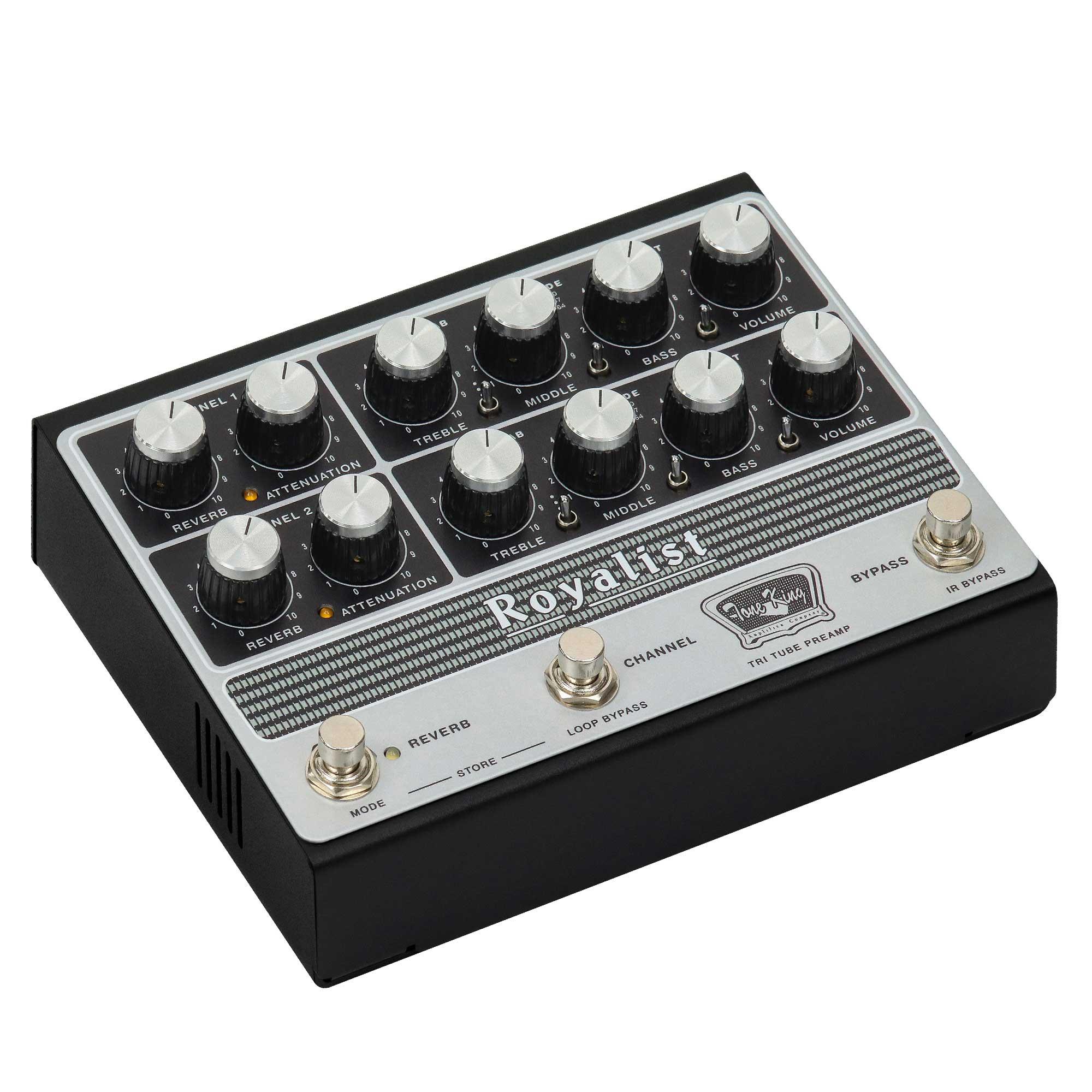
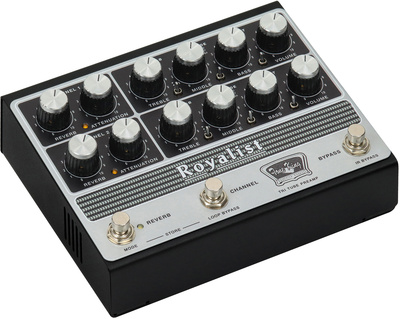
In terms of workflow, the layout is also nicely organized. The two different channels are clearly structured, and dialing it in is intuitive even without a manual. Basically, you operate the pedal just like an amp.
On the back, there are various connections for looping in effects or connecting the Royalist to an amp’s effects loop. We’re off to a good start for our Tone King Royalist review. So far, so good.
Review Setup
I paired the Tone King Royalist with a Fender American Professional II Strat and a Gibson ES-339. For monitoring, I used a Bose S1 Pro and Neumann KH 120 A studio monitors. This allowed me to hear whether the preamp performs similarly across different speakers.
I’d also like to mention that I’m familiar with similar devices, such as the Kemper Profiler, UAFX Lion ’68 Super Lead, and Strymon Iridium, from my daily work.
How does the Tone King Royalist sound?
The first notes you play are often crucial when it comes to determining whether a pedal’s or amp’s sound is appealing or off-putting. I always start with all controls set to 12 o’clock and work my way from there. In this neutral setting, however, the Royalist’s sound was too treble-heavy and at the same time very bass-heavy. So I had to adjust it first.
Dial treble back to 9 o’clock and turn the bass down as well. The result was much better now, although I still had the feeling that a high-cut and a low-cut were missing here. More on that later.
What immediately impressed me about the Royalist was how dynamic it was and how good it sounded with different articulations. When you strum the strings, you can hear every tiny nuance. The gain structure is also exemplary and typical of Marshall, although the gain headroom isn’t really sufficient for high gain.
Tone King Royalist Review: Three Marshall Modes
The three Marshall modes (1964/1967/1970) offer distinct audio characteristics and do justice to the namesake models. Pre-connected distortion pedals or boosters are also handled well and do not overwhelm the Royalist preamp.
However, this high degree of transparency and clarity also leaves a bit to be desired in terms of warmth and gentle compression. Which, considering that three preamp tubes are at work here, is a bit puzzling. The basic tone, regardless of the output, already sounds a bit harsh and cold. Of course, this is also a matter of personal taste.
Personally, I prefer a less aggressive default setting and a gentle EQ foundation. I can’t imagine ever needing to turn the treble or bass controls past the 12 o’clock position. I find that rather impractical.
Tone King Editor
Using the free Tone King Editor software, you can delve even deeper into the sound. Installing the Tone King Editor is simple, and the interface is nicely laid out. There, you’ll also find the missing low-cut and high-cut controls to tame the sound a bit more.
I really liked the selection of additional cab simulations, which all sound truly excellent. Everything is included, from 1×12 to 2×12 and various 4×12 IRs. Additionally, you can import your own impulse responses if needed.
The integration of additional preamps also works exceptionally well. Using the IR bypass button, the Royalist’s preamp section is bypassed, and the signal from external preamps goes directly into the cab simulation, including reverb. In my case, I tested this with an Origin Effects Halcyon and a Carl Martin Plexi Ranger and achieved excellent-sounding results.
How Does the Built-in Reverb Sound?
The built-in reverb in the Tone King Royalist Preamp exudes a rather subtle sonic character and sounds unobtrusive and natural. It’s also quite easy to dial in and doesn’t have any strange reverb tails.
Will it replace your favorite reverb pedal? No! Reverb enthusiasts will want to loop in their trusted reverb pedal via the available effects loop.

Conclusion
My conclusion on this Tone King Royalist review is mixed. Perhaps the Royalist doesn’t quite match my personal taste. There’s a lot I like about the pedal: its compact size, the amp-like, simple operation, practical features, impeccable build quality, and seamless integration with the Tone King Editor software.
All these aspects are wonderfully executed. However, after a while, its overly bright sound tires my ears. The criticisms regarding the sound described above, as well as the rather high price, dampen the overall impression.
Sonically, the Tone King Royalist Preamp will find many fans despite my criticism. It delivers authentic Marshall sounds with strong dynamics, brings them to your pedalboard, and can make an amp redundant.
Pros and Cons: Tone King Royalist Review
Pros:
- Versatile Marshall tones
- Easy to use
- Integration of external preamps and effects
- Build quality
- Tone King Editor
Cons:
- Somewhat cold, basic tonal character
- EQ effectiveness
- The built-in reverb is no substitute for a dedicated reverb unit
- Price
Price and Availability
You can find the Tone King Royalist Preamp and other interesting products from this manufacturer here at Thomann.*


*Disclaimer: This Tone King Royalist review contains affiliate links and/or widgets. When you buy a product via our affiliate partner, we receive a small commission that helps support what we do. Don’t worry, you pay the same price. Thanks for your support!

This might also interest you

2 responses to “Tone King Royalist Review: The Best “Amp in a Box” Solution?”
Perhaps this is a pedal you shouldn’t have reviewed because given what other reviewers say it appears your tastes are far from typical. So posting a review like this seems detrimental much like a sports car enthusiast posting a negative review of a pickup truck.
I don’t think the Bose S1 is a good match for this pedal as it definitely boosts the high and low ends. I got much better results using a Laney LFR 110 having initially tried the Bose.