Behringer Meatball: Budget Take on a ’90s Classic – Available Now!

 4,5 / 5,0 |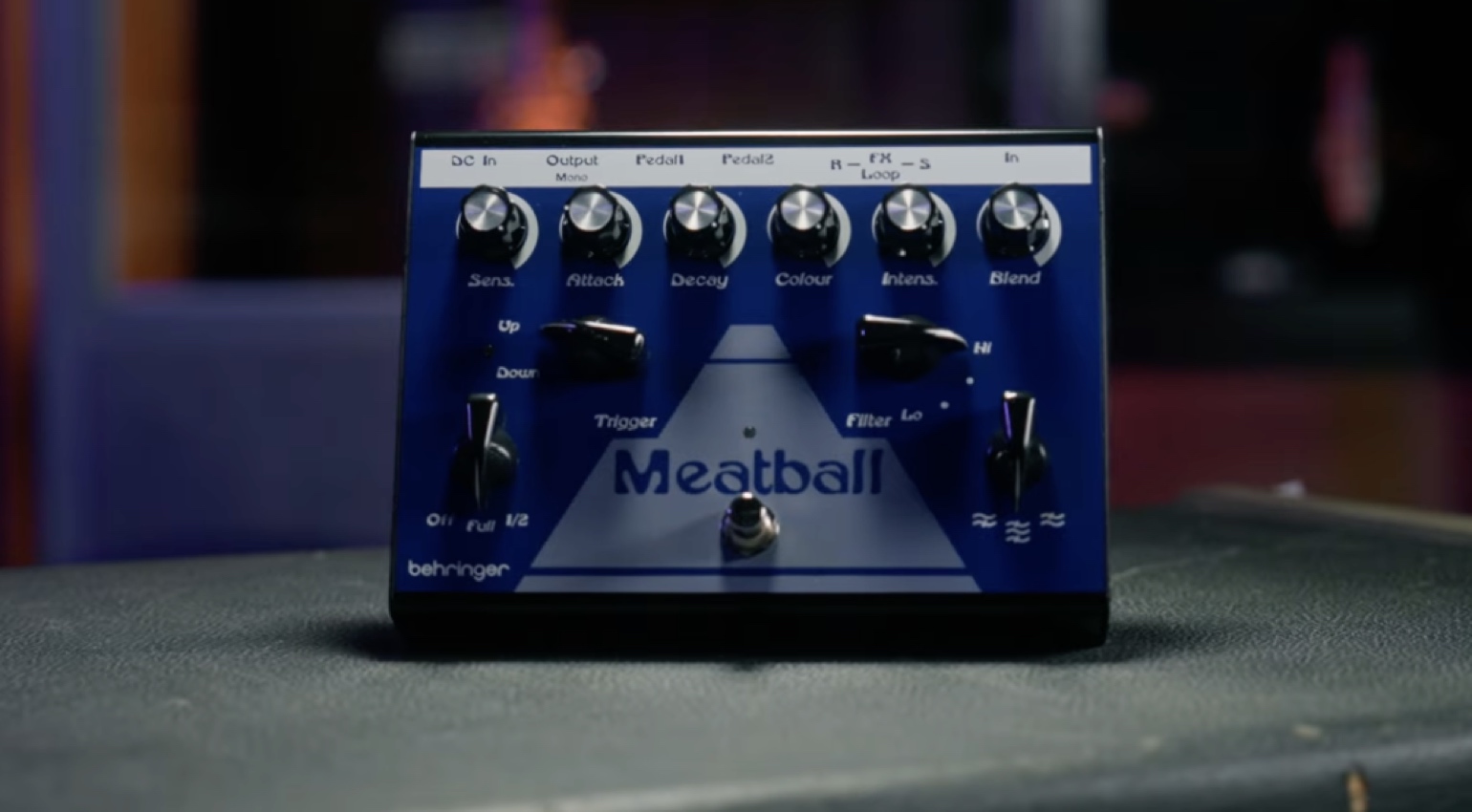

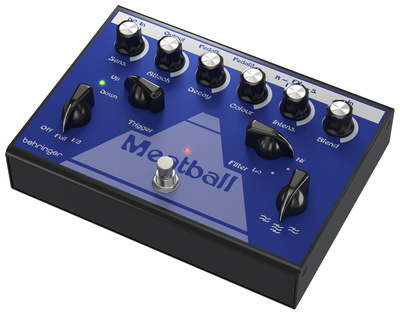
The Behringer Meatball is a clone of a classic 1995 boutique envelope filter, used by many famous players. Making a boutique, highly desirable pedal affordable for the masses, Behringer has created a spicy meatball for all!
Brief Overview
- Behringer Meatball is based on the Lovetone Meatball Envelope Filter
- Envelope filter for funk sounds, auto-wah, and experimental effects
- Six knobs, four switches, FX loo,p and two expression inputs
- Selectable low-pass, band-pass, and high-pass filters
Contents – Behringer Meatball
History – Lovetone Meatball
Released in 1995, the Lovetone Meatball, designed and hand-built in the UK by Dan Coggins and Vlad Naslas, is one of the most revered and sought-after envelope filter pedals ever made. It is considered a defining piece of boutique analog effects due to its versatility, analog warmth, and the sheer depth of its modulation capabilities.
While fundamentally an envelope-controlled filter, the Meatball is far more than a typical auto-wah. It offers dynamic filtering, phasing, and modulation effects. Its complex internal routing and external control options allow the effects to be tailored to respond expressively to the player’s dynamics.
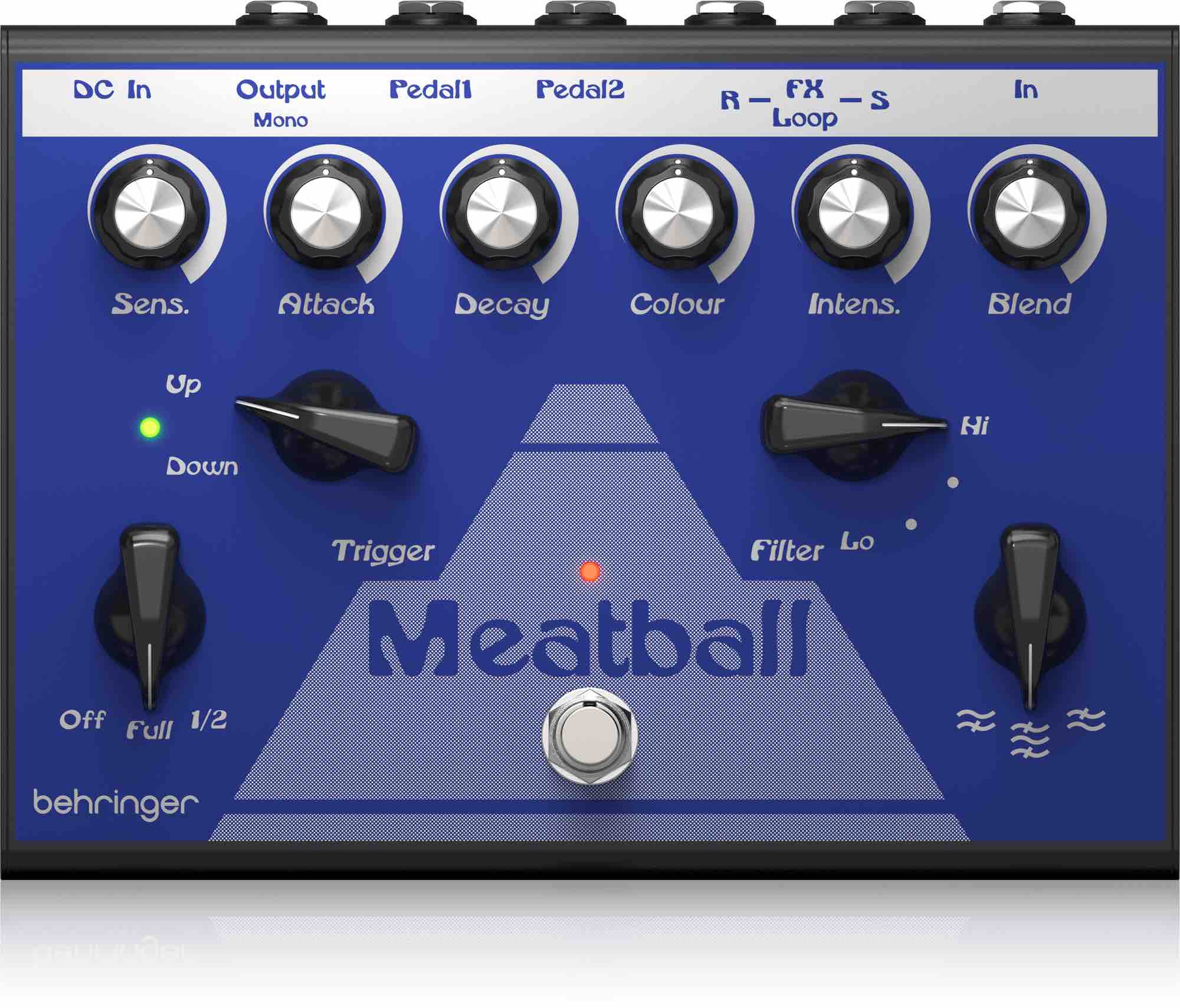
It features controls for Sensitivity, Attack, Decay, Colour, Intensity, and Blend. The filter is a resonant low-pass design with selectable bandpass and high-pass options, providing a broad palette of textures – from subtle, vowel-like tone shifts to wild, synth-like sweeps.
The fully analog circuit delivers a rich, organic quality with robust headroom and a wide frequency response, making it excellent for guitar, bass, synths, and studio use.
Behringer Meatball
Now, Uli’s team has cloned this much-loved effect and created the Behringer Meatball. It has all the same controls and also mimics the original pedal’s design aesthetically. It even has the original pedal’s built-in FX loop and external pedal controls.
Budget Meatballs
This puts the pedal into the hands of more people and makes it far more affordable than the original 1995 pedal ever could be.
The original 1990s pedals were hand-built in small batches, so they were always going to cost more to produce. The used market has seen prices soar for original Lovetone pedals, so this latest Behringer announcement will be welcomed by many who cannot afford an original.
With many famous users, including Kirk Hammett, Dan Auerbach, The Edge, Kevin Shields, J Mascis, and Radiohead’s Ed O’Brien, these are highly sought-after effects.
FAQ about the Behringer Meatball
What pedal is the Behringer Meatball based on?
It is based on the Lovetone Meatball, a legendary boutique envelope filter pedal from the nineties, which was used by, among others, Kirk Hammett, Jimmy Page and The Edge.
What music styles is the Meatball suitable for?
Especially suitable for funk, fusion, and anything that requires rhythmic filter movement. Thanks to auto-wah variations, the sounds also work for rock and metal leads in the style of Kirk Hammett.
How does an envelope filter work?
The effect reacts to the dynamics of the attack: louder signals open the filter more. In combination with high resonance, this creates typical “quacking” funk sounds.
What filter modes does the pedal offer?
You can choose between low-pass, band-pass, and high-pass filters. Additionally, four filter modes are available to adjust the shape and characteristics of the filter sweep.
What connections does the Behringer Meatball offer?
In addition to input and output, there is an FX loop and two expression pedal inputs: one for sensitivity and one for decay, to control the envelope progression in real time.
The Behringer Meatball is an envelope filter featuring six knobs, four switches, an FX loop, and two expression inputs. It offers low-pass, band-pass, and high-pass filter modes. The effect reacts dynamically to the input signal, enabling typical funk and auto-wah sounds.
Conclusion
The Behringer Meatball certainly looks the part, but how close will it get to the hand-built originals? There have been mixed reports on Behringer’s recent Moogerfooger clones, with some users claiming they aren’t as accurate as Behringer claims.
On paper, at least, these look good, and if they offer the same ballpark tones as the originals, then they will sell like ‘hot meatballs’!
Aesthetically, I think Behringer could have gone in a different direction, as this looks far too close to an original, and so maybe we will see another court action/rebrand in 2026?
Price & Availability
The Behringer Meatball is available at Thomann* for $95 / £84 /€98. It should be available early in 2026, so place your order now if you want one.


More Information

This might also interest you