8-Bit in a Heartbeat: The C64U Enters The Music Making Realm Again – Synth Journal
"Synth" U Been Gone...


We’re partying like it’s 1984, making tracker music with a brand new Commodore 64, the C64U, and Heartbeat Soundtracker, with Kelly Clarksynth for company!
There’s a bit of a retro feel to this week’s Synth Journal, and news of even more emulations of classic, but defunct hardware, but things are brought right back to the present with a new FM/Wavetable synth and a quirky but very usable synth named after an American Idol winner!
Synth Journal: October 24th, 2026
Heartbeat Soundtracker for Commodore 64 Ultimate
My story with the Commodore 64 goes way back to around 1983. My parents had divorced, and my sister and I were doing weekend visits to my Dad’s when, one Sunday, he revealed that he had bought a computer. And not just any computer. He bought the best home computer you could buy. A Commodore 64.
He told me he’d bought it to do things like his accounts on, or print out menus for the restaurant, but I only ever saw him play ‘Mr Wimpy’! To be fair, games were all I ended up playing on it, too. But with a burgeoning appetite for electronic music, and seeing things like the Fairlight, my mind was soon turned to the musical possibilities of the C64.
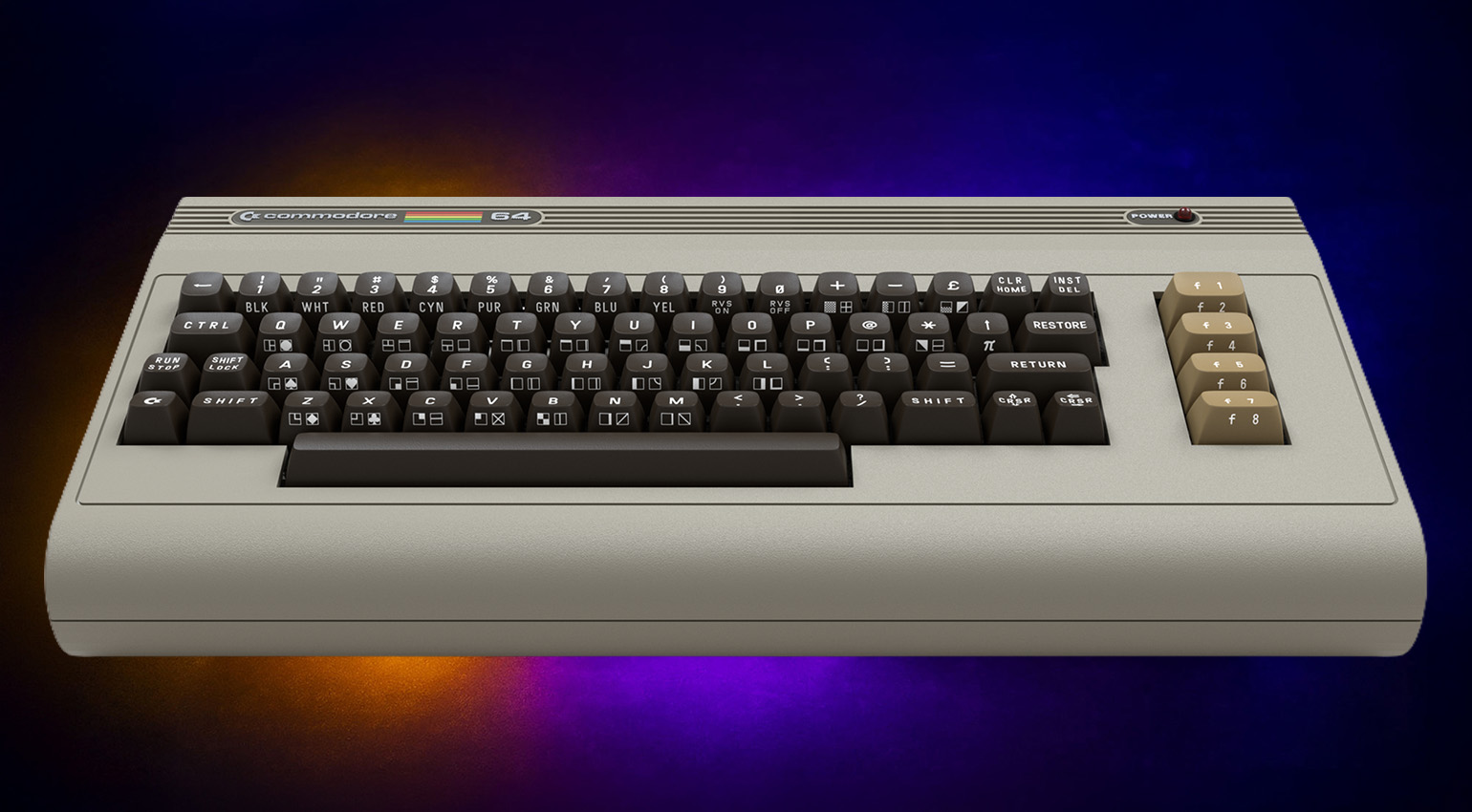
I ended up cutting my teeth on Electrosound 64, a three-track sequencer that made full use of the incredible SID chip inside the C64. It had huge limitations, but as far as this teenager was concerned, it was like having my own Fairlight!
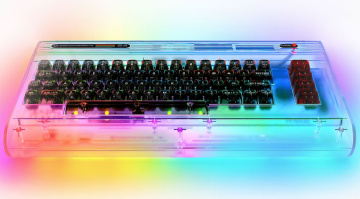
My ambitions soon outgrew the C64, but the seed had been sown. So when YouTuber Peri Fractic headed up a consortium to revive the Commodore brand just a year or so ago, and their first product was decided to be a Commodore 64 for the 21st century, my interest was more than piqued!
My C64U arrived a few weeks ago, and I have been wallowing in the deep waters of nostalgia ever since. Naturally, I dug out Electrosound 64, installed it and was somewhat disappointed, albeit with a fond tint of youthful memories, sat in my bedroom trying to program a version of Depeche Mode’s ‘Stripped’ on it!
But just this week, I was made aware of a new piece of software created specifically for the C64U called Heartbeat Soundtracker. What really drew me in was the demo track that they supplied with the freely downloadable trial version, which you can see and hear in this video…
This immediately recognisable tune sounded nothing like the SID chip on its own and I was struggling to believe that it was all coming from a C64U. But, sure enough, after loading up the demo version of Heartbeat Soundtracker, there it was, in all its glory!
You see, the C64U has not one, but 8 SID chips running within its FPGA innards, and along with the massively expanded RAM and storage space in the C64U, Heartbeat Soundtracker uses this to deliver 31 channels of sound: 24 channels of SID and 7 sampler channels. You can even add two further hardware SID chips to add another 6 SID channels.
Samples in Heartbeat Soundtracker are 16-bit/44.1kHz mono WAVs that are stored on either the microSD card or USB drive, with the C64U’s 16MB built-in REU (RAM Expansion Unit). Each song can feature 64 samples and 64 SID instruments, and it has the capacity for 64 patterns of 64 steps each.
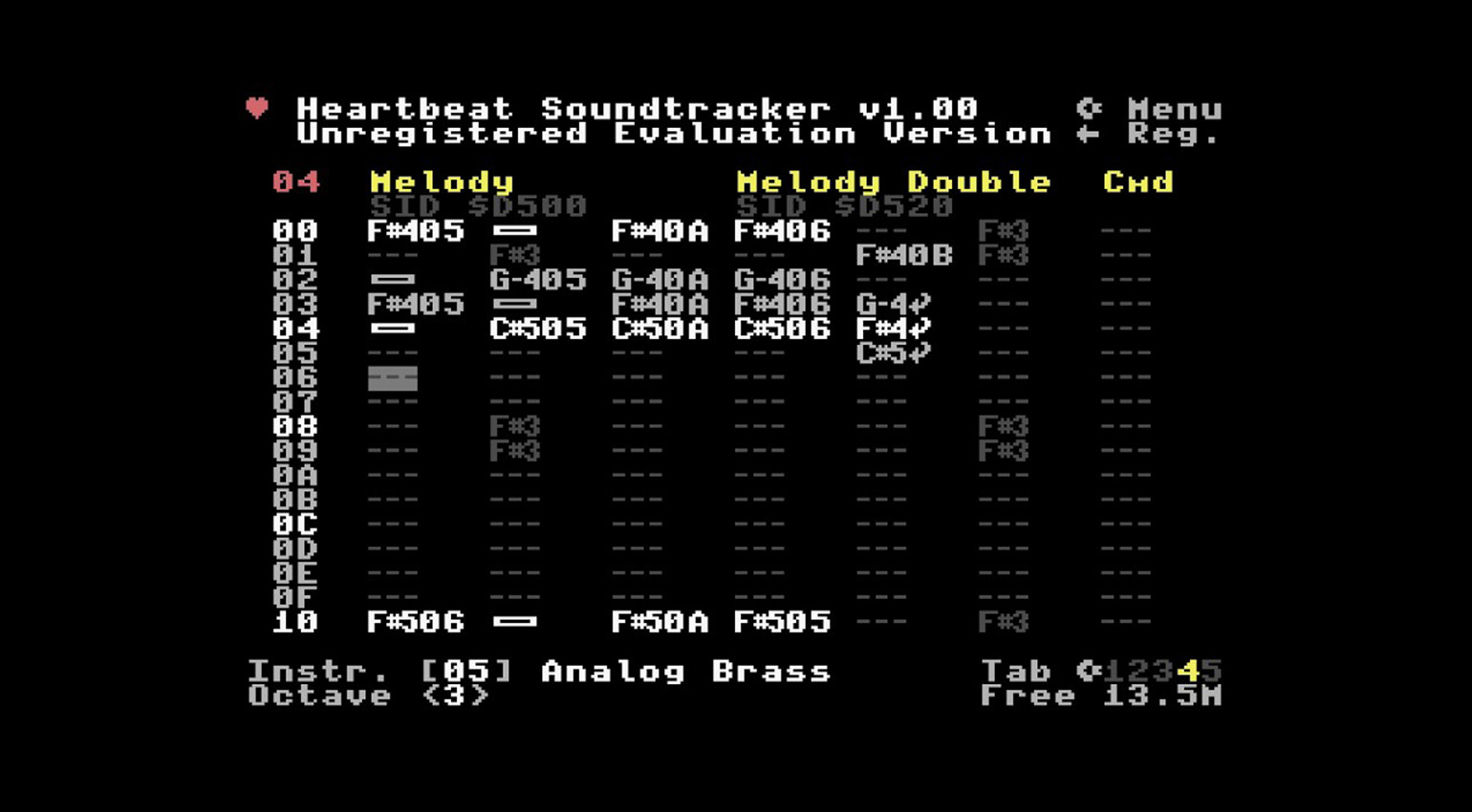
There’s a host of other features in Heartbeat Soundtracker, including Live Play functions that allow for live loop control and muting, as well as the ability to queue your next pattern or looping region. There’s a notepad function and also the ability to have a number of visualisations. It’s all very impressive!
My socks have been blown off by Heartbeat Soundtracker, and it’s as cheap as chips to get into. Download the evaluation version first, but once you’ve decided you want it, the Composer Edition is just €24.99. There are accessories and expansion packs available, as well as a Collector’s Edition that bundles up two Heartbeat Soundtracker licences with all currently available sound packs and all future ones too, along with a keyboard overlay and other treats, all for just €79.99.
Prepare for a new wave of chiptunes!
- Heartbeat Soundtracker Website
- The new Commodore 64 Ultimate
Kelly Clarksynth from DAWJunkie
This week’s award for the most bizarrely named synth of the week goes to the team at DAWJunkie for their Kelly Clarksynth! I’m not sure who came up with the name, the concept or even the graphics, but they deserve a medal for the incredulous looks and chuckles when this landed on the Gearnews news desk!
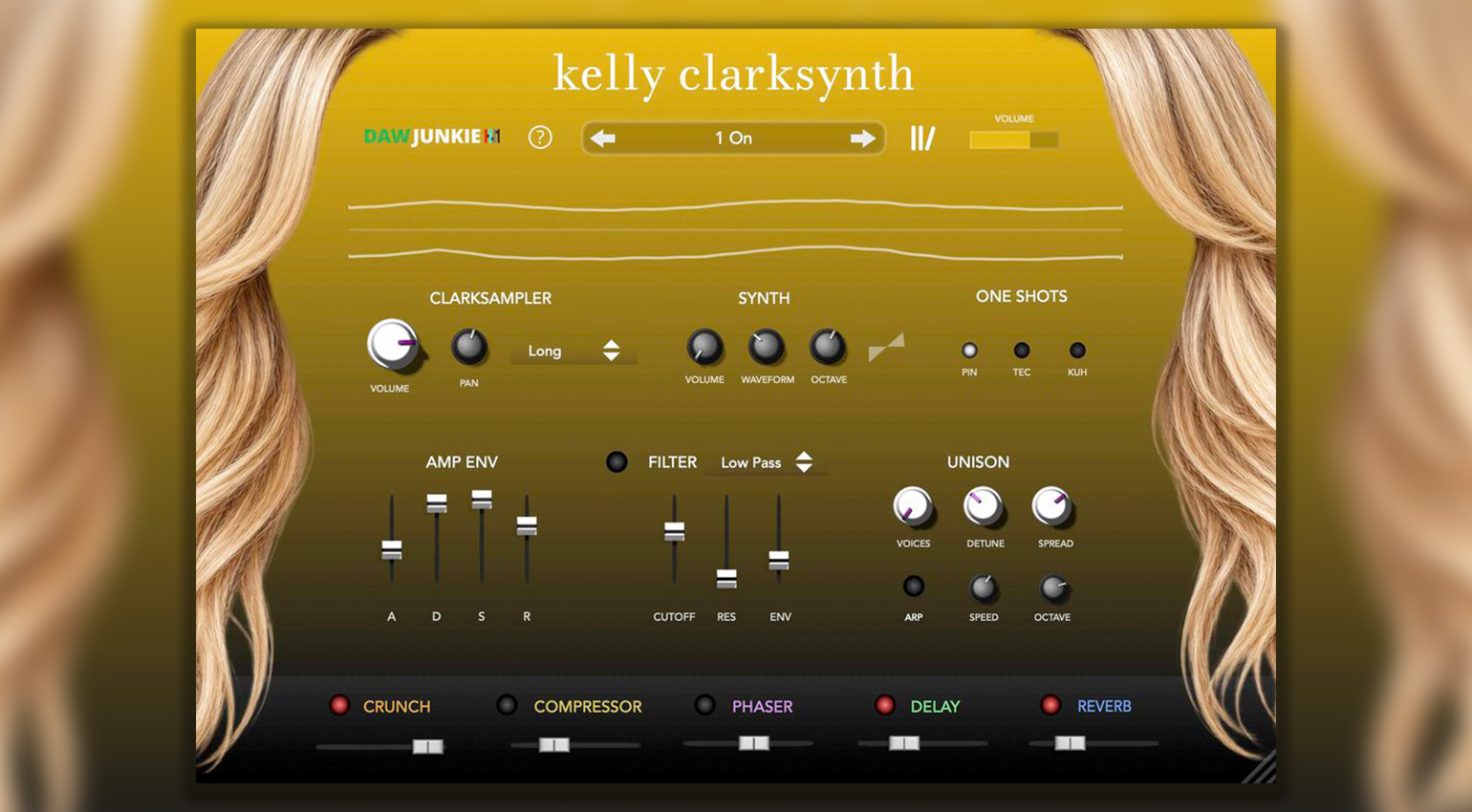
But, as the great Han Solo once said, “Laugh it up, fuzzball” because this is actually a serious synth that sounds seriously good! As you will hear in the demo video, Kelly Clarksynth has been imbued with a bunch of vocal samples that the DAWJunkie team have cleverly mixed up with a combination of other synth sounds and one-shot samples.
The result is a collection of sounds that have a distinct human quality to them, but with a very electronic feel. There’s almost a sense of early Art of Noise to this instrument. Once you’ve combined your vocal samples with synths and/or one-shots, everything is chucked through a multimode filter, amplitude envelope and FX, along with some very useful unison modes.
The end product is a hugely fun and entertaining instrument that is surprisingly very inspiring to play with! The name and look might be silly and frivolous, but the sound is anything but. The interface is simple, effective and will have you adding your own presets to the library in no time. Best of all, the whole thing is completely free of charge!
- Grab Kelly Clarksynth from the DAWJunkie’s website
IMFMSynth 8-Operator FM & Wavetable Synthesizer
I need no excuse to get excited by a new FM synth, particularly one that goes beyond the traditional paradigm. IMFMSynth is one such instrument that eschews the common hermeneutic of FM synthesis in favour of a freer and more expanded approach.
IMFMSynth has been developed by Japanese programmer, Kaito Sato and works on the basis of 8 freely assignable operators, with no algorithm in sight. The FM synthesis of the Yamaha DX family got interesting when they added more than just simple sine waves within their operators. IMFMSynth does something similar.
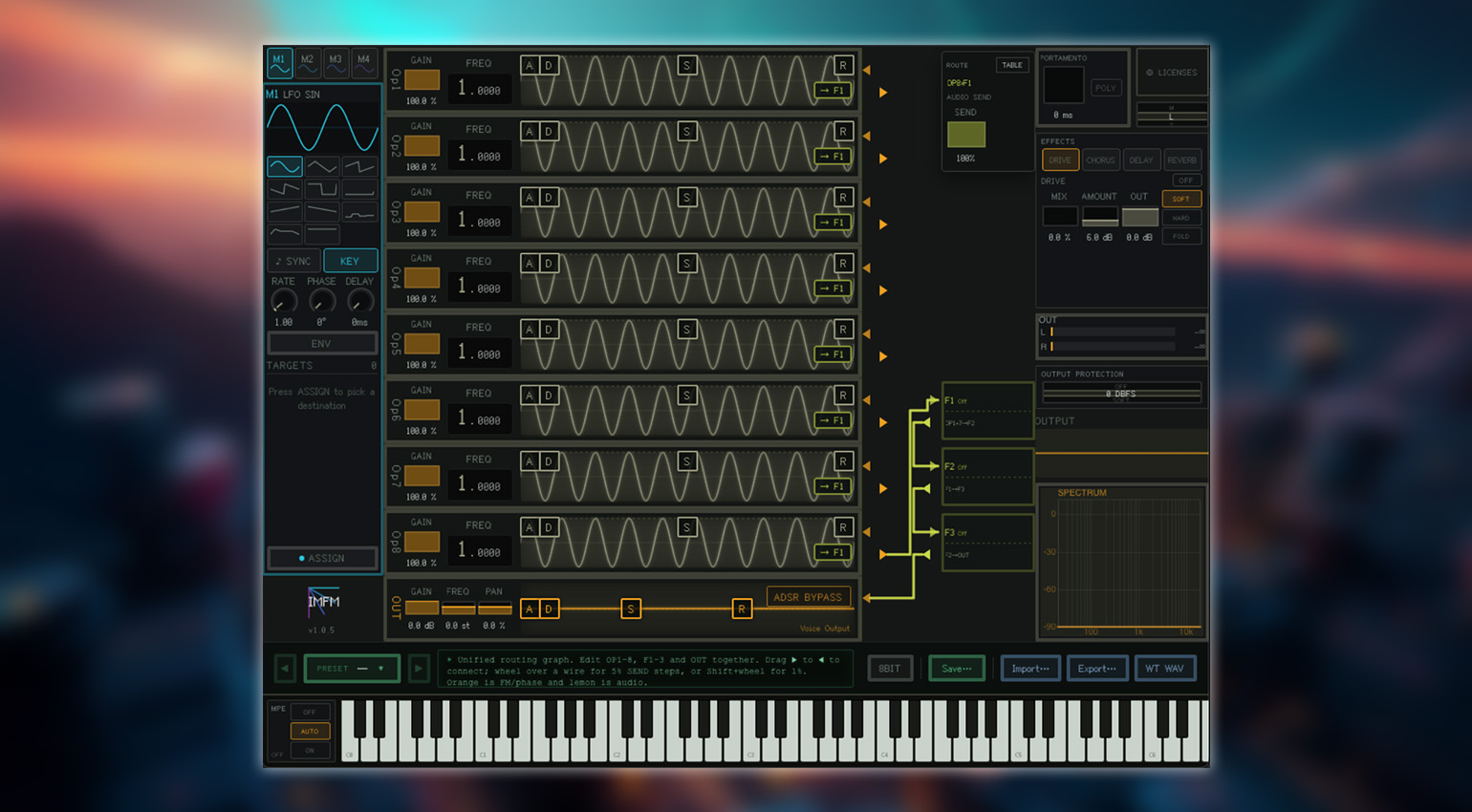
As well as sine waves, you can choose wavetables instead! This makes for some amazing and a virtually infinite number of possibilities. Noise can also be used in each of the operators. Operators are connected as carries and modulators by dragging input and output connections on-screen, either to other operators or to the filter stages which then go to the outputs.
This method also works for feedback, where the output of an operator is fed back in on itself for wild modulation. There is a small selection of FX, a useful limiter for when things get a little crazy and all of this takes place in a very clean and simple layout.
If you want to try before you buy, the instrument is presented on Kaito-san’s website where you can experiment and make up your mind. And I’m pretty sure that if messing with FM and wavetables is your thing, you will be more than happy to shell out the paltry $19 for this incredibly powerful FM synth. Bonus points to the developer for also making it available in 10 languages!
- IMFMSynth website
FSVR – A Yamaha FS1R Emulation
Continuing on our FM theme, a very interesting project caught my attention just the other day in the form of FSVR, an attempt to emulate Yamaha’s finest moment in FM, the criminally overlooked and now hugely sought after FS1R.
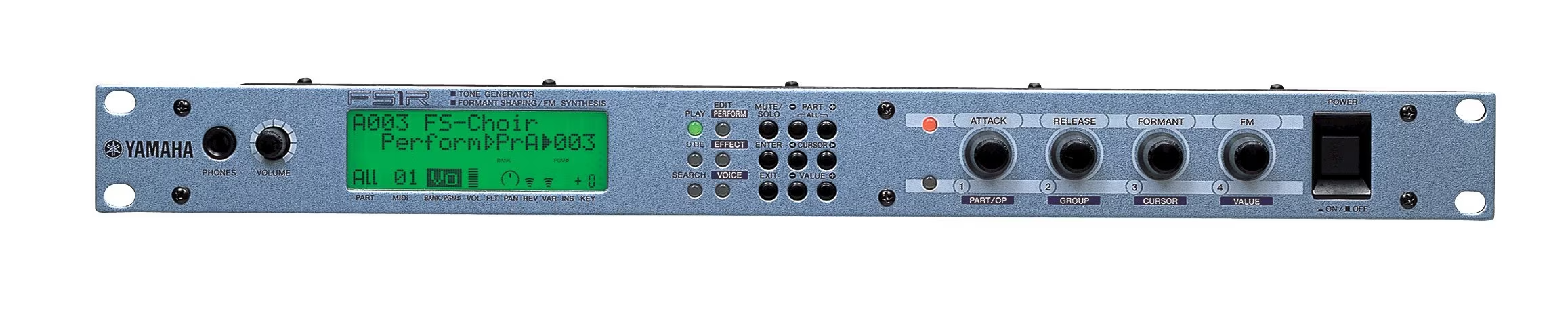
The original hardware unit was released in 1999 and was on sale for little more than a year. It saw Yamaha push algorithmic FM synths into new areas, using 8 voiced operators and a further 8 more unvoiced operators to pair up FM with Formant Shaping, an endeavour that had the firm approval of Dr John Chowning, the man who discovered FM synthesis in the first place.
Calling it, “…the most natural progression for FM synthesis”, Chowning understood how combining these two methods could deliver a vast range of sounds. But Yamaha, being Yamaha, decided to offer this miracle of FM in a 1U rackmount unit with a small screen, 17 tiny buttons and four multi-function rotary controls. Programming an FS1R is like painting the ceiling of the Sistine Chapel through a letterbox.
Word is that Yamaha had every intention of delivering a computer-based editor, but for reasons known only to them, it never materialised, and units were priced to clear by late 2000. And just like the DX7, most users ended up using the (extensive) presets included with the synth.
Many years later, when Yamaha was developing their eight-operator FM-X engine for the Montage, they hoovered up as many used examples of the FS1R as they could to give to sound library developers for the factory presets. This made a scarce machine even scarcer, hence why you’re looking at anything north of $2,500 for one these days.
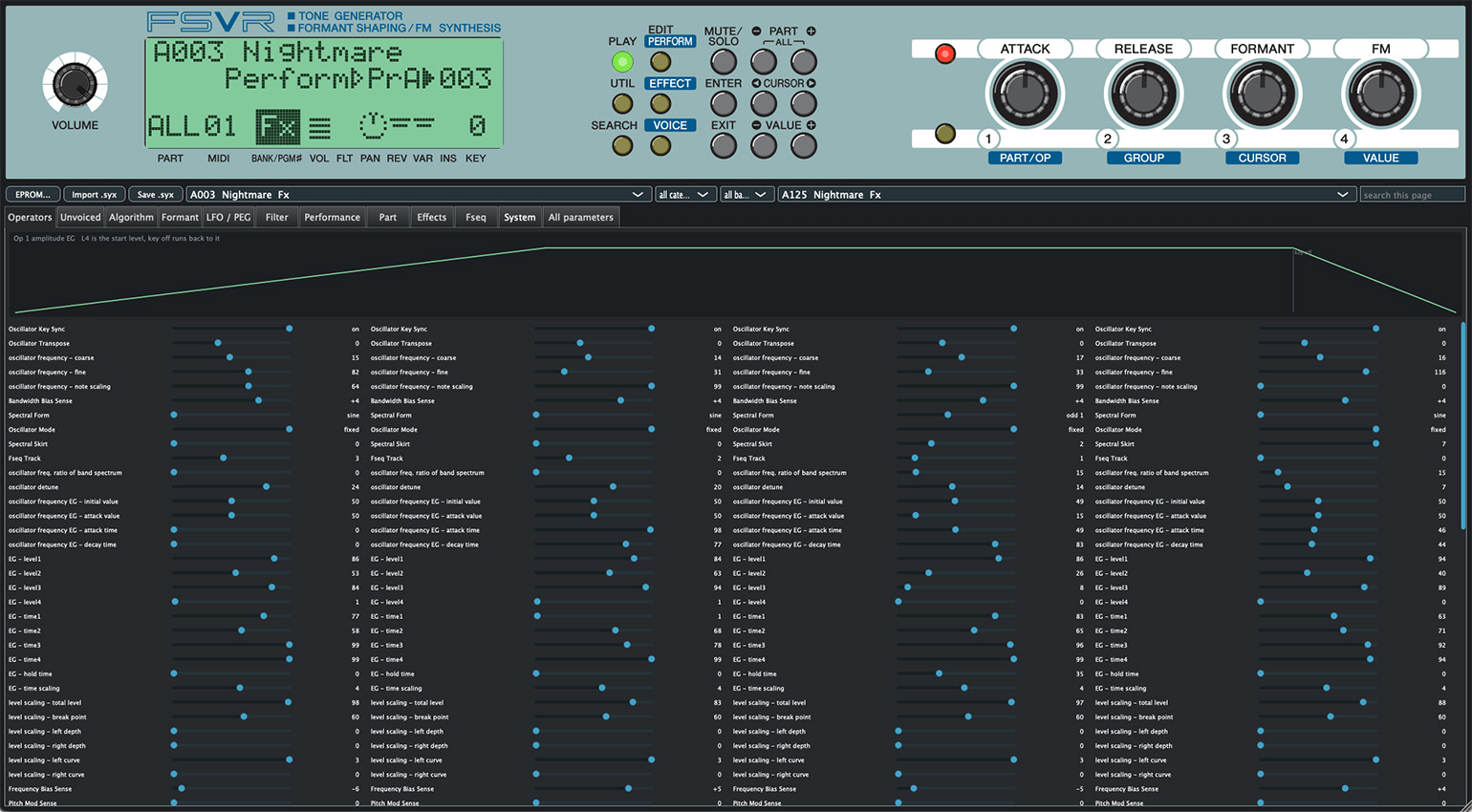
But FSVR might just be the answer to many people’s prayers as it aims to fully replicate the FSVR and, unlike many emulators of late, does not require the user to provide legally obtained ROMS to run it. Now, to be fair, this project is currently in the early stages of development and is far from ready, but as an FS1R owner myself, I can say that it is definitely on the right track.
Definitely one to keep an eye on!
- Visit musicastudio’s FSVR GitHub page here
The Usual Suspects Announce Triplex a Trio of Roland FX Emulations
The Usual Suspects team are on a bit of a roll at the moment! Their Roland Sound Canvas emulation, the 88Emu, moved very quickly from alpha to public availability, during which they announced Blue Giant and Goldfinger, their emulations of the Novation SuperNova II and Waldorf Q synths.
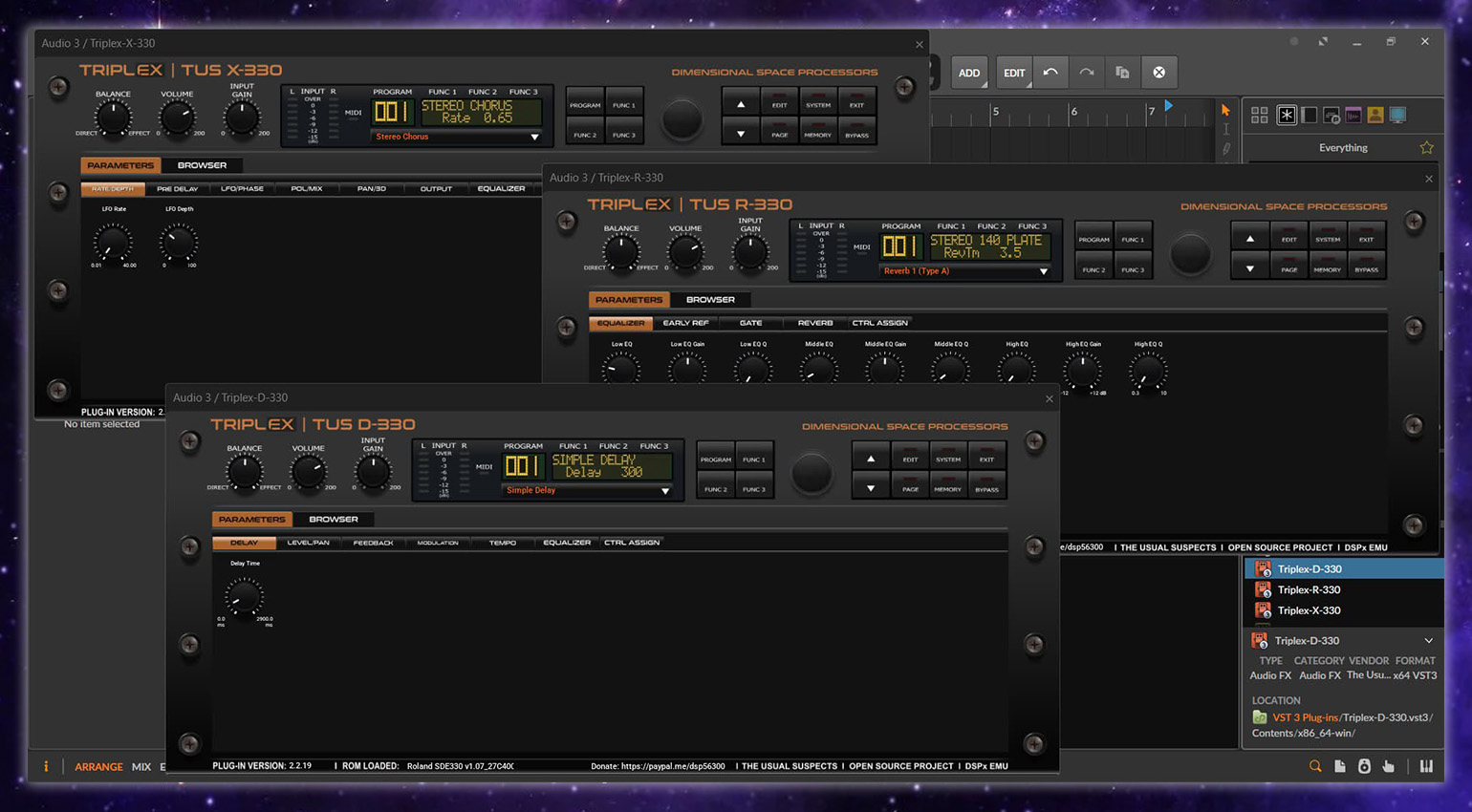
And it was in the video demo of Blue Giant that they teased one of the trio of Roland effects units that go to make up Triplex. This collection includes highly accurate emulations of the SRV-330, the SDE-330 and the SDX-330, effects units that all made use of Roland’s RSS technology.
Widely regarded as some of the best digital effects of their day, many people still swear by them and, aside from FX versions of some of their synth emulations, this suite heralds The Usual Suspects’ first foray into dedicated FX plugins.
Right now, these plugins are solely available to users who have donated to the TUS cause and are strictly in the alpha stage, but early indications are that these are pretty much on the money. As always, to use these, you must legally own the original hardware in order to own the ROM data that these all require to operate.

This might also interest you