Dillon Bastan ChatDSP: This Tool Builds Max for Live Devices from Text
AI Meets Max for Live

 3,0 / 5,0 |
Dillon Bastan ChatDSP: This Tool Builds Max for Live Devices from Text · Source: Dillon Bastan

ChatDSP introduces an unusual concept to the world of Max for Live. Instead of programming your own devices in Max, you simply describe the tool you want to create in text. Dillon Bastan’s new project then automatically generates a Max for Live device from that description. For years, Max for Live has been considered a playground for experimental tools in Ableton Live. Anyone interested in modulation, generative sequencers, or unusual effects will find a huge collection of creative devices there. However, many ideas can only be realized if you build your own patch structures. ChatDSP aims to lower that barrier significantly.
All About Dillon Bastan ChatDSP
Create Max for Live Devices via Prompt
The core idea initially seems almost absurdly simple. Inside Ableton Live, you describe the desired effect, instrument, or MIDI tool in just a few words. ChatDSP then automatically generates a corresponding Max for Live device. So if you are looking for a lo-fi effect, an experimental reverb structure, or an unusual delay sound, you no longer have to program it yourself. Simply enter a prompt and the tool builds the appropriate structure. ChatDSP therefore opens the door for producers who have little or no experience with Max programming.
Technically, ChatDSP is based on a combination of Max for Live and external AI services. The tool relies on models from providers such as OpenAI or Anthropic to generate the devices. This allows patch structures to be created directly from the entered prompt. At the same time, this approach also introduces additional costs. Users need an account with one of these providers and must use credits for generation. Dillon Bastan does not sell these credits himself. The tool functions purely as an interface within Ableton Live.
Create Your Own Max for Live Tools for Ableton Live
Once a device has been generated, it can be saved permanently. The created tool remains available inside the project and can be reused at any time. According to the developer, ChatDSP supports up to 48 parameters per device, which allows more complex instruments or effects to be built. In addition, the tool provides several basic templates. These include instrument devices with typical synthesizer parameters as well as audio effects with mix controls or sample access.
In practical use, this leads to a completely different workflow. Instead of spending time searching for a suitable Max for Live device, you can simply describe your own idea with a prompt. Within seconds, a customized tool can be generated. ChatDSP opens up an entirely new creative direction, especially for sound design experiments. Unusual effect chains can be explored quickly, and specialized instruments can be created that simply did not exist before.
Opportunities and Risks for the Max for Live Community
At the same time, a certain level of uncertainty remains. The quality of the generated devices depends heavily on how the prompt is phrased. More complex ideas often require several attempts before a usable result emerges.
In addition, the developer describes ChatDSP itself as experimental software. As a result, the behavior of the generated devices can sometimes be unpredictable. Producers who expect fully stable plugins and devices may not always be satisfied right away and might move on from the tool more quickly.
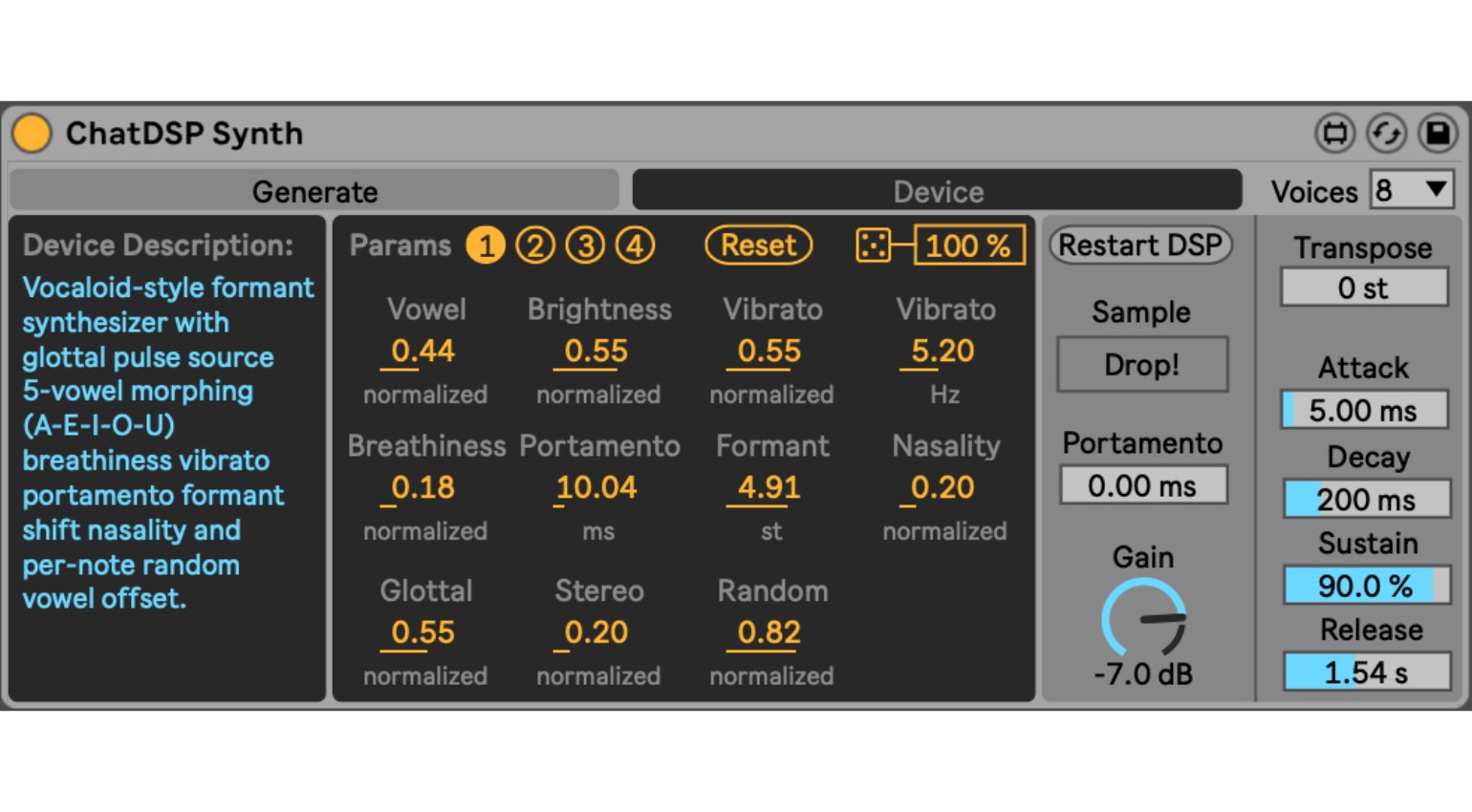
This also raises questions about the future of the Max for Live community. ChatDSP could trigger a new wave of automatically generated devices. Some of them will certainly be creative and inspiring. Others, however, may be quickly produced tools that lack deeper development and long-term support. In the commercial space especially, this could potentially lead to a flood of Max for Live devices created through rapid generation rather than thoughtful design.
Despite these concerns, the concept behind ChatDSP remains extremely interesting. The tool illustrates how strongly AI can influence the development of music software. Suddenly, producers have the opportunity to create their own tools without any programming knowledge. For Ableton users who enjoy experimenting, this could open up an entirely new creative playground. Whether this development will lead to a true shift in the Max for Live ecosystem or remain a short-lived trend will likely become clearer in the coming months.
Dillon Bastan ChatDSP is available on the manufacturer’s website starting at $10.
More Information

This might also interest you