Instrument X: Dreamtonics Makes Massive Sample Libraries for Orchestral Sounds Obsolete
From Vocal Synthesis to Full Orchestration, Without a Single Multi-Gigabyte Sample Library

 3,2 / 5,0 |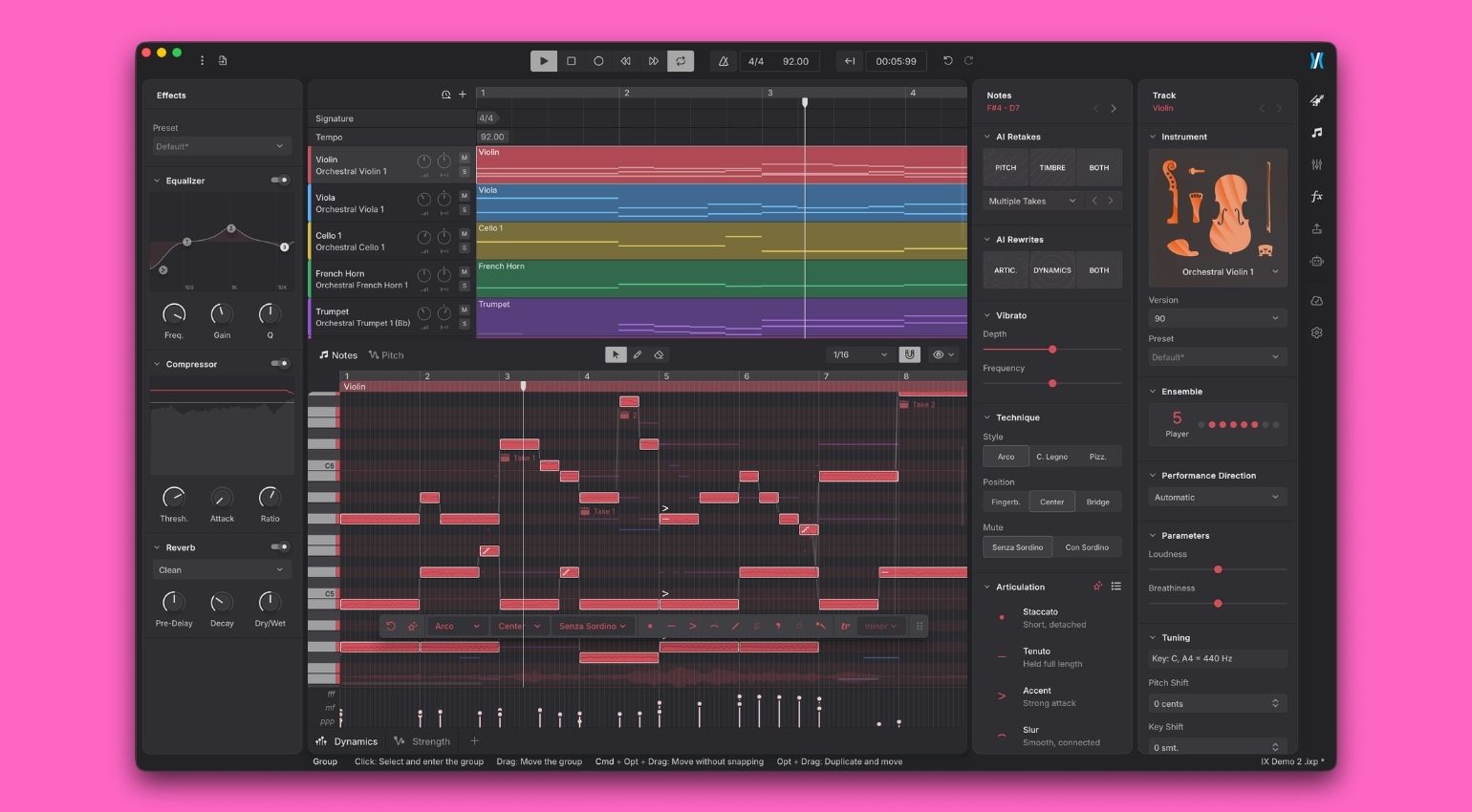
Instrument X: Dreamtonics Makes Massive Sample Libraries for Orchestral Sounds Obsolete · Source: Dreamtonics

Dreamtonics, known for its vocal software Synthesizer V and Vocoflex, is officially stepping out of the vocal booth with Instrument X and onto the film scoring stage. Instead of rigid, multi-gigabyte sample playback libraries, the new platform runs on neural acoustic modeling. Notation gets translated directly into sound wave radiation, giving composers and producers control over organic bow, breath, and key articulation right from the keyboard, with zero static loop triggering involved.
Dreamtonics Instrument X: Everything on the New Orchestral Instrument With Neural Acoustic Modeling
The Science Behind Neural Acoustic Modeling
For maximum mixing flexibility, Instrument X uses up to eleven concurrent microphone feeds, from close spot mics to a Decca tree setup and room ambience. Maintaining phase and structural coherency across that many channels is usually a notorious headache for standard neural audio synthesis approaches. They really thought of everything here.
Dreamtonics solves this with a patent-pending algorithm: by measuring the studio’s acoustic geometry with a custom-built dodecahedral speaker array, the physics-augmented neural networks learn to decouple the room’s directional acoustics from the dry instrument source. The engine runs entirely locally on a standard laptop, no internet connection or dedicated GPU required, while still supposedly delivering the genuine spatial depth and dynamic nuance of an actual tracking session. Sounds like a pretty tall order on paper, but it seems to produce genuinely convincing results in the end.
What Instrument X Can Actually Do
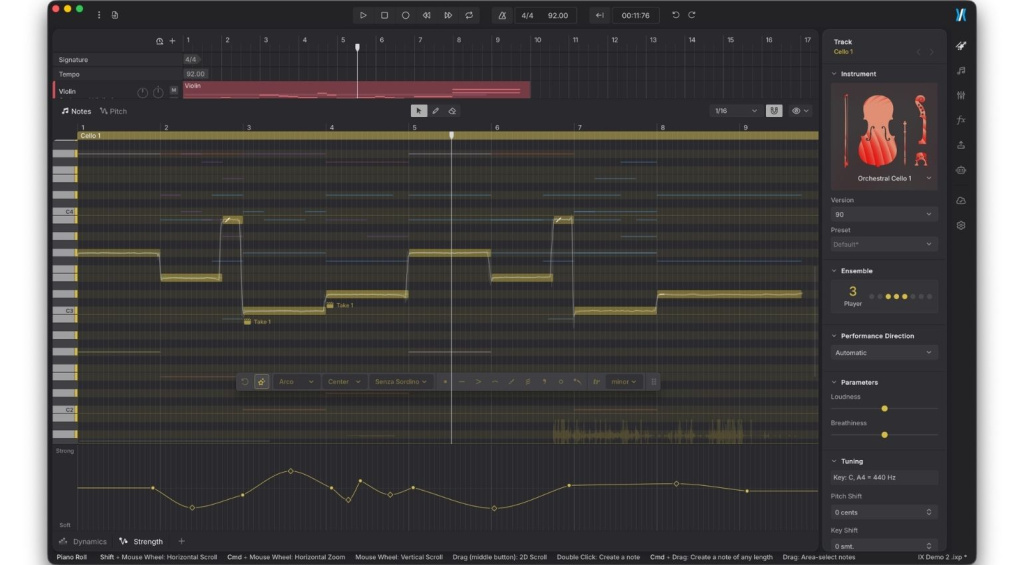
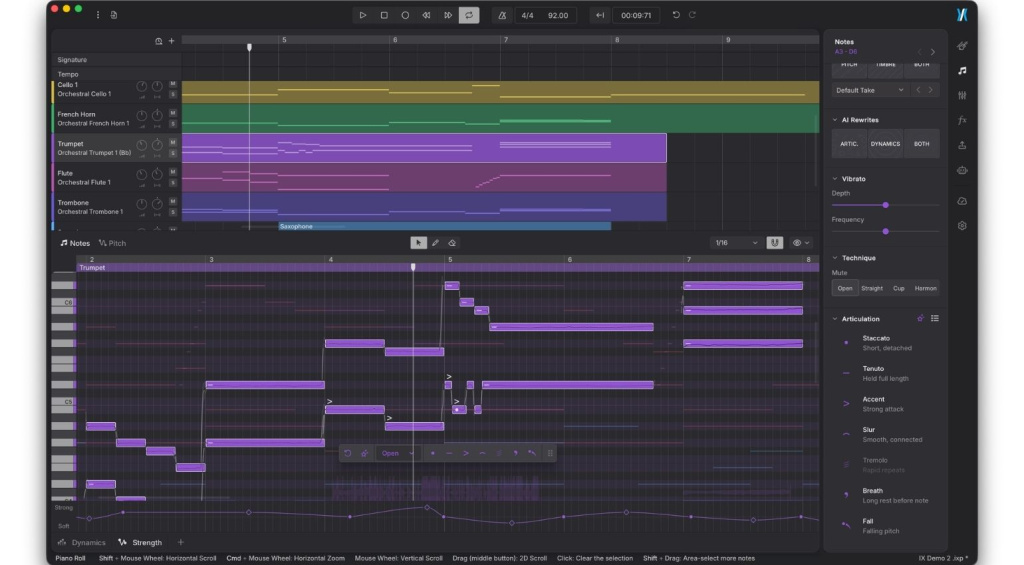
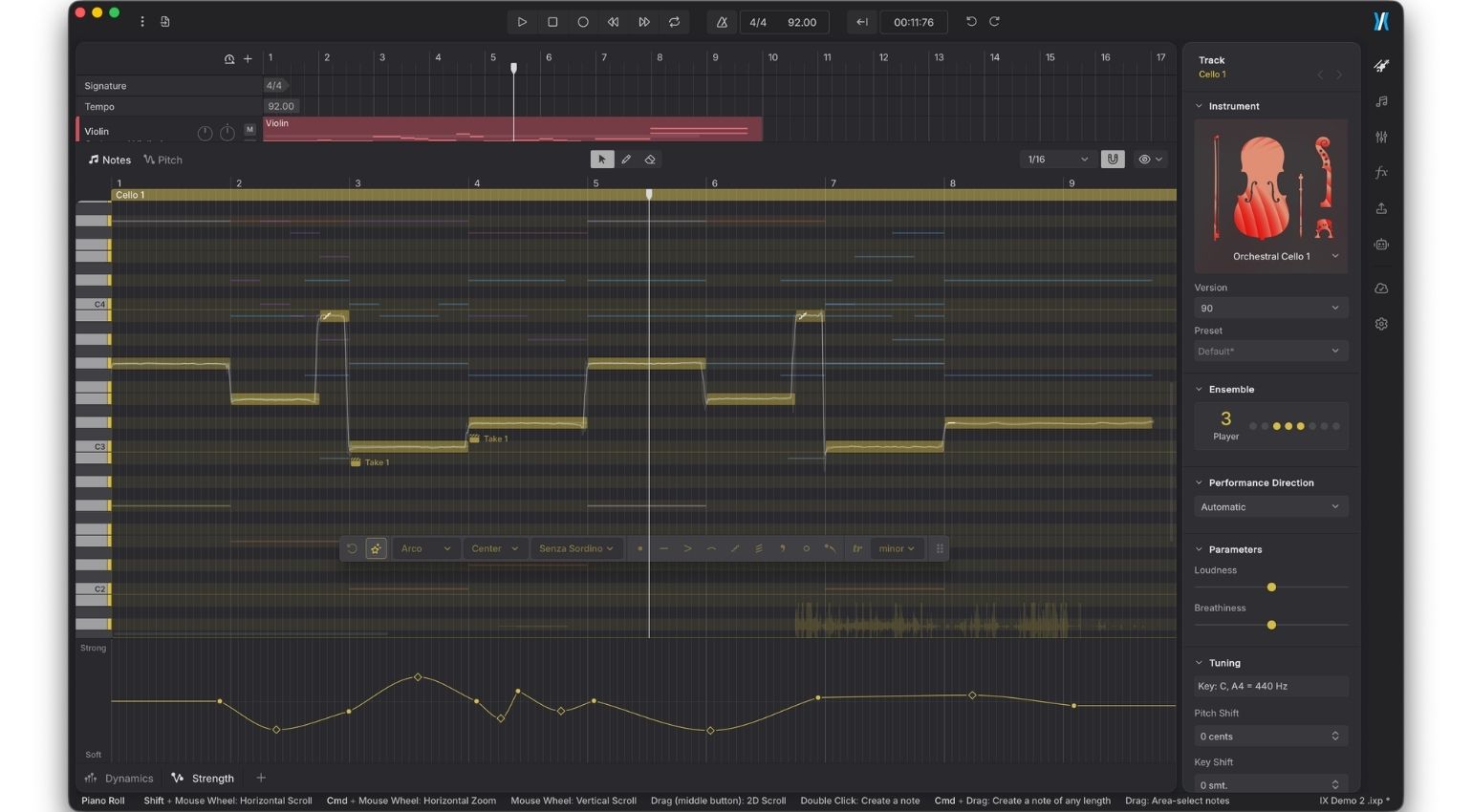
The Unified Articulation Editor manages performance techniques through one interface, with flexible switching between automated “Smart Articulation” and hands-on, note-by-note control. Standard articulations like staccato, legato, and tenuto can be combined with highly specialized, instrument-specific techniques like string col legno or brass mute configurations, and you can stack them arbitrarily on a single note.
The Dynamics Lane automatically maps context-appropriate dynamics across your arrangement based on pitch, note duration, and performance flow, with a full manual override for creative control. Adjusting these curves doesn’t just change volume, it dynamically morphs the physical timbre, harmonic saturation, and kinetic response of the instrument to mirror how a real player would actually execute the part.
AI Performance Retakes generate alternative, organic-sounding performance takes for specific phrases, either as a completely fresh take on an entire section or as a targeted micro-adjustment to individual parameters like timbre drift, micro-pitch curves, or kinetic intensity. Thanks to advanced polyphony, overlapping notes automatically render as fully separate voices instead of cutting each other off mid-bar. The Microphone Mixer Panel, finally, gives you complete control over the spatial architecture, balancing spot mics, Decca tree arrays, and wide stereo room pairs.
15 Instruments at Launch
The launch lineup includes 15 instrument expansions across three curated collections. The Orchestral Strings Collection covers Violin 1, Viola 1, Violoncello 1, and Contrabass 1, built for fluid legato lines, cinematic swells, and continuous micro-pitch bowing adjustments, including pizzicato, col legno, sul ponticello, sul tasto, and fully modeled con sordino muting.
The Orchestral Woodwinds Collection brings Flute 1, Piccolo 1, Oboe 1, Clarinet in A 1, and Bassoon 1, with organic breath dynamics and genuine register transitions, plus specialized articulations like inhalation triggers and trills. The Orchestral Brass Collection covers Trumpet 1, Trombone 1, Horn 1, and Tuba 1, including trumpet trills, trombone portamento glides, and stopped horn notes, with Trumpet 1 and Trombone 1 offering full modeling for straight, cup, and harmon mutes.
Every instrument also inherits the workspace DNA of Synthesizer V, including five style-shaping performance instructions (Adagio, Allegro, con Fuoco, Pop, Ballade) that apply globally across an entire arrangement through a single interface.
What Dreamtonics Founder Kanru Hua Has to Say
Founder and CEO Kanru Hua explains why Instrument X exists as its own standalone platform alongside Synthesizer V and Vocoflex: “Many users have often asked us to bring musical instruments into our ecosystem. We concluded that rather than overloading a single workspace, Instrument X should stand as a distinct, dedicated platform, completing our trilogy.”
The real challenge, he says, wasn’t the AI-driven synthesis itself, but fine-tuning the technology to meet the demanding standards of real-world composition and production professionals.
Bottom Line
An approach that ditches multi-gigabyte sample libraries entirely in favor of neural modeling is ambitious, especially given the track record Dreamtonics has already built with Synthesizer V in the vocal space. The combination of local processing with no GPU requirement, eleven simultaneous microphone perspectives, and stacked articulations sounds technically impressive on paper, but how this actually feels and sounds in practice remains to be seen. For film composers currently wrestling with massive sample libraries and complicated keyswitch maps, though, Instrument X could genuinely be an interesting new direction.
Price and Availability
Dreamtonics Instrument X is available now here at Plugin Boutique*. The core editor is completely free with the purchase of any Instrument Expansion, and every expansion comes with a free 14-day trial (limited to a 150-note group). Individual expansions can be purchased separately, or you can go with one of the bundles: the Dreamtonics Producer’s Bundle costs $229 and includes Synthesizer V Studio 2 Pro plus one voice, along with Instrument X plus one Instrument Expansion. The Dreamtonics Trilogy Bundle costs $499 and includes Synthesizer V Studio 2 Pro, Instrument X, Vocoflex, any two voices, and any two Instrument Expansions.



More Information
*Note: This article contains affiliate links that help us keep Gearnews running. The price for you always stays the same! If you buy something through these links, we receive a small commission. Thanks for your support!

This might also interest you
4 responses to “Instrument X: Dreamtonics Makes Massive Sample Libraries for Orchestral Sounds Obsolete”
yeah but everyone else js cares abt synthv
also have u heard abt teto?? kasane teto??
The director in the video seems happy that the musicians are out of jobs.
Musicians went out of jobs in his grandfather’s day…
We’ve been having this conversation since string synthesizers in the 70’s. Heck, we’ve been having this conversation since electronic music did the soundtrack to Forbidden Planet.
Feel free to perpetuate this tired trope…
see
This is a massive paradigm shift for music production. Moving away from bloated, terabyte-sized sample libraries toward advanced synthesis and AI-driven orchestration models like Instrument X is going to save so much disk space and workflow friction!