Korg phase8 Review: Brilliant Synthesizer or Overpriced Sound Sculpture?
Steel Resonators, Electromagnetically Driven, With a Sequencer and Wavefolder on Board

 3,1 / 5,0 |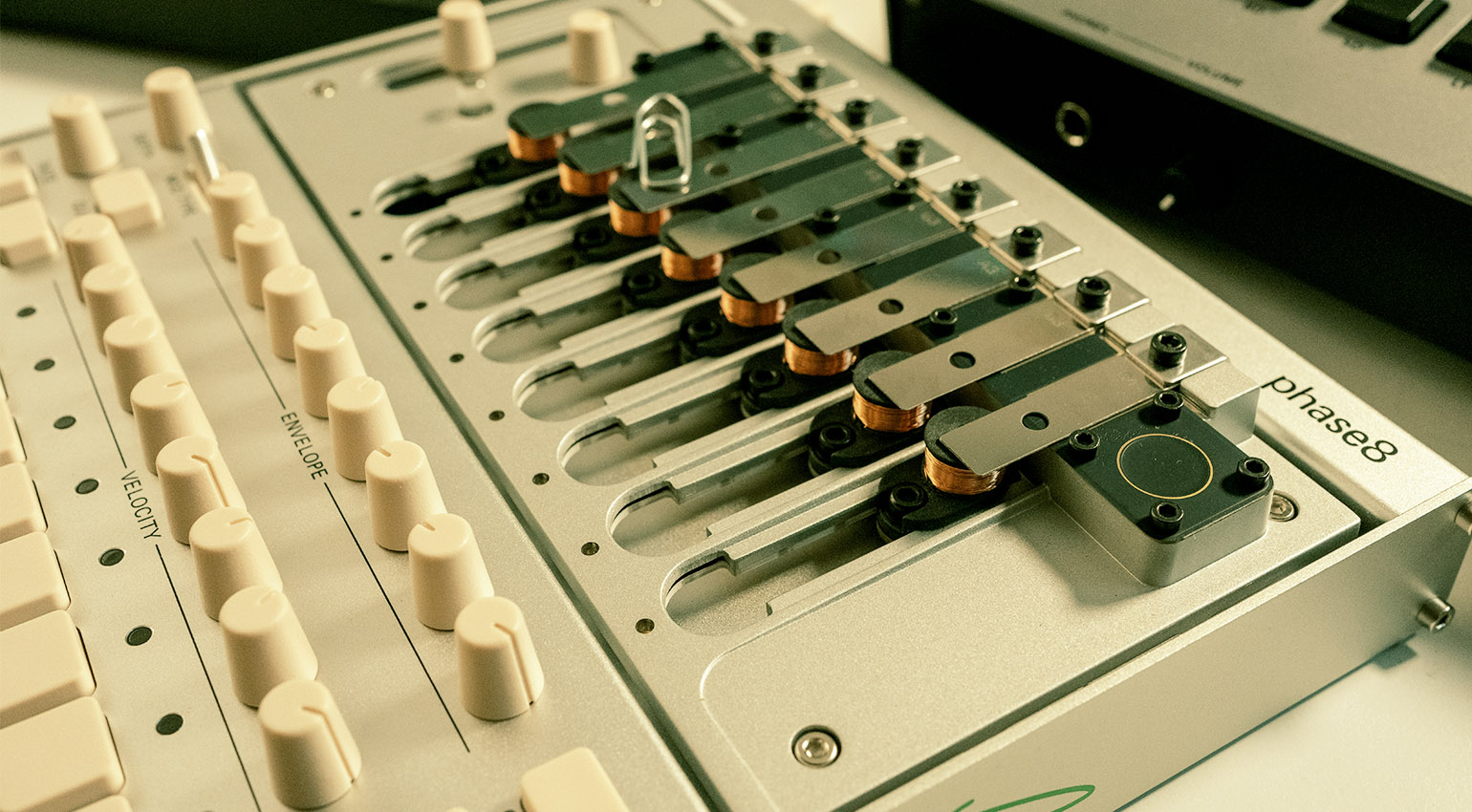
Korg phase8 Review: Brilliant Synthesizer or Overpriced Sound Sculpture? · Source: Marcus Schmahl

The Korg phase8* is the first product out of Korg Berlin, the Japanese giant’s experimental R&D outpost in Germany, headed by Tatsuya Takahashi, the man behind the Minilogue, Monotron, and the entire Volca lineup. Instead of another analog or digital synth, Takahashi built something he calls “beyond electronics”: an eight-voice acoustic synthesizer that uses physically vibrating steel resonators and pairs them with synth-style envelope control, wavefolding, and a polymetric sequencer. Sounds like a concept art piece, but this is a fully playable, shipping instrument at €969. I took it into my studio to find out if it delivers.
Korg phase8 at a Glance
We’ve been following the Korg Berlin project at Gearnews for three years now, from the first rough phase5 sketch at Superbooth 2023 to the finished thing that just landed on our doorstep. The Korg phase8 is finally here, and it’s exactly as weird, fascinating, and hard to categorize as promised. Here’s the quick rundown:
- Acoustic Synthesis: sound generation via electromagnetically excited steel resonators, no digital or analog circuitry in the audio path
- 8 independent electromechanical voices, 13 chromatically tuned resonators included (8 installed at a time)
- Analog wavefolding, three amplitude modulation modes, trigger delay
- Polymetric step sequencer with live recording and full parameter automation
- MIDI TRS-A In/Out, USB-MIDI, CV In (+/-5V), Sync In/Out
- Launch Edition with 3 additional special resonators
- Genuinely unlike anything else out there
- Price: €969
Korg phase8 Review: Everything You Need to Know About the Strangest Synthesizer Concept of the Year
From Concept to Product: the History of the phase8
To really get the phase8, you have to rewind a bit. Tatsuya Takahashi co-founded Korg Berlin in 2019/2020 alongside Maximilian Rest, the founder of E-RM Erfindungsbüro. The stated mission: no more variations on familiar ideas, only instruments that genuinely haven’t existed before. At Superbooth 2023, a playable prototype showed up for the first time, back then called the phase5, with five voices and more handmade character than production readiness. A year later at Superbooth 2024, it was called phase8 and looked significantly closer to a real product. At Superbooth 2025, Korg Berlin unveiled tooling samples, basically the actual production molds, a clear signal that things were getting serious. Then NAMM 2026 brought the official launch.
What makes this development process unusual is that Korg Berlin ran it completely in public. Year after year at Superbooth, with community feedback, with visible changes between versions. That’s rare in the synth industry. Products usually appear out of nowhere and go straight to press. With the phase8, the community watched it mature over three years and waited accordingly.
Takahashi’s core idea never changed throughout: he wanted an instrument that feels organic and alive, physically present, and responsive to its surroundings. In a market he describes as flooded with feature-heavy synthesizers, he wanted something you can actually feel when you play it.


The Concept: Acoustic Synthesis Explained
So what exactly is Acoustic Synthesis? Short version: eight thin steel tines, similar to the tines of a kalimba or a Rhodes piano, sit on the instrument and get set into vibration by electromagnetic impulses. Not sampled, not digitally modeled. Actually, physically vibrating. That means the sound comes from real material resonance, with all the natural irregularities, inharmonicities, and overtone structures that no plugin can genuinely replicate.
The concept feels like a kalimba stuffed inside a synthesizer. That comparison really does hold up: the mechanical core of a thumb piano, combined with synth-style control logic. Per-voice velocity, envelopes that go from short and percussive to long and sustained, and a signal path that then shapes that acoustic foundation through wavefolding and modulation.
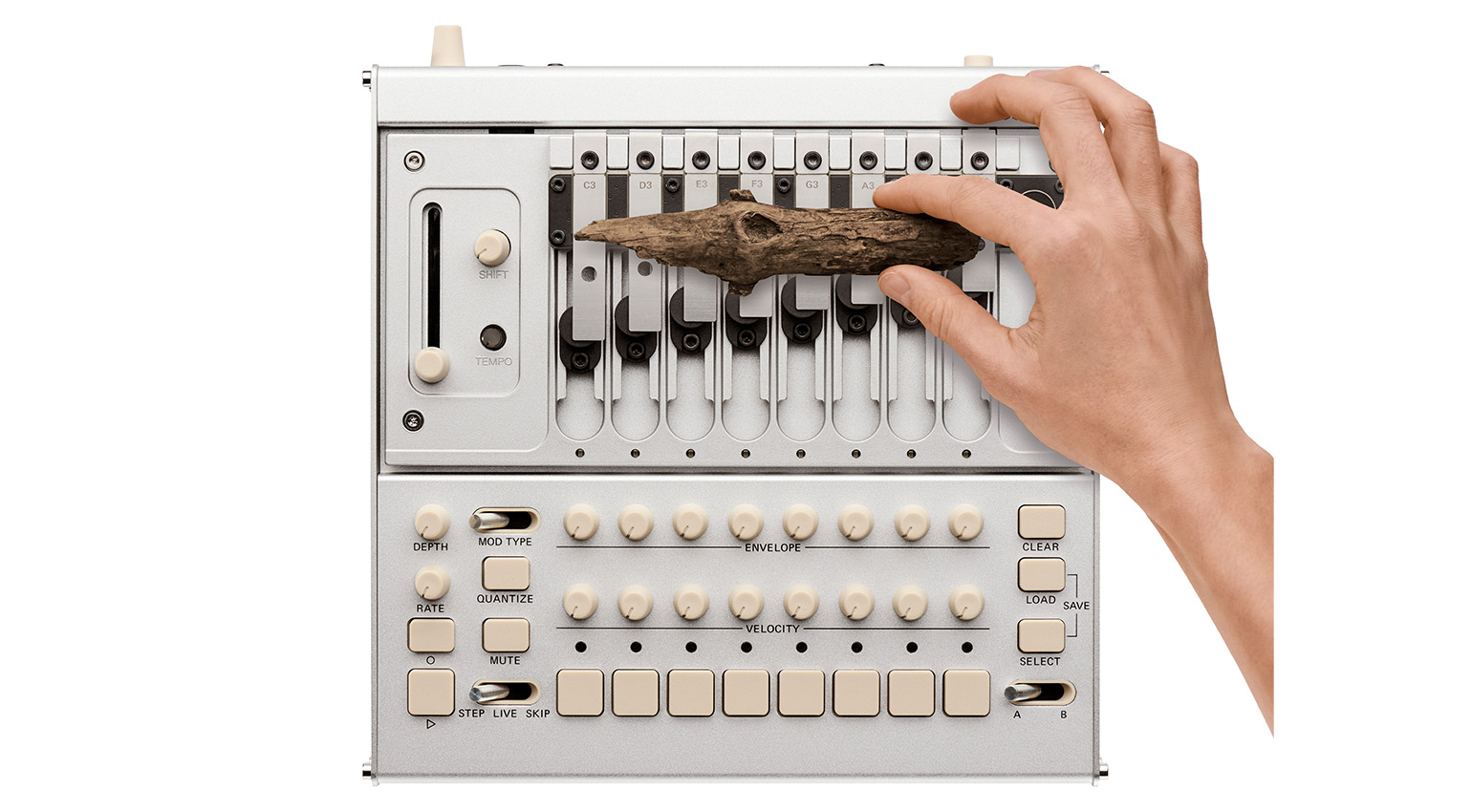
What makes the sound so distinctly alive: the resonators respond to their environment. The Air slider on the front panel boosts or dampens the acoustic response of the resonators to anything that comes into contact with them. Put a piece of metal on a tine and the sound changes immediately. Touch one with a finger while the sequencer runs and something happens. This isn’t a software simulation of touch interaction. It’s actual physics. And honestly, it’s a lot of fun.
The Resonators: the Heart of the Instrument
The phase8 ships with 13 chromatically tuned steel resonators. Eight of them install into the eight open slots on the top surface of the unit at any given time. The scale you’re working with is determined entirely by which resonators you’ve put in and how you’ve arranged them. That opens up pentatonic sets, chromatic configurations, modal tunings, or completely custom interval structures. Korg Berlin built the instrument around this principle from day one: no fixed scale, no hidden tuning preset buried in a menu.
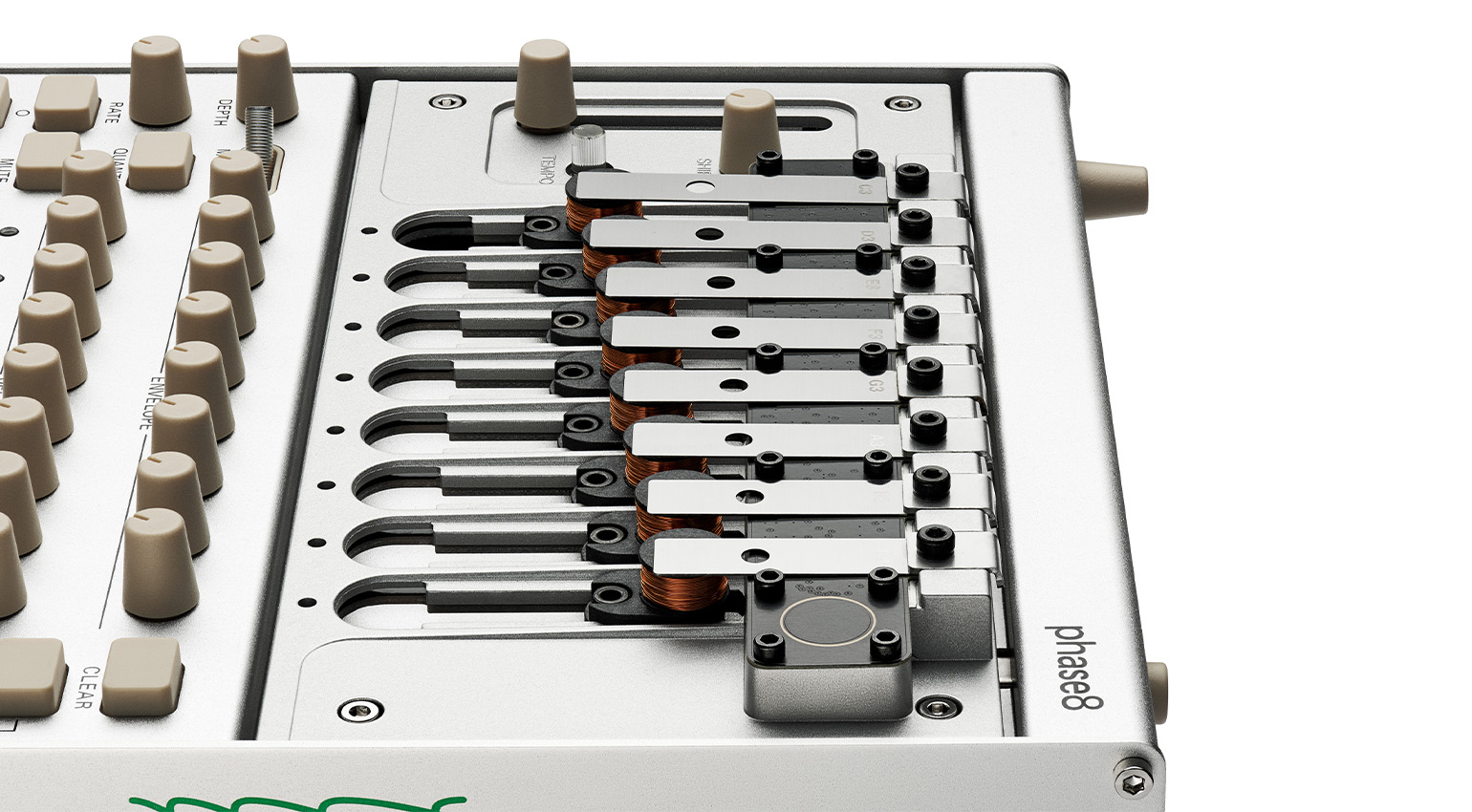
Now, the honest part: swapping resonators is not a quick move. You need the included hex key, and each resonator has to be individually fitted and tuned. This is not a live swap between sets mid-set. It’s a deliberate reconfiguration before a session. If you’re hoping to flip scales on the fly, you’ll be disappointed. If you treat the phase8 as an instrument with a defined tonal personality, or as a seriously interesting sampling source, you’ll be fine.
Physical interaction with the resonators is a different story. That part is immediate and intuitive: tap them, pluck them, lay objects on top. Korg explicitly encourages experimenting with found objects, coins, bits of metal, pieces of wood. Some Modwiggler users report the instrument even reacting to ambient noise and radio interference. Whether that’s a quirk or a feature is a matter of taste, but sonically it’s always interesting.
Sound Generation and Modulation in Detail
Sound control runs through three synthesis modes that fundamentally change how the envelopes behave. Depending on which mode you’re in, the same resonator trigger responds differently to velocity and decay settings, from a hard hit with a fast decay to a soft attack with long sustain. That gives the instrument a wider sonic character than it looks like it has at first glance.
After the resonators, you hit analog wavefolding in the signal path. If you’ve worked with wavefolders before, you know the territory: clean and bell-like at low settings, aggressively distorted and overtone-rich when pushed. Paired with the physical resonators, the wavefolding behaves differently than it would on a conventional analog synth, less predictable, because the input signal already has a lively, inharmonic character going in.
Then come three amplitude modulation modes: classic tremolo, plus two audio-rate, pitch-dependent modulation types. The third mode can optionally be harmonically quantized, which in practice means the modulation stays musically correct in tonal contexts instead of running free. These modulation types were introduced at Superbooth 2025 and in combination with the resonators they have a genuinely distinctive character, metallic and lively, with overtone behavior that’s unlike FM or AM on a digital synth.
The Shift knob controls a trigger delay: the point at which a resonator fires shifts relative to the tempo. Subtle, but in polymetric sequences it’s a useful tool for rhythmic complexity without extra programming.
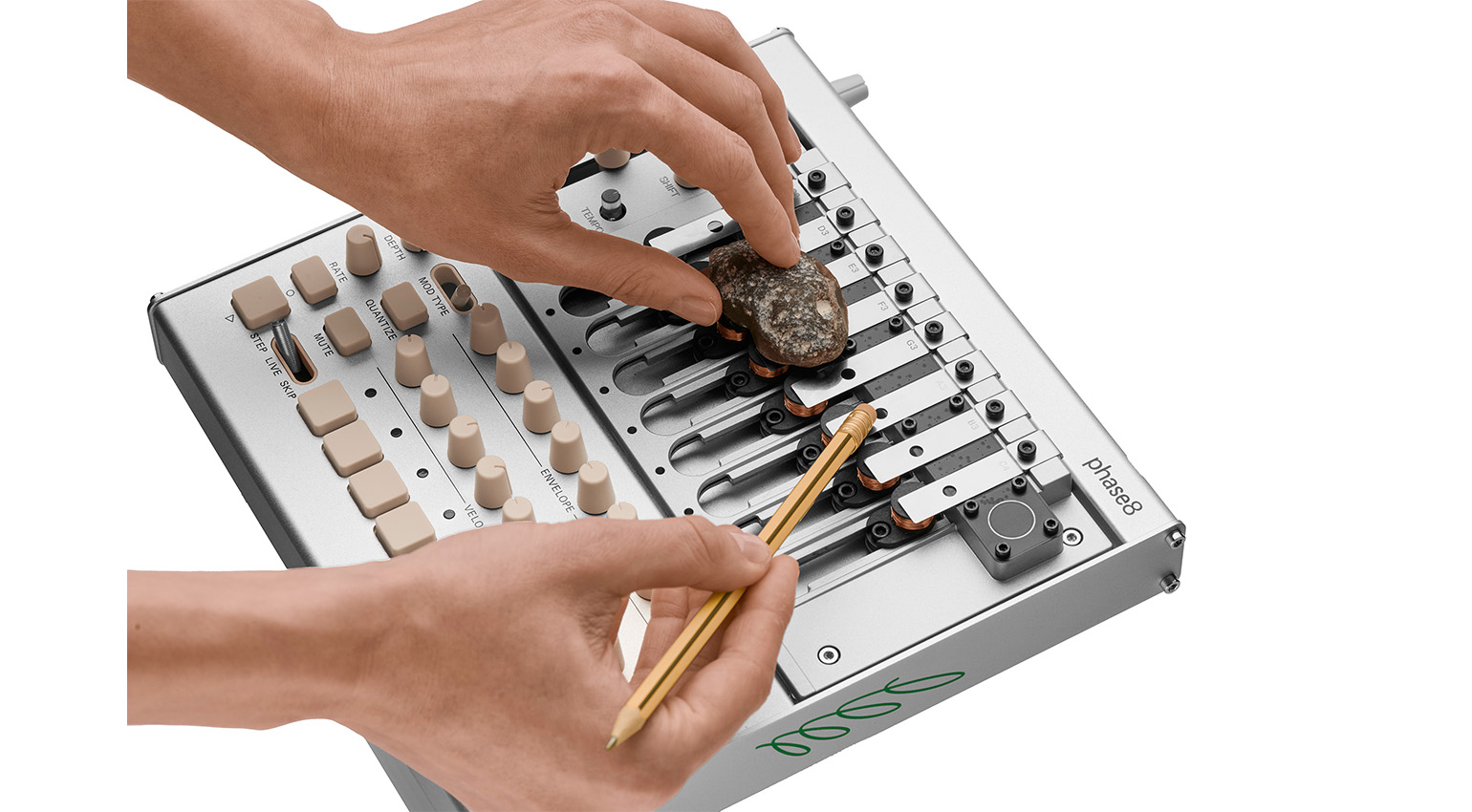
One heads-up for anyone planning to work quietly: at lower amplitude settings there’s a noticeable noise floor. That’s a real limitation for people who need clean, tonal pad sounds in a mix. On the flip side, I’ve got the same kind of thing going on with my tape echo, and that’s exactly why I love it. In a Raw Techno or experimental context, that noise floor is a resource, not a problem.
Oh, and no menu diving. Everything that matters is on the front panel. There’s a Shift layer for deeper settings, but no nested display system, no scrolling through submenus. That’s completely in line with Korg Berlin’s philosophy and a genuine advantage for live use. Love it.
Sequencer and Performance
The phase8’s sequencer is polymetric, and that’s more than a marketing phrase. Each of the eight voices can be programmed with its own step length, and the step-skip function lets you drop individual steps per voice. The result is patterns that drift against each other and never quite land at the same point simultaneously. That’s the core idea of polyrhythm: emergent complexity from simple building blocks.
Beyond step programming, the sequencer also takes unquantized live input. You play a pattern in free, the phase8 records it. That sounds less mechanical than straight step programming. Both modes can be combined.
What makes the sequencer even more interesting is full parameter automation. Every front-panel control, velocity, envelope, wavefolding, modulation, Air, and Shift, can be recorded in real time into a running sequence. If you’ve used the Volca series, you know how powerful this gets: build a basic loop, start turning knobs, and the phase8 stores those movements. The result is a living, evolving sequence that feels slightly different on every pass.
Eight sequence memory slots are available. Not a lot, but workable for a live-oriented session. For complex multi-pattern arrangements, external storage over MIDI is the way to go.
Connectivity: the phase8 in the Studio and on Stage
The back panel covers all the bases for modern setups. MIDI TRS-A In and Out handle integration into MIDI chains and let the sequencer trigger external gear. USB-C covers USB-MIDI and firmware updates, firmware v1.2 is already out. Sync In and Out handle clock sync with other Korg gear like Volcas and Monotrons, or anything that speaks analog clock.
The CV input takes +/-5V and routes external voltage to knob parameters. That means Eurorack LFOs, envelopes, or any other CV source can control the phase8 from the outside. Good news for modular users.
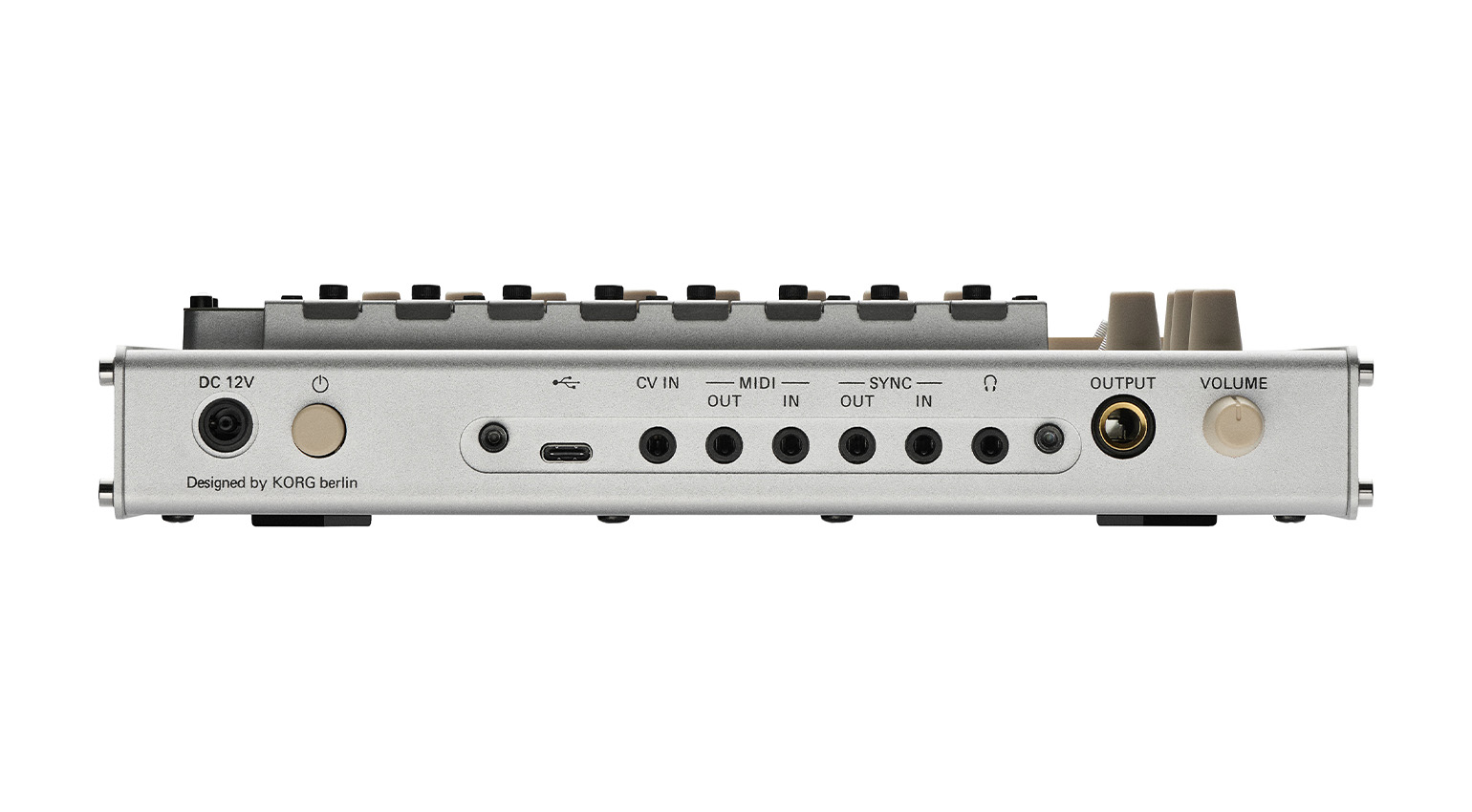
Audio leaves via a 1/4″ line output and a 3.5mm headphone jack. The phase8 is mono. It runs on a 12V power supply and draws just 4.8W.
Dimensions: 231 x 236.5 x 46 mm, weight 1.71 kg. That makes it a proper desktop unit that also fits in a bag. Not exactly a grab-and-go instrument in every context, but more portable than its sound concept suggests.
The phase8 for Electronic Music Producers: Progressive House, Melodic and Raw Techno
Rhythm and Polymetric Texture
The polymetric sequencer with step-skip is a direct on-ramp to asymmetric percussion textures for electronic music production. Set two or three voices to different step lengths, one on 8, one on 6, one on 5, and you’ve immediately got a layer that continuously drifts against a 4/4 groove without ever opening a DAW session. The metallic resonator sounds fill a frequency gap that a lot of electronic productions leave empty: between hats and percussion, in the zone of metallic overtones with natural inharmonicity. No sample pack gets you there. Perfect.
Melodic Techno and Progressive House: Drones, Pads, and Texture
Long decay settings combined with harmonically quantized modulation pull pentatonic or modal layers out of the phase8 that behave like organic pads while keeping that distinctly metallic, bell-like character. Wavefolding plus audio-rate modulation produces an overtone structure that’s vaguely reminiscent of FM synthesis, but with a physical source material that makes it sound completely different.
A signal chain that works well: phase8 (line out) into a reverb with long pre-delay times (Valhalla Vintage Verb, Strymon BigSky, or similar), then light saturation, then parallel to the main pad layer in the mix. The phase8 doesn’t need to sit up front. As an atmospheric texture layer that adds depth and movement to a mix, it’s remarkably effective.
Raw Techno: Noise, Feedback, and Prepared Resonators
The noise floor at lower amplitude settings is not a problem in a Raw Techno context. It’s a resource. A gate plugin in the DAW shapes that noise rhythmically, either tight sidechain-compressed against the kick or as a standalone noise layer between main elements. Putting objects on the resonators immediately produces industrial, unpredictable textures: a thin piece of sheet metal on two tines gives you a timbre that no preset will ever replicate.
For clock sync: feed the Sync input directly from a TR-style drum machine, an Elektron box, or the DAW. The phase8 locks tight to the groove while the polymetric patterns still supply movement and drift over the stable rhythmic foundation.
Practical Tip
Don’t buy the phase8 as a main instrument. Plan it in as a dedicated texture and percussion machine, and build the effect chain from day one. Without external effects, the core sound gets one-dimensional pretty fast. With reverb, delay, and a granular processor (Output Emergence, Max for Live Granulator II), the sonic range opens up significantly. If you want to test whether the phase8’s sound actually fits your music before committing: Loopop offers finished multisamples of the instrument on Patreon. Not a substitute for the real thing, but an honest preview of the sonic character.
Final Thoughts: an Instrument for the Curious
The Korg phase8 isn’t a synthesizer purchase, it’s a philosophy purchase. If you’re looking for tonal flexibility, lots of presets, and a broad sound palette, this isn’t for you. If you want to know what it sounds like when a steel tine gets electromagnetically triggered, run through an analog wavefolder, and sequenced polymetrically, and you’re willing to play with the physics of the instrument rather than just dialing in sounds, you’re getting something that doesn’t exist anywhere in any software catalog.
For electronic music production in Melodic Techno, Raw Techno, and atmospheric Progressive House, the phase8 is for me an extraordinarily interesting texture and percussion machine, as long as you commit to running it through an effect chain. As a standalone instrument it gets limiting fast. As part of a larger setup it opens up a sonic dimension that’s hard to describe but immediately audible.
Korg Berlin proved that four years of public development can actually lead to a real product. That’s not a given, and the phase8 is absolutely worth the result.
Price and Availability
The Korg phase8 is available for €969 at Thomann*.
Pros and Cons
Pros
- Completely unique sound concept, nothing else on the market sounds like this
- Fully front-panel accessible, zero menu diving
- Polymetric sequencer with full parameter automation, powerful and performance-ready
- Physical interaction as a genuine musical feature, not a gimmick
- Solid connectivity: MIDI, CV, Sync, USB-MIDI
- For what it is, €969 is fair
Cons
- Pitch and timbral range is deliberately narrow, not an all-rounder
- Swapping resonators is time-consuming, no spontaneous live swaps
- Noticeable noise floor at quieter amplitude settings
- Needs external effects to move beyond the core sound
- Only 8 sequence memory slots
- Mono output
FAQ: Common Questions About the Korg phase8
What is Acoustic Synthesis on the Korg phase8?
Acoustic Synthesis is Korg Berlin’s term for their approach of setting steel resonators into physical vibration via electromagnetic impulses. The sound comes from actual material resonance, not a digital model or a sample.
Is the phase8 a polyphonic instrument?
Yes, with eight independent electromechanical voices. Polyphony works by triggering multiple resonators simultaneously, each tuned differently.
Can you play the phase8 chromatically?
Essentially yes. The 13 included chromatically tuned resonators let you build a full scale. Since only 8 install at a time, you’re always making a selection. Which notes are available depends on your resonator loadout.
How loud is the phase8 without amplification?
The resonators produce an acoustic signal that’s audible in a quiet room, roughly kalimba-level. For musical use, the line output is the way to go.
Does the phase8 work with Eurorack? Yes. The CV input accepts +/-5V and routes external voltage to knob parameters. Sync In/Out handles clock sync with modular systems.
How much work is swapping resonators?
A few minutes with the included hex key. Not a quick swap, more of a deliberate reconfiguration before a session. Not suitable for spontaneous changes mid-performance.
Is there a MIDI Out for external gear?
Yes, MIDI TRS-A Out is onboard. The sequencer can send notes to external MIDI devices.
Is the phase8 beginner-friendly?
Technically it’s accessible, no menu diving, everything on the front panel. Conceptually it’s better suited to musicians who are already curious about experimental sound generation and know what they want from a niche instrument.
What effects work well with the phase8?
Reverb and delay are the obvious starting points and work great. External effects are a solid addition overall. Granular processors like Granulator II or Output Emergence take the core sound somewhere else entirely. For Raw Techno use, gates and sidechain compression are worth exploring.
More Information
*Note: This article contains affiliate links that help us keep Gearnews running. The price for you always stays the same! If you buy something through these links, we receive a small commission. Thanks for your support!

This might also interest you
5 responses to “Korg phase8 Review: Brilliant Synthesizer or Overpriced Sound Sculpture?”

You are currently viewing a placeholder content from Facebook. To access the actual content, click the button below. Please note that doing so will share data with third-party providers.
More InformationYou are currently viewing a placeholder content from Instagram. To access the actual content, click the button below. Please note that doing so will share data with third-party providers.
More InformationYou are currently viewing a placeholder content from X. To access the actual content, click the button below. Please note that doing so will share data with third-party providers.
More Information
I applaud Korg for its willingness to fund and develop this instrument in the manner it did. Unfortunately I think the BASTL kalimba will completely take the wind out of the phase8’s sails. Completely.
Yes. I liked this until I saw the BASTL Kalimba. The Kalimba seems like it’s more flexible and will be _way_ more fun.
Bastl Kalimba is way less a “physical synth” than Phase8. It does have a built-in mic to capture the kalimba sound but it’s mostly built to work without the sound of the tines. The tines of Bastl kalimba are mainly used as a controller for the onboard synth.
They are two very different instruments.
That said, if I had to chose i’d get the Kalimba anytime.
So Korg tries to be Soma synths and sucks at it. Gotcha.
The only thing I would change about the Kalimba is to make it a bit more professional: use 1/4″ jacks instead of 1/8″ jacks, and add a dedicated PSU power jack in addition to the USB-C power input.
Apart from that, it completely outclasses the Phase8. The Phase8 started as a good idea, but at that price point, it simply doesn’t deliver.