The 7 Best Guitars for Bluegrass Beginners: Your First Dreadnought
Eversthing you need to know

 3,8 / 5,0 |
The 7 Best Guitars for Bluegrass Beginners: Your First Dreadnought · Source: John Anderson / Alamy

The best guitars for bluegrass beginners tick a lot of boxes. They’re affordable, they sound good, they feel like an extension of your hands, and they work well in a band context. So, we picked six models as a starting point, whether it’s for you or as a birthday or Christmas present.
Our Picks:
The Best Guitars for Bluegrass Beginners: Where it all began
Of course, bluegrass players didn’t invent the dreadnought; they just made it famous. When Bill Monroe picked up a Gibson in the 1940s and started pushing the tempo on songs like “Blue Moon of Kentucky,” he changed the musical landscape. Monroe’s string band format, built on mandolin, banjo, fiddle, upright bass, and a hard-driving rhythm guitar, defined the genre and made the dreadnought its anchor instrument.
Guitarists who followed, like Doc Watson with his lightning-fast flatpicking runs and Tony Rice with his technique that pretty much rewrote what the instrument could do, cemented the format. Big body, steel strings, played with a stiff pick.
For decades, bluegrass stayed a genre that mainstream audiences respected but rarely sought out. IN recent years, however, something changed. Billy Strings won a Grammy in 2021, sold out theatres across the US, and started landing in playlists next to Radiohead and Neil Young. Molly Tuttle brought flatpicking into rooms that had never heard it before.
The new generation didn’t water down the tradition. They just played it harder and faster, and suddenly a whole wave of guitarists wanted in. If you’re one of them, the first question isn’t which scale to learn or which YouTube channel to follow. It’s: What are the best guitars for bluegrass beginners?
The Best Guitars for Bluegrass Beginners: What to Look For
The answer to what the best guitars for bluegrass beginners are matters more in this genre than in almost any other acoustic style. Generally speaking, the dreadnought’s large body and long scale length generate the volume, projection, and low-end punch that bluegrass jams demand.
Specifically, if you really want to be serious about it, you’re looking for a 14-fret dreadnought with a spruce top and mahogany or rosewood back and sides. It’s a configuration that’s sat at the heart of the style since Martin built the D-18 in the 1930s.
Body shape and Wood Types
Especially if you’re playing bluegrass in a band, it just has ti be a full-size dreadnought. As mentioned, spruce is the standard tood type for the top, because it’s stiff and resonant. A solid spruce top can make a real difference compared to laminate, because its tone is more open and dynamic, and it responds better to hard flatpicking.
In terms of back and sides, mahogany gives you a more warm, punchy midrange that’s ideal for rhythm work, while rosewood adds more bass depth and articulation for flatpicking leads. Either option is suitable for a beginner. If your
Action, Neck and Playability
The fast strumming and picking of bluegrass is much more physically demanding than in genres like folk or blues. You just hit the strings harder and you need a neck that lets you move quickly. Also look for a nut width of around 43–44 mm (narrow enough for chord work), medium-to-low action straight from the box (most beginner guitars benefit from a basic setup anyway), and a neck profile that isn’t too chunky for single-note runs.
A bone nut can be a small upgrade that noticeably improves sustain and tuning stability. Many of the best guitars for bluegrass beginners in this price range often come with plastic nuts, but you can always get it set up from your local luthier.
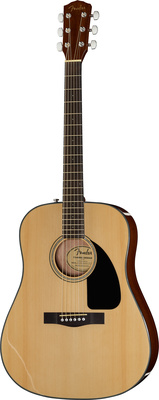
Fender CD-60 V3
The Fender CD-60 NA V3 is dreadnought model built from laminate wood (spruce top, mahogany back and sides). It is worth noting that this model comes with a slightly shorter scale (643mm vs. the standard 648mm). Its nato neck is comfortable, and it comes with a walnut fingerboard.
The shorter scale can even be an advantage for beginners, as it’s a bit faster to get around. The Fender CD-60 NA V3 is the most affordable entry in our list of the best guitars for bluegrass beginners. Check it out at Thomann*.


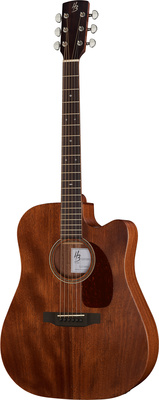
Harley Benton Custom Line CLD-15MCE
The Harley Benton Custom Line CLD-15MCE is an all-solid dreadnought guitar with a cutaway with a solid Okoume top. Oukme is an African hardwood with a tone somewhere between mahogany and cedar that’s both warm and immediate. The top sits over a sapele body with scalloped X-bracing and a proper dovetail neck joint. A pau ferro fretboard, built-in pickup, and a modified oval C neck profile (neck: Okoume) complete a spec sheet that would probably cost significantly more under any other brand name.
For bluegrass use, Okoume might be less traditional than spruce or mahogany, but it delivers real projection and a punchy midrange that works well with a heavy flatpick. Buy the Custom Line CLD-15MCE from Thomann*.

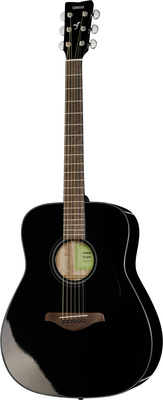
Yamaha FG800 BL
The Yamaha FG800 comes with a solid spruce top with Yamaha’s scalloped X-bracing, nato back, sides and neck, walnut fretboard, standard 650mm scale, 43mm nut. The solid top is key: it gives the FG800 greater tonal openness and dynamic response than laminate-top guitars in the same price range.
Super reliable tuning stability, consistent build quality, and a tone that holds up in a band context make the FG800 a practical first instrument for anyone who wants to get serious without spending serious money. The Yamaha FG800 BL is the only black model in our list of the best guitars for bluegrass beginners. Get it from Thomann*.

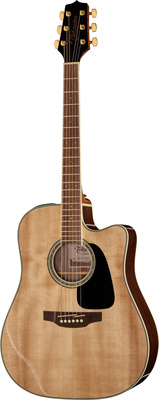
Takamine GD51CE-NAT
The Takamine GD51CE-NAT is where this list crosses from beginner gear into something a working player would actually take to a gig. Solid spruce top with quartersawn X-bracing, black walnut back and sides, mahogany neck, and Takamine’s own onboard electronics: you get quite a lot of guitar for your money here.
Black walnut might be a less common tonewood choice than rosewood or mahogany, but it earns its place: bright and articulate in the highs, with a focused midrange and enough low-end presence to hold its own alongside a banjo or mandolin. It’s a definite candidate for the best guitars for bluegrass beginners.
Check out the Takamine GD51CE-NAT at Thomann*,

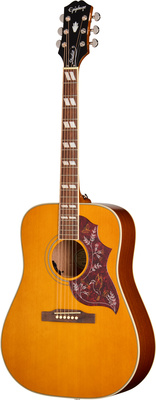
Epiphone Hummingbird Studio
The Epiphone Hummingbird Studio Antique Natural brings the essentials: a solid spruce top, mahogany back, sides, and neck, a rosewood fretboard with the classic split parallelogram inlays, and an antique natural finish that makes it look like it’s been on the road since the Nixon administration. Note that the slope-shoulder body produces a slightly rounder, more mid-forward tone than a square-shoulder dreadnought.
For bluegrass use it holds up well. It’s worth mentioning that this model does not come with a pickup, so you’ll need to mic it or add a pickup for live use. The Epiphone Hummingbird Studio can be ordered from Thomann*, a worthy entry among the best guitars for bluegrass beginners.

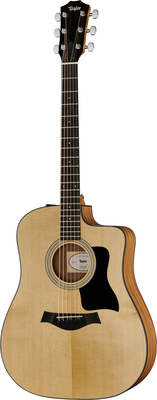
Taylor 110ce Sapele
The Taylor 110ce Sapele comes with Taylor’s NT neck system: a bolt-on construction with a precisely controlled neck angle that delivers consistently low action and fast fretting straight out of the box. The solid torrefied spruce top is quite a step up over standard spruce. Torrefaction is a heat-treatment process that artificially ages the wood, giving it the resonance and responsiveness of a broken-in instrument.
Layered sapele back and sides, ebony fretboard, Taylor’s ES-2 electronics, and a gig bag is included. If your priority is a guitar that’s genuinely easy to play, sounds great plugged in, and will serve you across multiple styles as your playing develops, the 110ce makes a strong case.
Check out this model from Taylor at Thomann*. It’s one of the best guitars for bluegrass beginners, no contest.

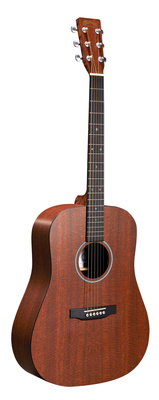
Martin Guitar DX1E Mahogany
The Martin DX1E Mahogany comes with top, back and sides all mahogany high-pressure laminate (HPL). The neck is a rust birch laminate, and the fretboard is Richlite rather than rosewood or ebony. Martin uses HPL specifically for durability and weather resistance. The herringbone rosette and tortoise pickguard give it the classic Martin look at a price well below the Road Series.
For bluegrass specifically, the all-laminate build is the honest limitation here. The HPL top won’t open up and develop the way a solid top does, and the tonal depth that makes a Martin a Martin — that warm, complex dreadnought voice — is only partially present at this price point. What you’re paying for is the name, the build quality, the electronics, and the resilience. If budget is the constraint and you want a Martin on the headstock, this is the entry point. If tone is the priority, the extra spend to reach the Road Series solid-top models is worth it.
Martin’s DX1E is one of the best guitars for bluegrass beginners. Get more details from Thomann*.

Conclusion on the Best Guitars for Bluegrass Beginners
Which models did we miss? Which of our seven picks of the best guitars for bluegrass beginners would you, as a seasoned player, not have chosen? And what did you start out with?
Let us know in the comments!
FAQ: Best Guitars for Bluegrass Beginners
What kind of guitar do I need for bluegrass?
You going to want a full-size dreadnought with steel strings. Its large body produces the volume and projection you need to hold your own alongside a banjo and fiddle.
Do I need a guitar with a pickup for bluegrass?
Not necessarily! Traditional bluegrass is played acoustically, and a well-built dreadnought should be loud enough for jamming without amplification. Once you gig more often, you can always have your model equipped with one.
Do I need an expensive guitar to start playing bluegrass?
No! As always, it’s all in the fingers. So, learn your bluegrass chops on an affordable model that plays well. The best guitars for bluegrass beginners don’t have to break the bank: a solid-top dreadnought in the €200–250 range sounds noticeably better and will grow with you.
What pick should I use for bluegrass?
Pick one that’s both thick and stiff, between 1mm to 1.5mm. Bluegrass flatpicking demands speed and precision, and a thin pick fights you on both.
*Disclaimer: This post abut the best guitars for bluegrass beginners contains affiliate links and/or widgets. When you buy a product via our affiliate partner, we receive a small commission that helps support what we do. Don’t worry, you pay the same price. Thanks for your support!


This might also interest you

One response to “The 7 Best Guitars for Bluegrass Beginners: Your First Dreadnought”

get a used.d28 .Martin guitar and learn bluegrass music ..it’s the best options