Eurorack in Techno 2026: Why Does a Modular System Belong in a Modern Techno Setup?
Modular Systems Define Groove, Tension, and Character in Techno

 3,5 / 5,0 |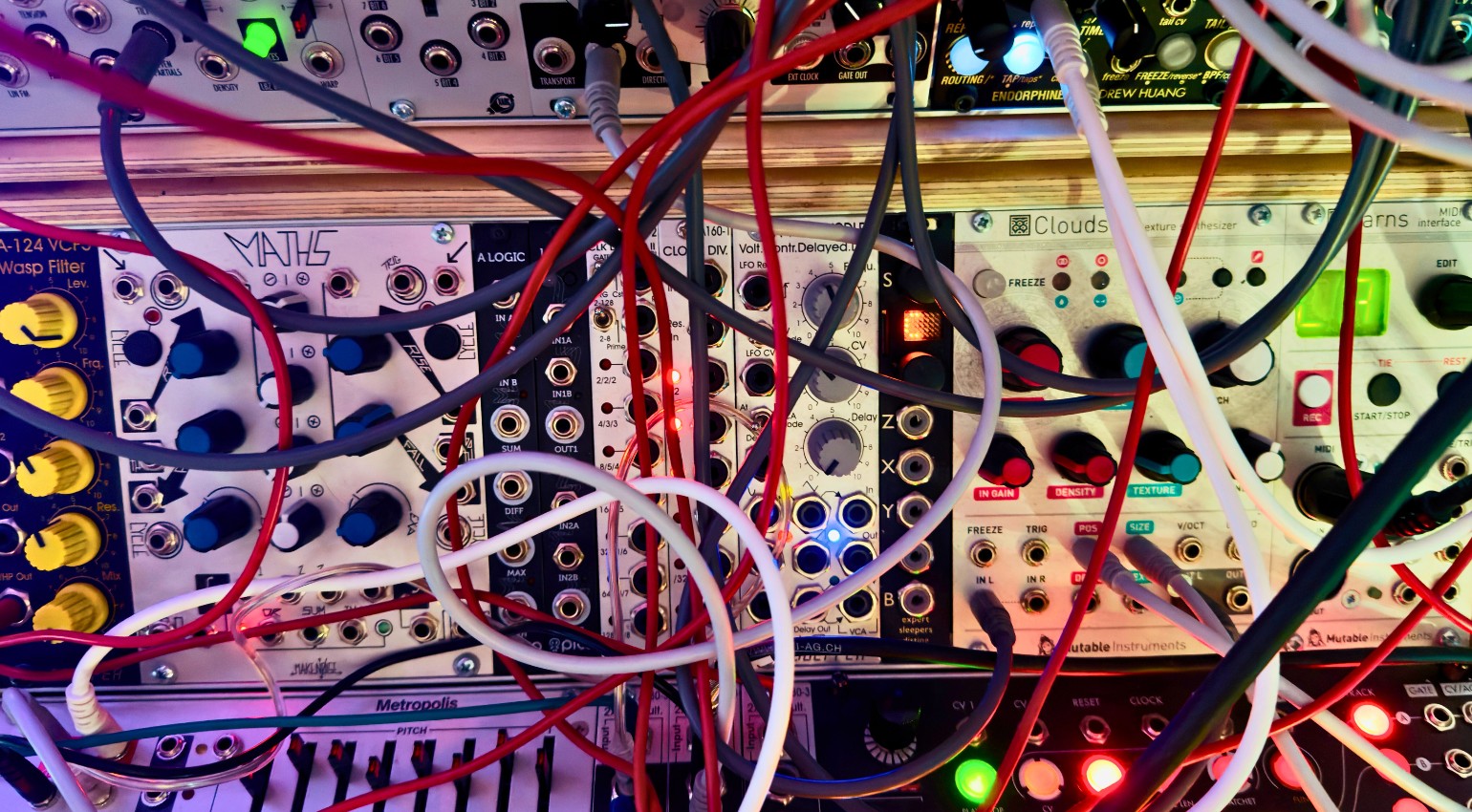
Eurorack in Techno 2026: Why Does a Modular System Belong in a Modern Techno Setup? · Source: Marcus Schmahl

Eurorack in Techno: The techno genre has always been about more than patterns and presets. It’s about movement, tension, repetition, and the organic development of a track. This is exactly where the various Eurorack modules come in. They are not a shortcut or a “one-knob magic” solution, but rather a toolbox for producers who want to create techno music rather than just arrange it. We want to show you what you need for this. Here, you can find more information about techno and synths or drum machines in techno.
The Most Important Facts in Brief
- Eurorack stands for modular techno with maximum control
- Modules do not replace a DAW – they expand its creative potential
- They are ideal for rhythm, modulation, texture, and transitions
- It is particularly strong in live performances and hybrid setups
- You can start small and focused
Alle About Eurorack in Techno
Why Does Eurorack in Techno Play Such a Central Role?
Eurorack is not a fad in techno, but a logical consequence. While drum machines provide the groove and synthesizers create melodies, a Eurorack system takes on the role of driving force. Modulations, random processes, clock divisions, and CV connections ensure that even simple patterns remain lively.
What makes Eurorack special in techno is the dissolution of classic roles. A module is rarely just an oscillator, filter, or envelope. It is part of a system. This fits perfectly with the techno genre, where tension often arises from subtle changes rather than major harmonic shifts.
Eurorack in Techno: Basics for Your Productions
Before we explore specific modules, let’s review the essential components of techno production:
- Clock and timing: The heart of any modular techno system
- Sequencing: Steps, triggers, probability, and polyrhythms
- Sound sources: drums, noise, bass, and textures
- Modulation: LFOs, randomness, envelopes
- Dynamics and shaping: Filters, VCAs, and distortion
A good techno rack doesn’t have to be big or expensive, but it does have to be well thought out.
Drum and Percussion Modules: Rhythm Beyond Classic Drum Machines
Eurorack drums are rarely realistic emulations. They are abstract, direct, and often aggressive. That’s exactly why they work so well in techno. Kick modules deliver punch and can be continuously modulated in terms of pitch, envelope, and distortion. Percussion often comes from noise, filters, and envelopes, creating a raw, organic sound.
In practice, Eurorack drums complement classic drum machines perfectly. While a TR-style kick provides stability, the modular system generates instability and groove through small deviations. This is a decisive advantage, especially for industrial, hypnotic, dub, or experimental techno.
Bass & Sound Generators: More Movement Instead of Classic Basslines
In the Eurorack context, a bass is rarely “just bass.” Oscillators are folded, modulated, distorted, and rhythmically chopped up. Bass structures often arise from the interaction of the sequencer, filter, and modulation rather than from a fixed pattern.
For techno with Eurorack, this means basslines breathe. They evolve over time, responding to clock divisions or external triggers. Minimalist tracks, in particular, gain depth without losing clarity.
Sequencer & Trigger: The Real Star of Eurorack in Techno
Sequencers are often more important than sound sources in Eurorack. They determine when and how often something happens. Step sequencers with probability and random functions, as well as variable pattern lengths, are ideal for techno.
This creates grooves that constantly shift without losing their pulse. Thus, a 16-step pattern becomes a living organism. This is exactly what modular techno is all about: relinquishing control without creating chaos.
Modulation and Randomness Create Movement Instead of Automation
While automation is recorded in the DAW, modulation takes over in Eurorack. LFOs, random generators, and complex envelopes create subtle changes. Filters open slightly differently, decays vary, and accents shift.
This kind of movement feels particularly organic in techno. It is unpredictable yet controllable. That’s exactly what makes Eurorack exciting for long, hypnotic techno tracks.
Filters, VCAs, and Distortion Shape Club-ready Sound
Eurorack filters are sound-shaping tools and performance instruments. Resonance, drive, and cutoff can be modulated in real time or changed manually. VCAs control not only the volume but also the rhythmic accentuation.
In techno, distortion is not an effect but rather part of the sound. In a modular context, it is often created by overdriving individual stages – subtle or brutal, but always lively. Above all, distortion adds warmth and character.
Eurorack in Techno: These 10 Eurorack Modules are Worth It!
Eurorack in Techno aren’t about using as many modules as possible; they’re about defining clear roles. Sequencing, rhythm, modulation, and tone shaping. This selection of examples covers these areas, from creating your first groove to performing live.
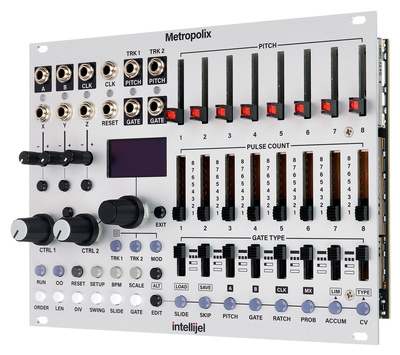
Intellijel Metropolix
This sequencer-centric classic focuses on pattern variation and performative play. It’s perfect for creating hypnotic bass and rhythm structures that evolve over time without resorting to pure DAW pattern work.


Mutable Instruments Plaits
This versatile “macro oscillator” covers a wide range of sound sources, from subtractive basslines to percussive textures to experimental pads. It’s especially great as a rhythmic sound source in techno. Tip: You can also purchase this oscillator in module form from other manufacturers with different features.
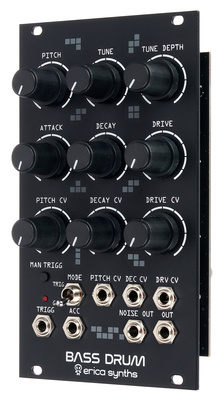
Erica Synths Bass Drum 2
It’s not just a kick drum emulator; it’s a resonant analog kick generator with drive and layer options. It’s ideal for hard, club-ready bass drums or as a basis for modulated kick grooves.

Noise Engineering Basimilus Iteritas Alter
This “drum machine in a module” has character, offering crisp percussion, deep kicks, metallic claps, and noise textures, all of which are controllable via CV. It’s ideal for techno, where drums are more than just 4/4 clicks.
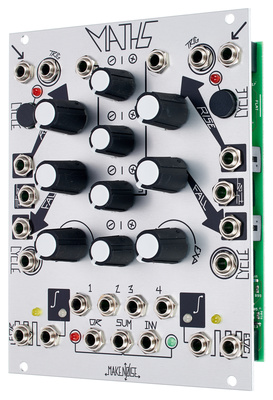
Make Noise Maths
A universal modulation tool with an LFO, envelope, slew, and attenuverter. Compact and performative. It’s ideal for bringing filters, VCAs, or sequencer parameters to life. It’s the Swiss Army knife for Eurorack in techno.

WMD Multi Mode Filter
This resonant multi-mode filter has a raw, analog character that is perfect for shaping drums and bass in the mix. In minimal techno tracks especially, this filter is the difference between “nice” and “dirty and punchy.”
Mutable Instruments Marbles
A random and probability generator that shapes static patterns into lively grooves. It is ideal for achieving rhythmic variation without rigid patterns.
2hp Trigger/Sequence Tools (Sigma, Cue, etc.)
These compact trigger and gate utilities are useful for splitting, shifting, delaying, or randomizing patterns. They are inexpensive and ideal for techno sequencing.
ALM Busy Circuits: Pamela’s New Workout
Clock and modulation center. With clock divisions, ratchets, slew CV, and LFOs on eight outputs, it’s a centerpiece for dynamic rhythms in your rack.
Mutable Instruments Ripples
This versatile, musical analog filter has a great drive for bringing basslines and textures to the forefront or coloring drums with a “dirty” sound.
3 Software Modular Alternatives to Eurorack for Techno: Affordable and Inspiring
If you want to experience the Eurorack sound for the first time but don’t have a big budget for hardware, consider the following software systems as real alternatives.
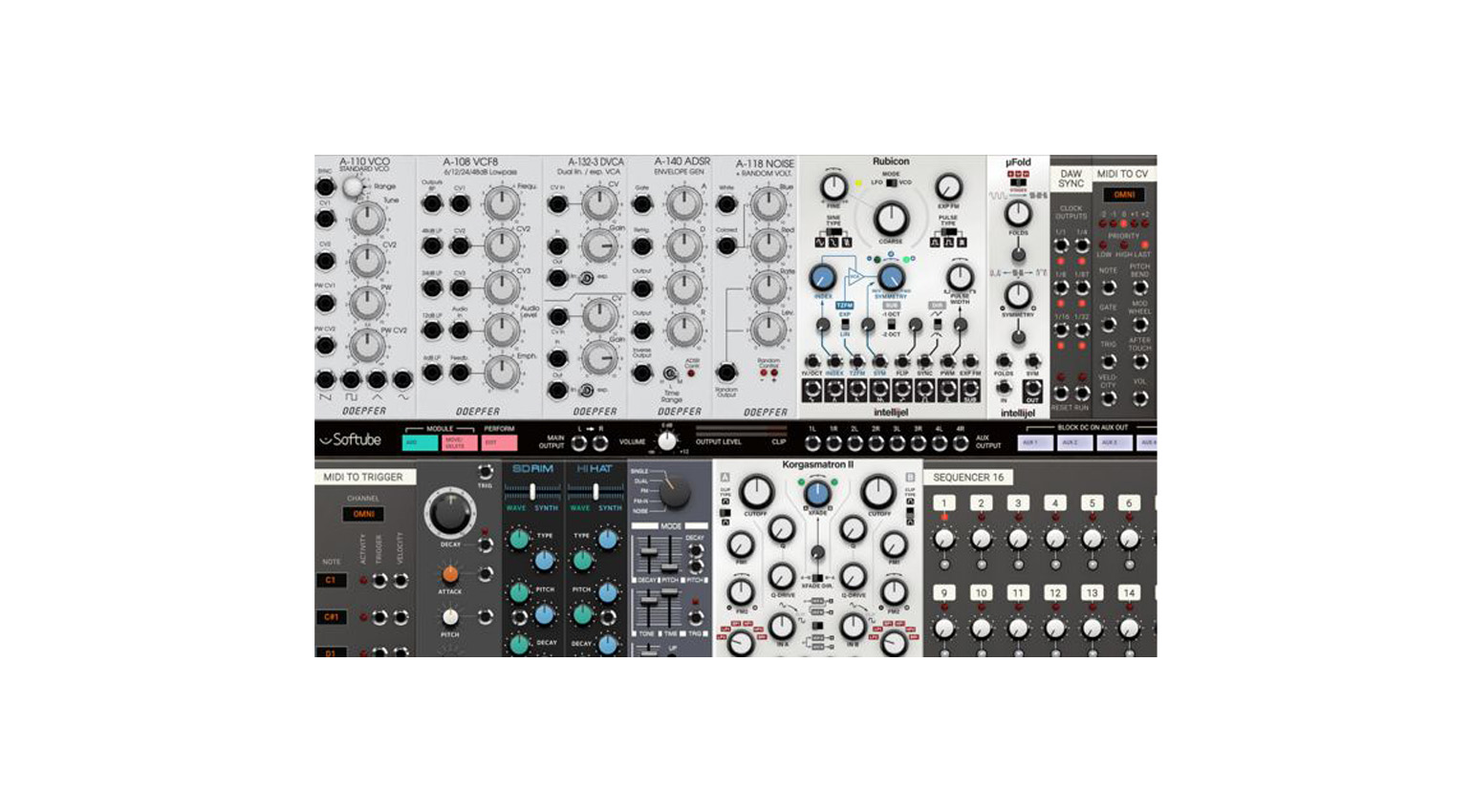
Softube Modular
A virtual Eurorack environment with licensing for official modules (e.g., Buchla, Moog, and Intellijel).
Why it’s interesting for techno:
- Very stable DAW integration (VST/AU)
- High-quality filters, LFOs, sequencers, and utilities
- Plays like real modular patching without cable clutter

VCV Rack
VCV Rack is probably the best-known free software modular environment, offering hundreds of free modules and many commercial extensions.
Why it’s interesting for techno:
- Huge community library
- Native CV control, clock, and sequencer modules
- Perfect for quickly testing modular ideas
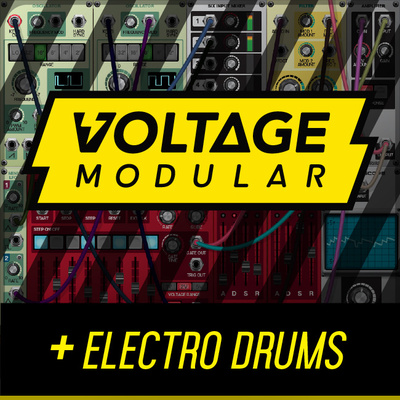
Cherry Audio Voltage Modular
It’s a flexible system with a resistive patch style and a focus on creative sound development.
Why it’s interesting for techno:
- Good performance and many sound design tools
- Commercial modules with their own character
- Low barrier to entry and many presets

How do You Build a Techno Rack From This?
Eurorack in techno can seem abstract at first. Here is a structured recommendation for different goals:
Starter Rack (Small but Effective)
- Pamela’s New Workout (clock)
- Maths (modulation)
- Basimilus Iteritas Alter (drums).
- Ripples (filter)
This combination is perfect for creating groove, movement, and sound shaping with just a few modules.
Advanced Rack (Performance & Variation)
- Metropolix (Sequencer):
- Plaits (Sound Source):
- Marbles (Probability/Groove):
- Bass Drum 2 (kick)
- WMD Multi-Mode Filter
- Pamela’s New Workout (clock)
Use for more complex patterns, transitions, and modulated grooves.
Live Rack (Modular Hybrid)
- Pamela’s New Workout (Clock & Mod)
- Marbles (Variation):
- Metropolix (Sequencing)
- Multiple Drum Modules (Basimilus, Bass Drum 2)
- Various filters and VCAs
The goal is to create a performative, organic, and dynamic piece with no static patterns.
Practical Tips for Eurorack in Techno
- Clock first: Techno thrives on pulse, so always start your chain with a clear clock or sync source, such as Pamela’s Clock, Clocked, or a DAW clock.
- Modulation is groove. LFOs and randomizers are rhythm generators, not effects. Use them for attack, filter, and timing – and, most importantly, for variety!
- Texture instead of tracks: In a modular system, you don’t build song parts; you build events over time. That’s what makes techno organic.
Why are Eurorack and Software so Powerful Together?
Software modular systems, such as VCV Rack or Softube Modular, are ideal for developing patches before translating them into hardware. Many producers use them as an experimental environment before investing in real modules.
Once the first patch is in place, The software often becomes the hardware transfer, a path that helps many techno producers reach their goal faster.
Eurorack in Techno in Practice: Which Modules are Right for Me?
Minimal/Hypnotic Techno
Small racks with a focus on sequencing and modulation. Few sound sources, lots of movement.
Industrial/Hard Techno
- Multiple drum and distortion modules, aggressive filters, and fast triggers.
Live Techno
- Clock-stable systems, performative sequencers, and clearly structured signal paths.
The decisive factor is not the brand of the module, but rather its role in the system.
Eurorack in Techno: My Approach to Modular Systems
A Eurorack system forces you to make decisions. There are no presets or “undo” functions. Every patch is a moment. This suits techno well, as it is a genre that thrives on repetition but is carried by many small changes.
To me, Eurorack is less of an instrument and more of a process. It helps me avoid overproducing tracks and instead build tension over time. In combination with drum machines and your DAW, it creates a workflow that blends technology and emotion. This works live in the studio or on stage and ultimately results in a lot of movement in the track.
Modern Workflows: Eurorack + DAW + Drum Machines
Today, most techno producers work in a hybrid way.
- Clock sync: DAW or drum machine as master
- Audio routing: Individual voices or submixes into the DAW
- CV integration: MIDI-to-CV for sequencing and automation
- Recording: Long takes instead of short loops
The Eurorack system is played live, not arranged – it’s jammed. The DAW only takes care of the structure, recording, and mixing.
Conclusion: Why Eurorack Works So Well in Techno
For me, Eurorack techno has less to do with sound fetishism and more to do with attitude. It forces you to make decisions, listen, and allow processes to happen. Rather than calling up presets or endlessly copying loops, music is created through movement, subtle changes, and the interaction of individual modules. This fits perfectly with techno, a genre that thrives not on harmony but on tension, time, and characteristic repetition.
At the same time, Eurorack is not a replacement for drum machines, synthesizers, or a DAW; rather, it is an extension. Its greatest strength is evident in hybrid setups, where it serves as a motor for modulation, variation, and organic development, as well as a source of creative ideas. Those who embrace it won’t get faster results, but deeper ones. That’s exactly where the appeal lies for me. Eurorack doesn’t help you produce more tracks; it helps you produce better ones with more effect. And that’s what we want.
More Information and Links About Eurorack in Techno
- Drum Machines for Techno 2026: Punch, Workflow, and Character
- Techno Beats in Ableton Live Made Easy!
- The Best Synths for Techno Productions in 2025: Powerful, Flexible and Creative
- Techno Rumble in Ableton Live – Made Easy!
- Modular Starter Pack: 3 Tips for Entering the Modular World – Perfect Match
- How to Control a Modular Synth from a DAW (and Vice Versa)
FAQ: Eurorack in Techno
What Exactly does Eurorack Mean in Techno?
In techno, Eurorack describes the use of modular systems to generate rhythms, modulations, and sound movements that often transcend classic song structures.
What role do Software Synths Play in the Modular Techno Workflow?
They provide additional sound sources, modulations, and sequencing options and often serve as an experimental environment before hardware patching. They are particularly interesting for beginners.
Can Software Synthesizers Replace Eurorack?
No, but they can map many concepts. Software is ideal for learning, testing, and developing modular ideas beforehand.
Why are Software Modular Systems Particularly Suitable for Techno?
They offer clock-based modulation, random functions, and complex sequencing, all of which are crucial for creating hypnotic and evolving techno grooves.
When is it Worth Switching From Software to Eurorack Hardware?
When the focus is on performative work, haptic control, and spontaneous sound changes, hardware offers clear advantages. Plus, hardware just sounds like hardware!
Does a Hybrid Setup of a DAW, Software Synth, and Eurorack Make Sense for Techno Production?
Yes, as many modern techno productions use this combination to blend structure, recording, and mixing with modular spontaneity.
Eurorack in techno stands for modular signal processing to create dynamic, evolving sound structures. Software synthesizers and modular software environments complement these systems with flexible sound sources, sequencing, and presimulations. This creates an efficient combination of digital control and modular movement in hybrid workflows.
*Note: This article about Eurorack in Techno contains affiliate links that help us finance our site. Rest assured, the price for you always remains the same! If you purchase something through these links, we receive a small commission. Thank you for your support!

This might also interest you
4 responses to “Eurorack in Techno 2026: Why Does a Modular System Belong in a Modern Techno Setup?”

Best thing I did with my 7000+ € Eurorack system : sell it.
Works the same as crack : it’s fun when you use it but it’s gonna ruin you very quick and in the end it was all for nothing.
Got Behringer Proton, Neutron and Kobol Expander with 3 module stand. Killer modular system for well under $1000 and taking little space.
That’s not the kind of modules that piqued my interest. I wanted stuff that were not easily replicable in other formats : colored and rare filters and distortions, odd tools, advanced VCOs with plenty of possibilities… All of those don’t come cheap. And of course I also needed all the necessary “regular” stuff (mults, envelopes, seqs, mixers, VCAs… etc…) to go with this. And I also had a tendency to get all the new modules with innovative functionalities.
I had plenty of modules from Make Noise, Bastl, XAOC, Intellijel, and plenty of obscure limited series modules from small companies…
Behringer does the exact opposite of what I was craving for. They do copies of regular and popular stuff (don’t get me wrong it’s a good thing, but that was exactly what I was not looking for at all).
But that’s ok, I managed to get clean from all of this 😀 (and as a true addict I kept a small 120 HP rack of my favourite filters and distortions).
Thanks for your feedback. This article is more or less for an entry level. Do you have any examples of modules you really like and which are interesting for techno productions?