A World Without Bowie – 10 Years On…

 4,8 / 5,0 |

David Bowie made a career of killing himself off and rebirthing into something new, different and unique. But on the evening of Sunday, the 10th of January, 2016, two days after celebrating his official day of birth and releasing his 26th solo studio album, ‘★’, he died one last time. And for real. Never to return.
Remembering David Bowie
I don’t recall the first time I became consciously aware of David Bowie. Unlike the generation before me, who in 1972 were teenagers or older, I wasn’t privy to the incredible mind-blow that was Ziggy Stardust. I hear tales and recollections of the impact it had on their lives, on their parents, on society as a whole, and I can only sit there, completely envious, and try to experience it vicariously through their wistful memories.
My First Experiences of Bowie
As I grew up in 1970s England, tucked away in East Anglia, I recall being fond of ‘The Laughing Gnome’ that got regular airplay on the radio, and ‘Space Oddity‘ too, or of seeing images of some flame-haired, strangely dressed individual that just seemed odd to me at the time. I was particularly impressed, however, that he sang about the Norfolk Broads, a place where I lived and played for many years.
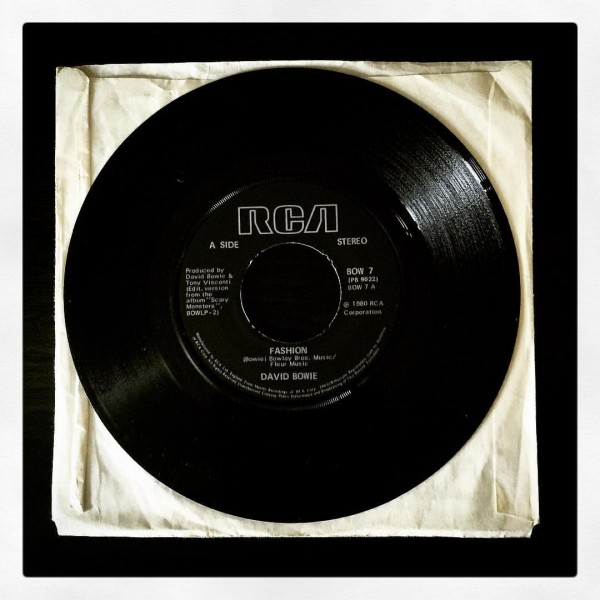
But it was when ‘Ashes to Ashes’ and its parent album, ‘Scary Monsters‘, dropped that I finally took notice. By this time, I was tuning in more and more to pop music, being more aware of what was what. And finally, with this song, followed by ‘Fashion’, I became acutely aware of David Bowie and his allure. I bought ‘Fashion’ there and then.
In fact, the more I think about it, I think I bought it from a kid at school whose Mum used to restock jukeboxes. Every so often, he would come into school and dish out old 45s that had been removed. But some he would sell, to make a few pennies to spend in the village shop. And I think that’s how I got my first David Bowie record, which I still have to this day.
From this point, I was a fan. And, as it would happen, the next album, ‘Let’s Dance‘, was to be his biggest commercial success, and it felt to me like I’d gotten on board at about the right time. Little did I know of the wealth of back catalogue, nor of the creative slump that would follow.
That’s how I discovered Bowie. And such is the depth of his oeuvre that it takes an awful long time to fully discover him, musically. As I type this, I am listening to Emre Ramazanoglu’s Atmos mix of the legendary Ziggy album, and I can’t help but be distracted by Bowie’s amazing lyrics. So clever, insightful, witty, crazy, bonkers, visionary, prophetic, intelligent… You get where I’m going.
That Fateful Day
I was woken that morning in 2016, not by my alarm clock, but by my wife, sobbing, hugging me and breaking the news to me. In my dreams, someone had been insisting that I visit someone else before they died. Coincidence, I know, but how odd to wake to that news after that dream.
I was instantly reminded of December 9th, 1980, when I woke to the sound of my mother sobbing as the news of Lennon’s death filtered through breakfast radio. That too was a devastating day and a devastating loss. But Bowie was different. Despite having a band or a production team, he was always singular. And he had prevailed far longer, was far more prolific in the studio and on tour and commanded a far larger and more diverse audience, in my humble opinion.
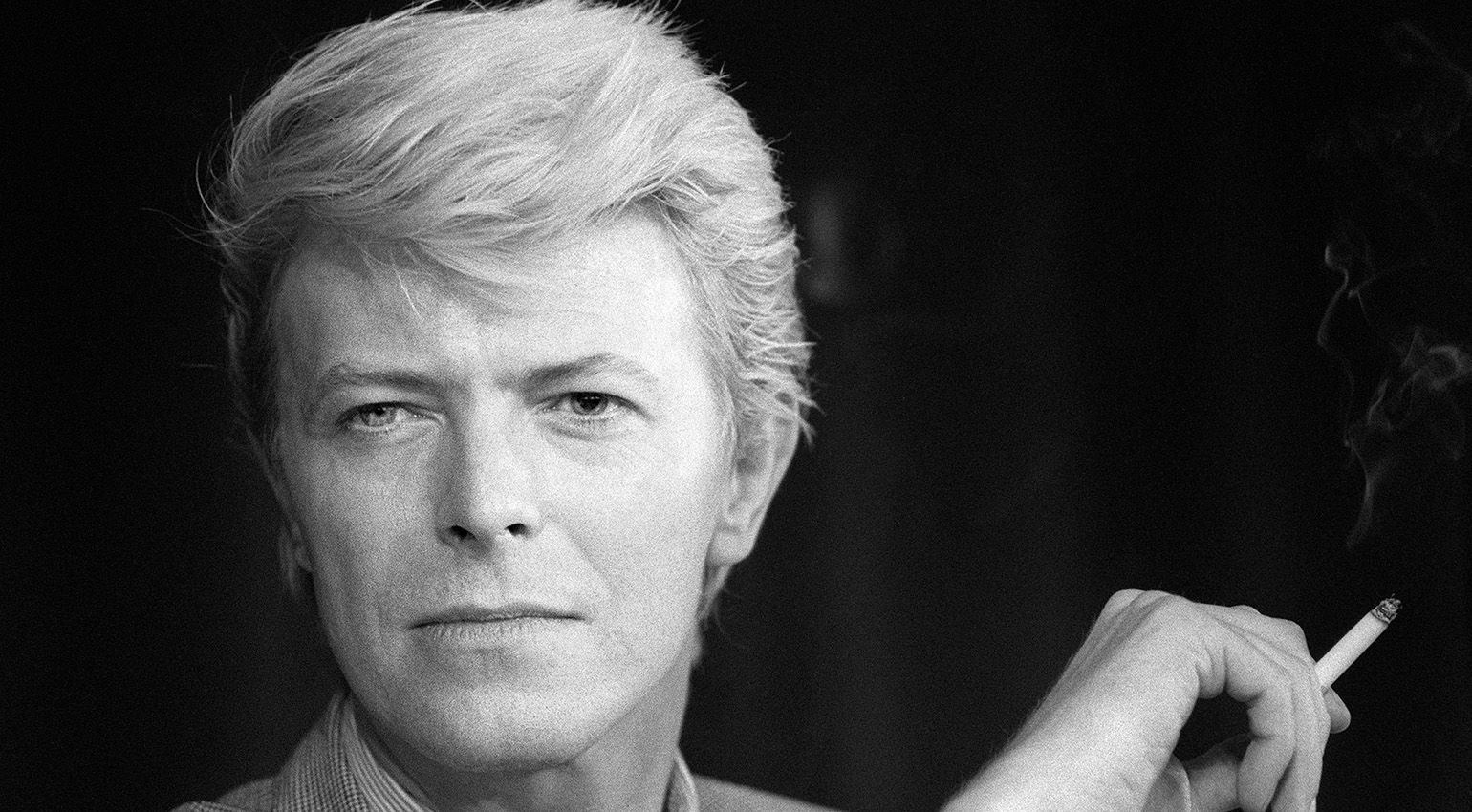
Bowie’s influence is far reaching. If you weren’t impacted or influenced by him directly, those who did influence you were probably influenced by Bowie. You can probably trace every musical artist of note since 1972 back to Bowie. He’s like a ground-zero of pop music. He is a rarity, someone whose name will be spoken quite comfortably with the likes of Da Vinci, Michelangelo, Beethoven, Mozart and Picasso.
He wasn’t just a pop star. He was a teacher, a companion, a muse and a leader. He innovated, filled spaces with his creativity, and if the space didn’t exist, he created it and filled it with his genius. I truly believe we still don’t know the extent of his “powers”. There is likely more to come from this man, through revelations, memoirs or some such.
Innovator, Enabler, Visionary
He was often referred to as other-worldly, and with reasonable cause. But the amazing thing about him was that despite the fact he seemed not to be of this earth, he was exactly like every one of us, and he became our voice and inspiration. The miracle of David Bowie is that he was human after all. And we all wanted to be like him.
In doing so, we all sought out our own unique identities and felt less awkward about them. We wore the clothes we wanted, sang the songs our parents hated and grew our hair long. Because Bowie showed us we could. He never told us to be or do anything. He simply opened our eyes. Through the medium of music, fashion, words and photography, he shed light on our existence and showed us the opportunity and excitement that had previously lain hidden, banished or dormant.
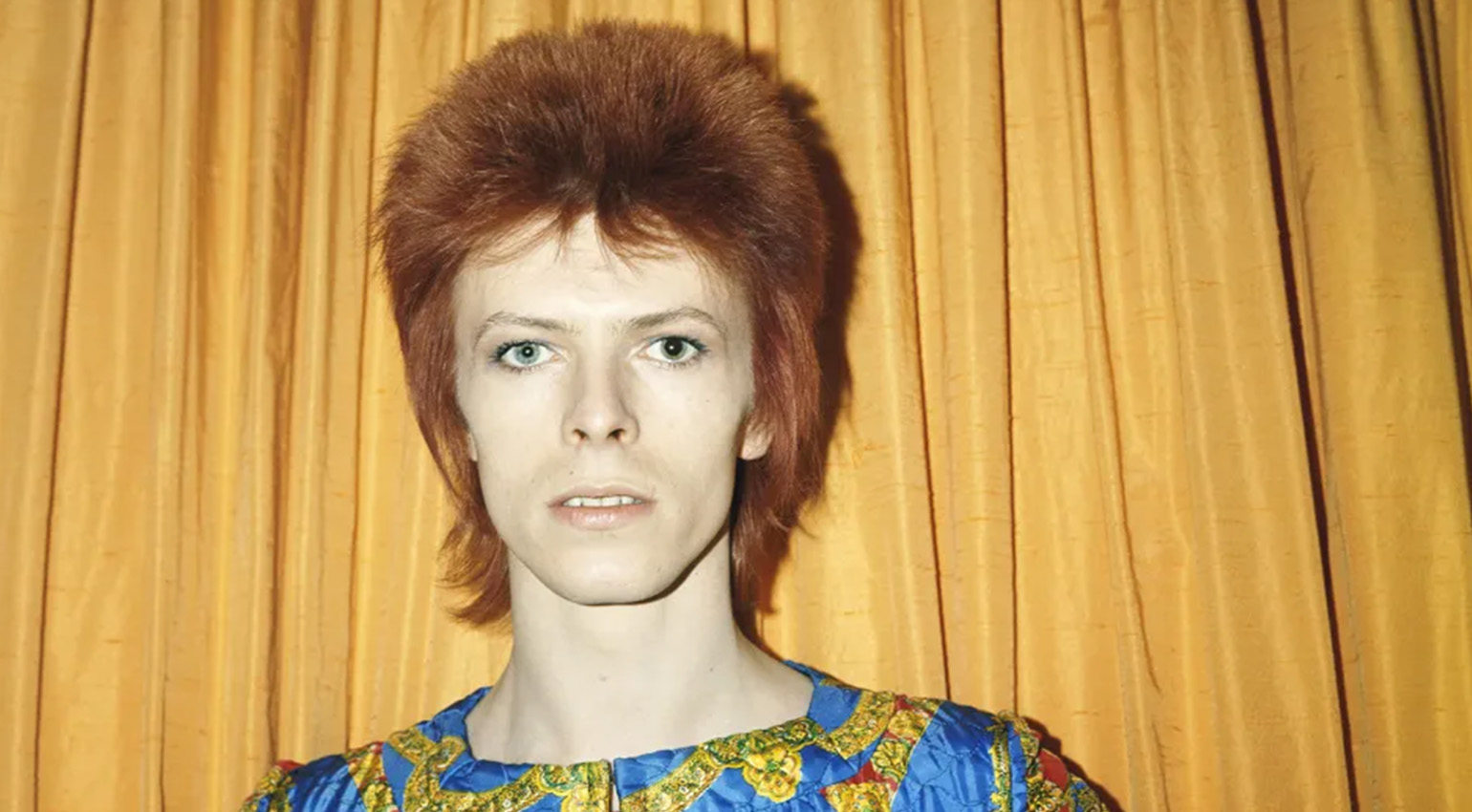
Without Bowie, punk would not have had the licence to be as uniquely extravagant as it was and, in turn, would not have inspired the likes of Westwood, McLaren and Ant to dress flamboyantly and, in turn, would not have allowed this shy, Norfolk boy of Anglo-Italian descent to wear make up, hair braids, frilly shirts and earrings, aged 10, around a village where my father ran a respectable business. My Dad called me a “poof”, hated everything about it, but Bowie’s indirect influence on me, via Adam Ant, made me not care one bit.
Over the years, I grew incredibly fond of Bowie’s musical catalogue. It is such an incredible body of work that will remain unsurpassed for centuries to come, if at all. There is such rich diversity and originality in there. And sure, over the last 59 years, there have been high points and low points, but the peaks have far outweighed the troughs.
That incredible run, from ‘Hunky Dory‘ to ‘Scary Monsters‘, is unbelievable. Because of that, we can forgive him the occasional “miss”, and even then, with age, those albums (I’m looking at you, ‘Never Let Me Down‘ and both Tin Machine efforts) have matured and become easier on the ear. Maybe he just reached a little too far ahead of himself on those, and we are only now catching up.
You Know I’ll Be Free, Just Like That Bluebird…
His final album, which only came out two days prior to his passing, on the occasion of his 69th birthday, was another career high. Despite the lyrics and the content of the two videos released in advance of the album, nobody guessed it was his own, planned, hand-written epitaph. So swept up in its brilliance, we were, that nobody, until that day, understood that “Lazarus” was his goodbye, both lyrically and visually.
At the beginning of the video, Bowie emerges from a wardrobe, or some might say a closet. We see him in a hospital bed, eyes bandaged with buttons where his famous eyes would be. A strange figure lurks in the room, under the bed, at the foot of it at times, trying to reach out to him. The cancer, maybe? A flurry of activity from a now unmasked Bowie sees him dancing, the way only Bowie can, and writing furiously as if possessed to do so, finally retreating backwards into the wardrobe and closing himself in. Marry this imagery to the lyrics, and it is as clear as day that “Lazarus” was his farewell.
And then there’s the closing track, ‘I Can’t Give Everything Away’. When I played ‘★‘ in its entirety, I pondered how this song had a powerful sense of release, particularly in the chorus. It builds tension (“I can’t give everything, I can’t give everything”), and then delivers the release (“Away”). It just conjures images of a bird launching into flight. The bluebird from ‘Lazarus’, maybe?
Bowie knew he was dying and, like every other thing in his long and brilliant career, he had complete control over his destiny. Everything was planned, every song, every visual, just like he had done, over and over again. He had killed Davy Jones, and gave birth to David Bowie. He created Ziggy, Aladdin Sane, the Thin White Duke, the alien in human form, the Pierrot.
He killed them all, so that the next one could live. And so, when it came to the last, the one he couldn’t kill but would die nonetheless, he made sure of a fitting exit, with music and imagery, and turned his death into his final performance, as all great performers do. He departed quietly, stage left, leaving his audience in tears, bursting with admiration, fulfilled by his artistry and crying for more. But on the night of January 10th, 2016, we went to sleep knowing that there was no more. And we cried again…
I’ve seen this quote flying around the internet quite a lot since that day, attributed to everybody and nobody. I am merely repeating it here because it helps alleviate the grief, albeit a little…
“If you’re ever sad, just remember… the world is 4.543 billion years old and you, somehow, managed to exist at the same time as David Bowie.”
And we should all be eternally grateful for that.
The Next Day…
So what has happened in the 10 years since his passing? As far as Bowie’s catalogue is concerned, quite a bit. Some of it has been deeply welcomed by his fans, other bits not so much, with accusations of cash grabs and poorly considered compilations. What many don’t realise is that Bowie himself laid out what should happen with his catalogue once he had passed.
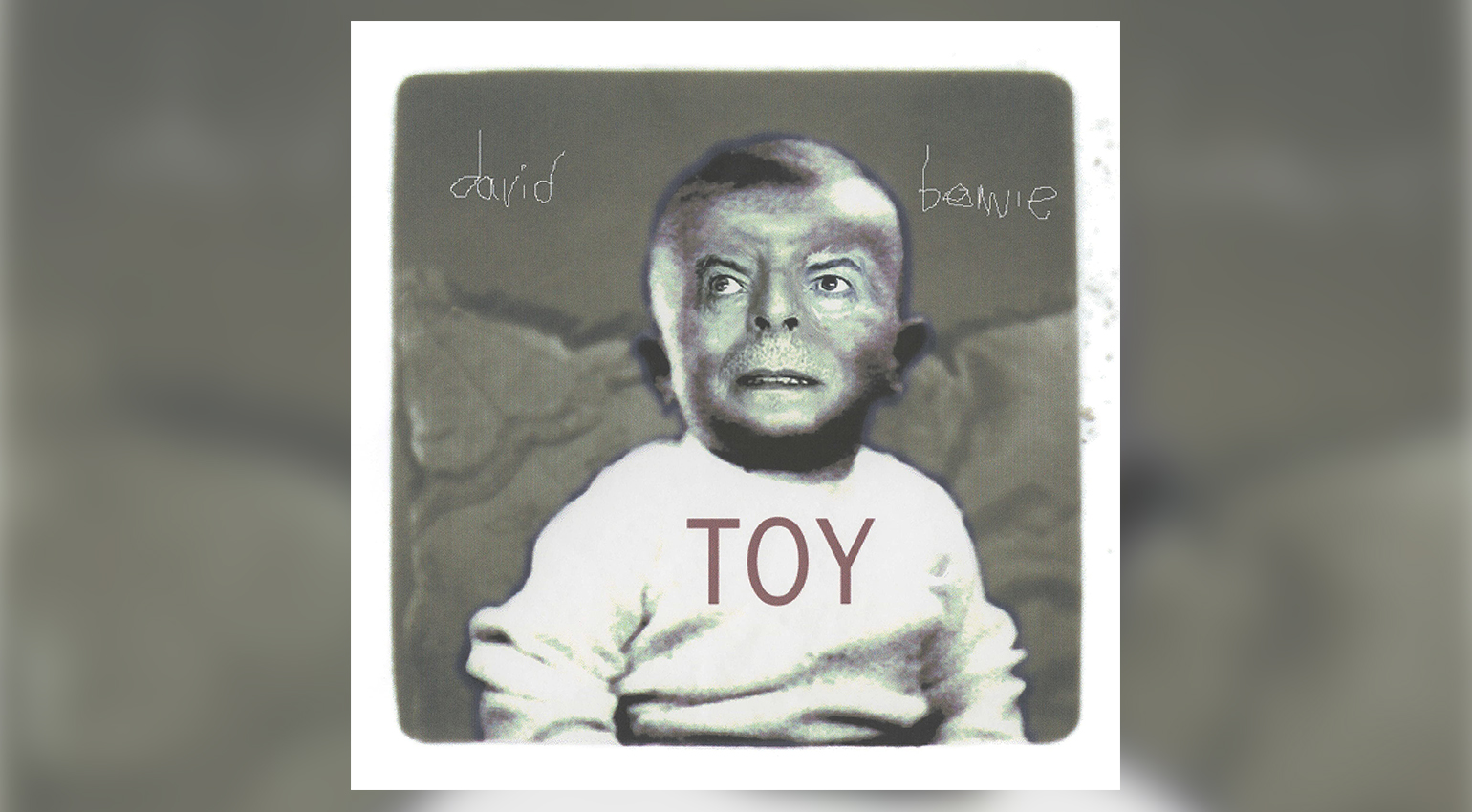
David prepared a five-year plan before he died, so many of the decisions made about these reissues were made by the great man himself. One controversial issue was the cover of ‘Toy’, a shelved album from 2001. Bowie had this idea in 2000 to record an album very quickly, live in the studio, and then release it almost immediately.
EMI didn’t like this, and their decision to shelve it caused David to leave the label. It subsequently got leaked some years later, but David’s wish for it to be released properly was granted posthumously two decades later in 2021. The image on the front cover was David’s own choice, but fans hated it. That said, ‘Toy’ lived up to the hype and is a worthy addition to his legacy.
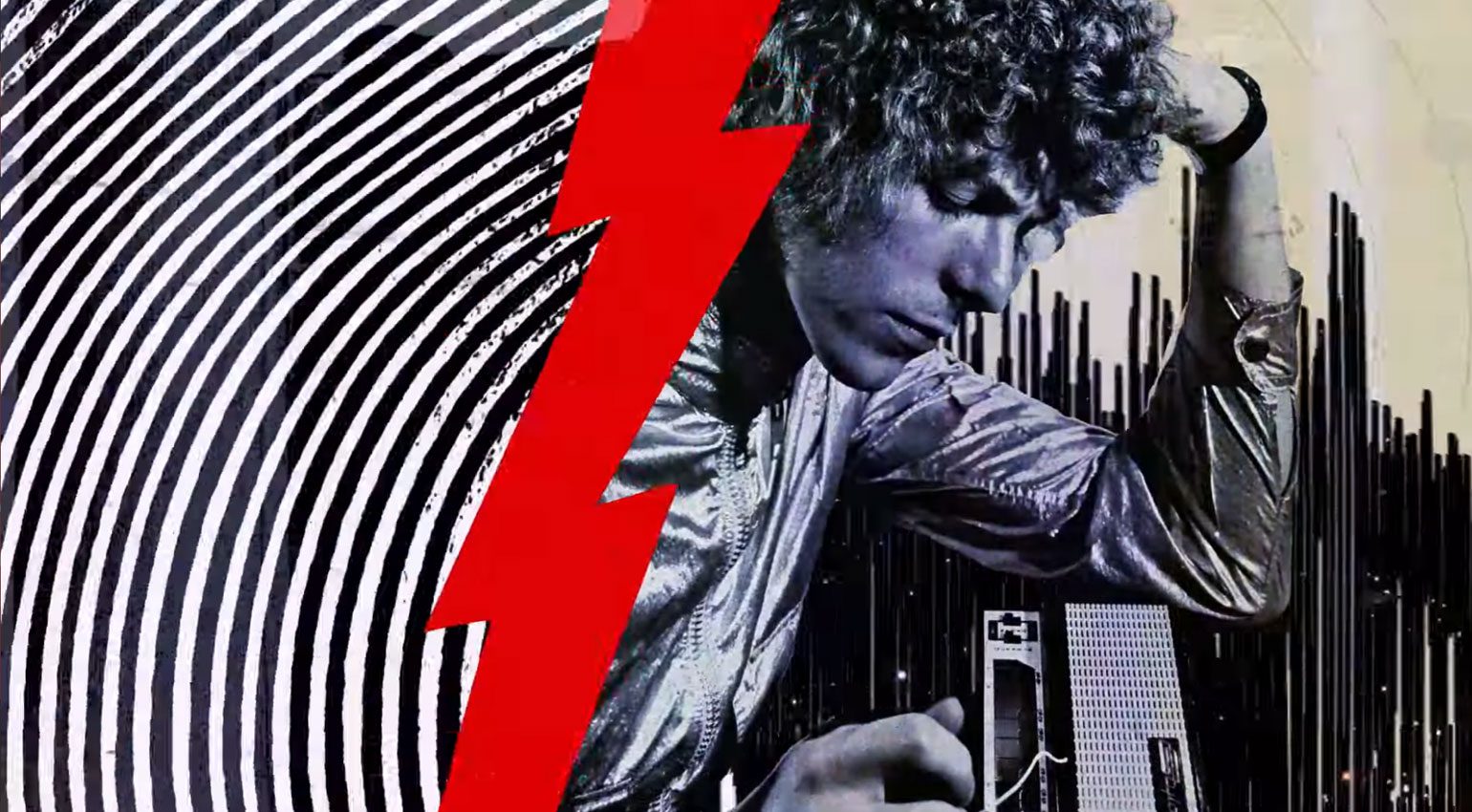
There have been numerous box sets and compilations over the last 10 years. Most notably, the “eras” box sets, of which there are six. Each covers a segment of his career with remastered albums, new compilations, live albums and huge selections of b-sides, rarities and demos. These haven’t been cheap, especially the vinyl versions, nor have they been completely definitive, but they are very well produced and representative of his multi-faceted musical career.
Even much-maligned albums like ‘Never Let Me Down’ have received improvements, courtesy of the freedom that these box sets afford. Bowie repeatedly acknowledged that this album was a creative low point, and often expressed an interest in revisiting it, especially after forming a working relationship with Reeves Gabrels.
In 2018, as part of the ‘Loving the Alien – (1983-1988)’ box set, his wish was granted when large parts of the album were re-recorded, laying David’s original vocals on top. Far from being a record label folly, this was all part of Bowie’s posthumous plan, as he even hand-picked the musicians for this re-recording. Out went the synths and drum machines, replaced by real strings and Sterling Campbell on drums.
Other great releases include in-depth collections around a single album, such as ‘Rock ‘n’ Roll Star’, a collection that focuses on the infamous Ziggy era. Similarly, ‘Divine Symmetry’ dwelled on the ‘Hunky Dory’ era. These contain demos, alternate takes, radio sessions and provide excellent context around a single album. More of these please!
There have, of course, been numerous documentaries, some better than others. The standout one so far is ‘Moonage Daydream’, a highly celebrated 2-hour+ retrospective using a lot of previously unseen footage, a lot of which came from Bowie’s personal archive.
Many books have been written on the man and his life. Two of my favourites are by Paul Morley, ‘The Age of Bowie’ and ‘Far Above the World’. There have been many exhibitions, both in New York and at the V&A in London. Then, of course, there is Lazarus, the stage musical that Bowie developed shortly before his death, which went on to receive mixed reviews. I saw its opening night in London and thoroughly enjoyed it!
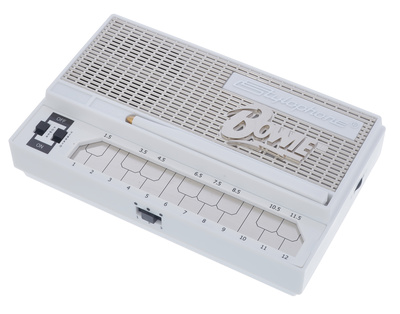
There’s even been a Bowie-badged Stylophone release! Bowie was never particularly synonymous with a particular instrument, other than the saxophone which always featured in his work, here and there. But the use of the Stylophone in ‘Space Oddity’ stuck, forever marking this cheap analog synth as an all time classic!




The world’s continued fascination with David Bowie and his work will continue for a very long time. In fact, as I alluded to earlier, I am certain he will be celebrated with the classical greats of the arts for many decades and centuries to come. Even before his untimely passing, he transcended the pop world that most know him for. His influence and impact will continue to resonate and be felt for a very long time.
And how relevant and wonderful was it that the final track on the biggest TV show in these past 10 years, Stranger Things, was ‘Heroes’, a show that started the same year that Bowie passed. That track was always linked with the show after the Duffer Brothers decided to use Peter Gabriel’s moving and powerful rendition from his album, ‘Scratch My Back’ to close Episode 3 of Season 1
They repeated its use at the end of Season 3 and then used David’s original for the extended end credits at the end of the overall finale, watched by millions on New Year’s Day 2026. Still powerful, still relevant and still recognised the world over.
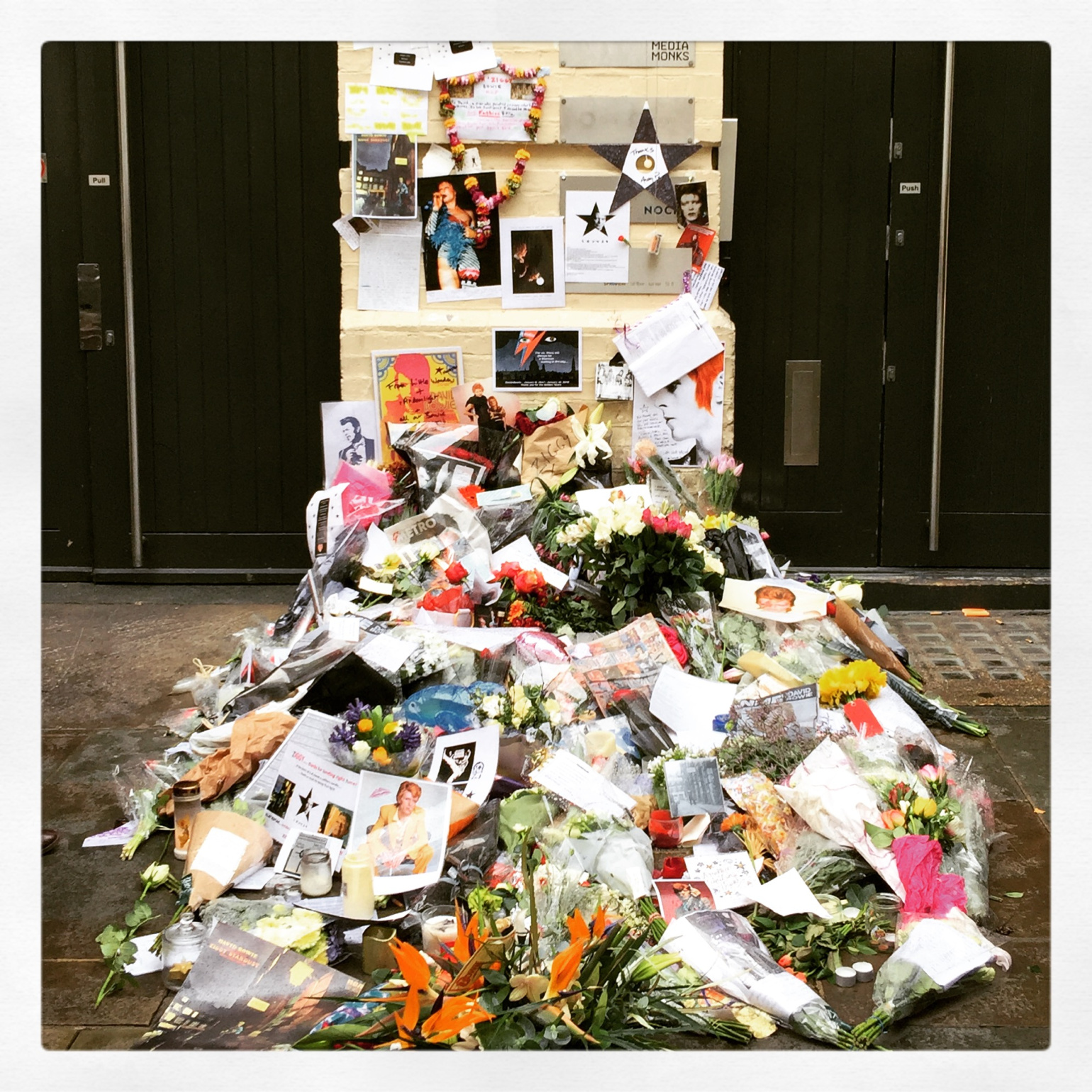
Shortly after January 10th, 2026, I was in London for the premiere of my friend Mark Reeder’s film, ‘B: Movie: Lust & Sound in West Berlin – 1979-1989‘, and I had a few minutes to spare, so I walked over to Heddon Street where the famous image of Bowie as Ziggy was shot. It had been turned into a small memorial and was festooned with flowers, images and written tributes.
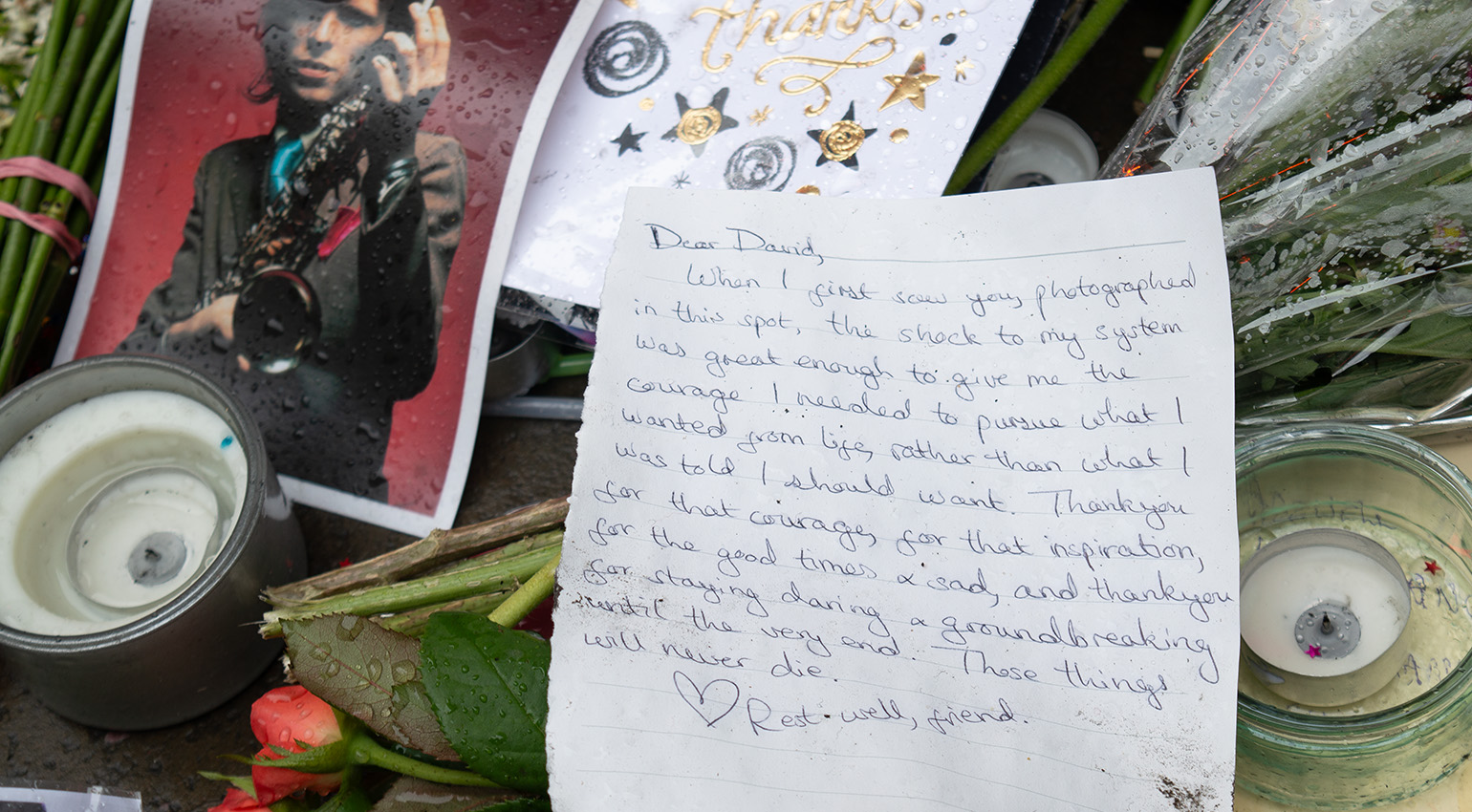
It was quite the moving experience, and what struck me was the wide range of mourners that were gathering, sharing thoughts and consoling each other. There were kids whose only experience of Bowie may well have been his last two albums. It was sombre, but it felt right to be there.
Back at the ICA that evening, much of the conversation was of Bowie, not least because the film being shown was about a time in Berlin, post-Bowie’s residency there, and the news was fresh in our minds. I sat with Neil Tennant for a while, and we shared our memories of how Bowie had impacted our lives.

His passing still resonates, but there’s something odd about it. I think it has to do with the fact that, for 10 years or so, he basically vanished, choosing to spend time with his family and being a Dad. And then, out of the blue, he was back in our lives and then snatched away.
We had made peace with the fact that he had chosen to step away, but he was always still there, which was comforting. So that last burst of creativity, cut cruelly short by illness, had so much more impact. Just like his life and career, he retained complete control. He didn’t just create works of art. He was one.
Dave
Finally, I wanted to maybe create a playlist of my favourite Bowie tracks, but there was no way I was ever going to create something fitting enough. I honestly wouldn’t know when to stop. However, this tribute, in both sound and vision, by Radio Soulwax (aka the Dewaele brothers, who are also known as Soulwax and 2ManyDJs), was made 3 years before his passing.
It’s a wonderful homage to David’s work, not only under his own name, but the work he did for others. A solid hour of David’s music, mixed and mashed to perfection with an incredible video to match. If, like me, you’re struggling to choose what to listen to, to remember David on this sad anniversary, such was the depth of his oeuvre, this may well satisfy your needs…
Thank you, David. The world owes you everything, you beautiful human being.
More Information
*Note: This article contains advertising links that help us pay for this site. Don’t worry: the price for you will always be the same! If you buy something through these links, we will receive a small commission. Thank you for your support!

This might also interest you