The 7 Best UniVibe Pedals in 2026 for Every Budget: Beyond Hendrix and Gilmour
Not a chorus, not a vibrato, but both and something very different, too!

 3,8 / 5,0 |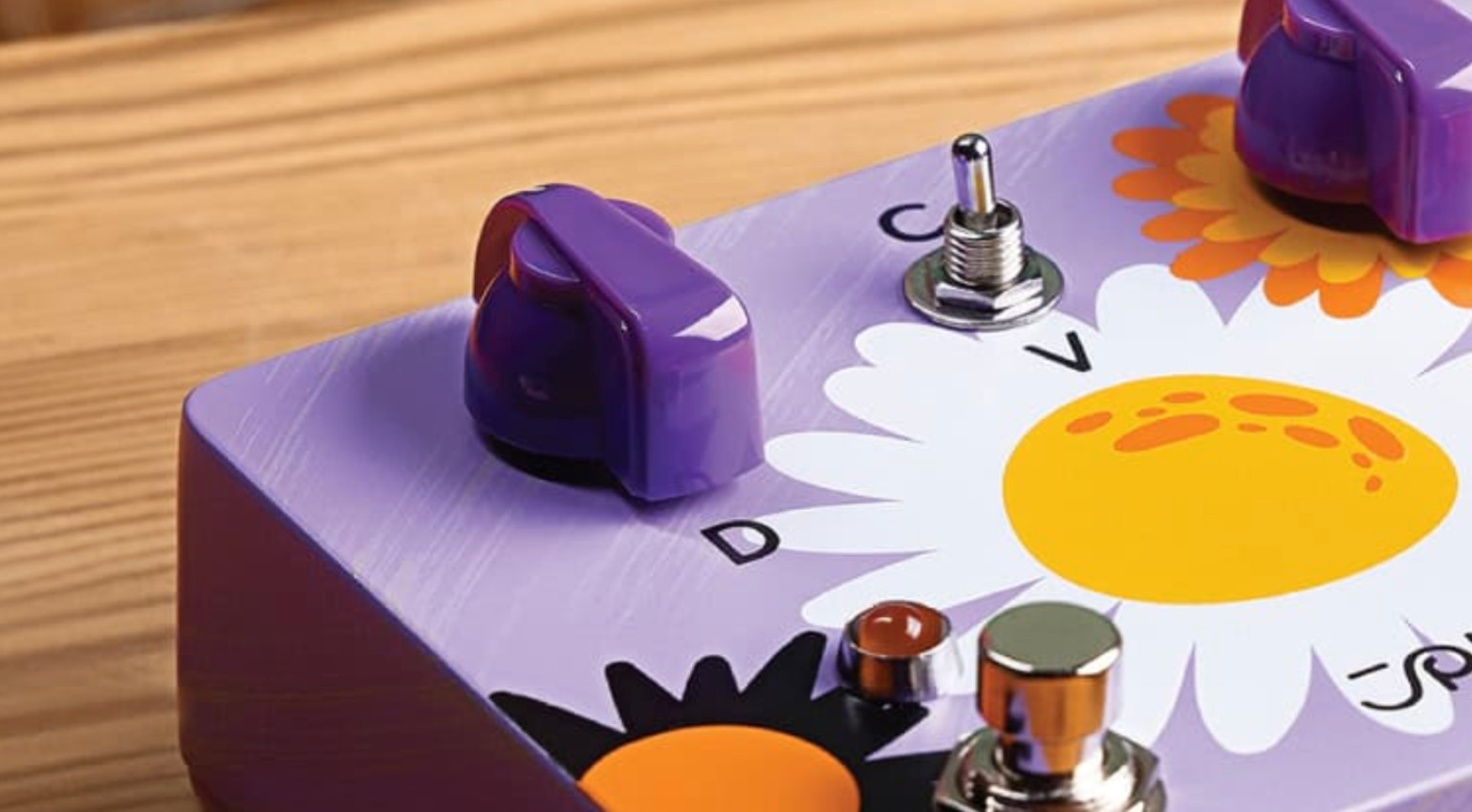
The 7 Best UniVibe Pedals in 2026 for Every Budget: Beyond Hendrix and Gilmour · Source: Jam Pedals

The best univibe pedals of today will give the psychedelic swirl of yesterday. Made famous by one Jimi Hendrix, univibe pedals can be much more than what he used them for, sonically speaking. We’ve picked the seven best pedals for every budget.
Key Takeaways
- An analog Uni-vibe pedal is a phase-shifting modulation effect built around a light bulb and photocells. Sitting between chorus and phaser, it produces the watery, throbbing swirl heard on Hendrix, Pearl Jam, and Pink Floyd records.
- There are three types of circuit: true photocell (the most authentic), JFET analog (stable and budget-friendly), and digital (the cheapest and most flexible).
- Jim Dunlop now owns the Uni-Vibe name, which is why almost every other pedal maker sells a ‘Vibe Machine’, ‘Good Vibes’ or ‘RetroVibe’ instead.
- Best all-rounder: MXR M68 Uni-Vibe. It’s the most common vibe on pedalboards and the only one here that legally carries the Uni-Vibe name.
- The best boutique vibe is the DryBell Vibe Machine V-3: compact and endlessly tweakable, it is the favorite among players on forums who want that sound.
Our Picks for Best Univibe Pedals
The Best UniVibe Pedals: From Hendrix to Today
The UniVibe pedal is something of a happy accident. In the late 1960s, the Japanese company Shin-ei (then trading as Honey) created a modulation effect pedal designed by engineer Fumio Mieda. The common myth is that it was intended to imitate the sound of a rotating Leslie speaker.
However, Mieda later corrected this, stating that the effect was actually inspired by the sound of radio signals drifting in and out of phase under atmospheric modulation. American company Univox soon acquired the rights to the pedal and released it in North America in 1968 as the Uni-Vibe. While it never quite captured the Leslie sound, it produced something else entirely and much better: a staggered, asymmetric swirl created by an incandescent bulb pulsing against light-dependent resistors.
This circuit was adopted by some of the most famous players almost immediately. Jimi Hendrix placed it at the end of his effects chain, and his live performance of “Machine Gun” with the Band of Gypsys remains the definitive example of what a Uni-Vibe pedal can achieve. David Gilmour used it on Pink Floyd’s “Breathe” from The Dark Side of the Moon, setting the speed low so the pulse never got in the way.
Later, Pearl Jam’s Mike McCready popularized the sound during the grunge era with the solo on “Alive” (with a Dunlop Rotovibe).
What to Look for When You’re Shopping for the Best UniVibe Pedals
The most important distinction is the type of circuit. True photocell designs use an actual light bulb and light-sensitive resistors, just like the original models, to produce that uneven, pulsating throb which distinguishes a vibe from an ordinary phaser. By comparison, JFET-based analog pedals skip the bulb in favor of a more stable, cheaper build and come impressively close, purists can hear the difference.
Overall, digital modeling is the most affordable option and often adds stereo and presets, albeit at the expense of some organic feel. When looking for the best Univibe pedals, check the modes too: most pedals offer Chorus (dry blended with the modulated signal) and Vibrato (wet only, a pitch warble that’s used far less). If a pedal only has one mode, it will almost certainly be chorus.
After that, it comes down to how you play. Tap tempo is rare on vibes, but can a genuine advantage live if the effect is more pronounced. And expression control lets you ramp the speed with your foot, Hendrix-style. Finally, a point most buying guides skip entirely: your amp matters more than you think. Those classic records were cut through loud 100-watt amps, and a vibe that sounds flat through a small practice amp can come alive through a cranked one.
Let’s check out our seven picks for the best univibe pedals!
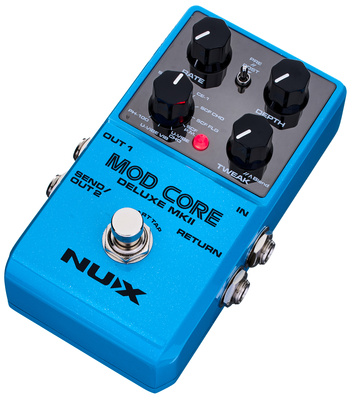
Nux Mod Core Deluxe MKII
I usually try to stay clear of full-on modulation effects for these lists that do phaser, flanger, and chorus all in one. It’s just easier to differentiate. But for the best univibe pedals, I had to include quite a few of these, because otherwise, this would have been a pretty short list.
Let’s start with the Nux Mod Core Deluxe MKII. It’s the most affordable pedal on this list; it offers not one, but two “U-Vibe” modes, and another six modulation effects. For less than 100 euros. If you want to get started in the world of UniVibe, this pedal might be one of the best univibe pedals on the market, as you get to explore other modulation effects as well!
Check it out at Thomann*.


Nobels MOD-mini
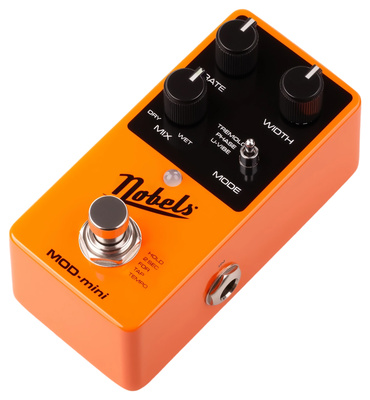
Don’t be fooled by its small size. In terms of sound quality and “analogue-ness”, the MOD-mini is up there with the big guys. You get the “pulsating tremolo of the swinging ’50s, the funky phaser and U-Vibe grooves of the ’60s” all in one tiny orange, pedalboard-friendly box.
Nobels have also posted knob sheets on the pedal’s product page, so you’ll have an easy way to dial in just the right settings for your uni-vibes. Oh, and did I mention you can use this little beast in full stereo? For this price, it’s definitely one of the best univibe pedals on the market.
Buy it from Thomann*.

MXR M68 Uni-Vibe
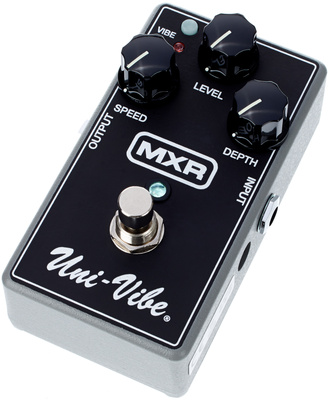
The MXR M68 is the univibe pedal you will most likely see on the boards of famous players, from Mike McCready to Zakk Wylde. For most univibe fans, it is the obvious first choice among univibe pedals. It runs on a JFET analog circuit rather than a true photocell design — a fact that purists are quick to point out — but MXR made this design choice deliberately: the pedal is compact, robust and extremely simple to use, with just a Speed knob, a Level knob, a Depth knob and a Vibe switch for Chorus/Vibrato.
For reliability, size, and value, other univibe pedals can touch it, and it pairs beautifully with overdrive and fuzz. If you only want one univibe pedal and don’t want to overthink it, this is the safe pick. A definite must on any list of the best univibe pedals.
Available at Thomann*.

Electro Harmonix Good Vibes Univibe
The EHX Good Vibes offers a genuine bulb-driven photocell circuit at an affordable price. This versatile effect covers both chorus and vibrato, and features a volume control to keep you at unity gain. It also takes an expression pedal, allowing you to sweep the speed with your foot.
For most players chasing an authentic photocell throb on a budget, this pedal lands in the sweet spot between the JFET-based MXR and true boutique units.
Buy the pedal at Thomann*.

JHS Pedals Unicorn V2
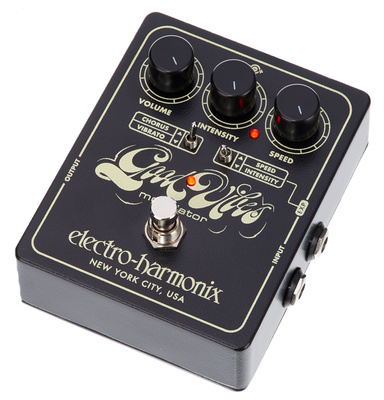
The Unicorn’s headline is a genuine first: a fully analog, bulb-driven photocell univibe with tap tempo, which was pretty much unheard of until JHS made it. Add a Ratio knob (quarter notes, dotted eighths, triplets) and an expression input, and it’s one of the most gig-flexible photocell vibes on the market.
If you play live and want tempo-synced swirls without a laptop or MIDI clock, the Unicorn V2 is one of the best univibe pedals on the market.
Check it out at Thomann*.

DryBell Vibe Machine V-3
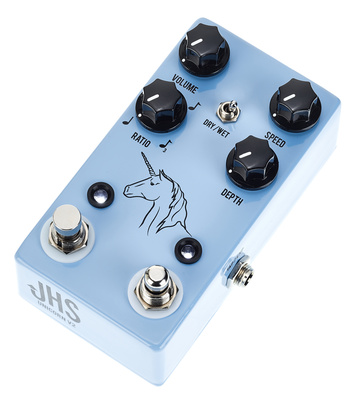
The V-3 blends into your tone rather than scooping it out. For over a decade, DryBell’s team has been chasing one thing: the best possible Uni-Vibe in the smallest possible box. The result is barely larger than the M68, yet it packs in an actual bulb, Chorus/Vibrato modes, three voicings (Original, Bright, and Custom), tap tempo, expression and footswitch support, and Leslie-style fast and slow ramping.
The side trimmers are factory-set, making them plug-and-play straight out of the box. These trimmers are also the reason why it handles fuzz better than almost any other effect pedal. If you’re looking for a hassle-free boutique vibe that fits any board and offers a genuine Uni-Vibe experience, this is the one all others are measured against, a worthy contender on our list of the best univibe pedals.
Available from Thomann*.

JAM Pedals Retrovibe mk.4
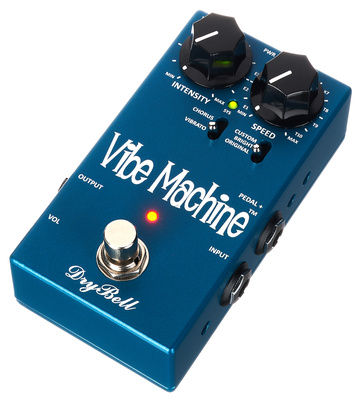
The hand-built, Greek-made RetroVibe Mk.4 is the boutique pick that trades vintage-circuit purism for control and features, and it belongs on any list of the best univibe pedals. IAs version 4 dropped the optical bulb of earlier iterations, it runs a touch more phaser-leaning than the classic bulb-driven throb. For controls, you get Depth and Speed, a Chorus/Vibrato switch, an internal volume trimmer, a 10k expression input, and a dedicated tap-tempo footswitch with a press-and-hold ramp for Leslie-style speed changes.
It’s the priciest pedal in this guide, but what you’re paying for is the build, the warmth, and the tap/ramp feature set.
Order this Univibe pedal at Thomann*.
Conclusion on the Best UniVibe Pedals
Now that we’ve presented our seven picks for the best univibe pedals, it’s your turn:
Which univibe is on your board? And did we leave your favorite off the list? Tell us in the comments below.
FAQ on the Best UniVibe Pedals
What is a Univibe pedal?
A univibe pedal in its original form is a modulation effect that uses a pulsing light bulb and photocells to create a series of staggered phase shifts. The result is a watery, throbbing swirl that sits between chorus and phaser. It was designed in the late 1960s and made famous by Jimi Hendrix.
Photocell, JFET, or digital: which one is the best?
True photocell circuits (EHX Good Vibes, JHS Unicorn, JAM RetroVibe, DryBell) give the most authentic, uneven throb. JFET analog (MXR M68) is stable, cheaper, and gets close. Digital is the most flexible and affordable. Your amp and how loud you play affect the sound as much as the circuit does.
Is a Univibe the same as a chorus or a phaser?
No. Technically, a univibe is a type of phase shifter, but its uneven, asymmetric staging gives it a throb that a standard phaser or chorus doesn’t have. Most univibe pedals offer a Chorus mode (the classic sound) and a Vibrato mode (a pitch-warble that’s used far less).
Where does a Univibe go in the signal chain?
A common starting point is after your fuzz/overdrive and before delay and reverb, but Hendrix, for example, ran fuzz into the Uni-Vibe for that snarling, vocal texture.
*Disclaimer: This post about the best univibe pedals contains affiliate links and/or widgets. When you buy a product via our affiliate partner, we receive a small commission that helps support what we do. Don’t worry, you pay the same price. Thanks for your support!

This might also interest you