Cherry Audio SH-MAX Celebrates Roland’s 70’s ‘SHuper SHynths’!

 3,7 / 5,0 |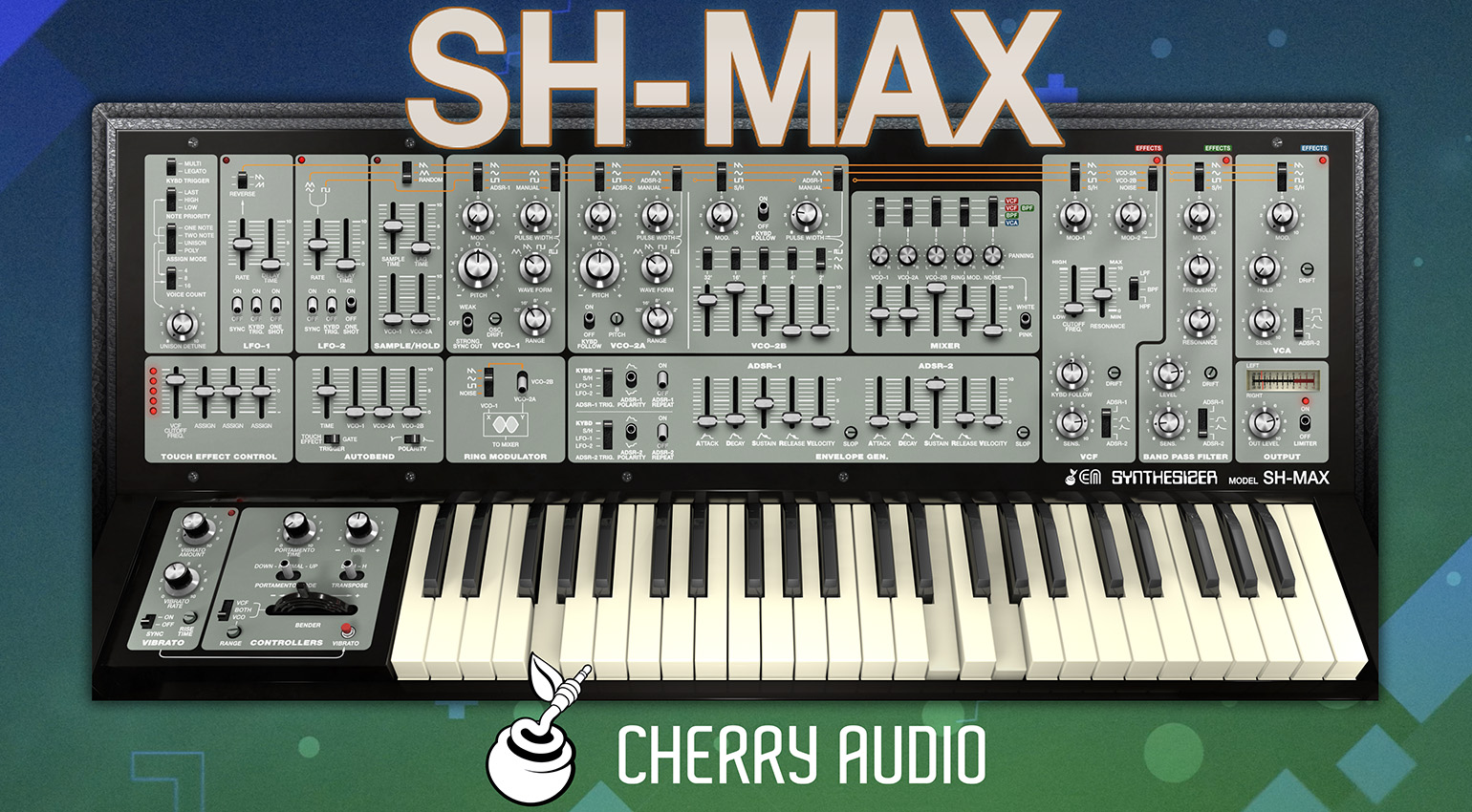

Cherry Audio’s SH-MAX celebrates the often-overlooked SH range of synths with not one, not two, but three ‘clasSHics’ represented in one instrument!
Cherry Audio SH-MAX Highlights
- Combines the SH-3A, SH-5 and SH-7 for a ‘SHuper SHynth’!
- Five sound sources
- Multimode filters and a separate, dedicated bandpass filter
- 20 studio quality FX
- Tempo syncable LFOs and two ADSR EG’s with velocity and loop options
- Model 104-style sequencer
- Polyphonic Aftertouch capable
- User-swappable interface designs
Cherry Audio SH-MAX – What’s it All About?


Some Background
Ok, I promise to stop with the Sean Connery pronunciations, but as soon as the SH-MAX landed in my inbox, I began debating whether to refer to it as SHMAX or ESS-AITCH MAX. The former is way more fun but gets annoying after a while. So I ‘promish to shtop’.
Roland’s SH range of synths evolved from the SH-1000 and SH-2000, which were Roland’s first two synths in their history, to the SH-3 in 1974 and the SH-5 two years later. It would be another two years after that till we saw the SH-7.
The SH-7 was an evolution of the SH-5, with the SH-3 being more of an evolution of the original SH-1000. But all three of these instruments stood out because of the use of Roland’s distinctive filters. The 5 and 7 also had a useful ‘sit-up-and-beg’ style user interface.
SH-MAX
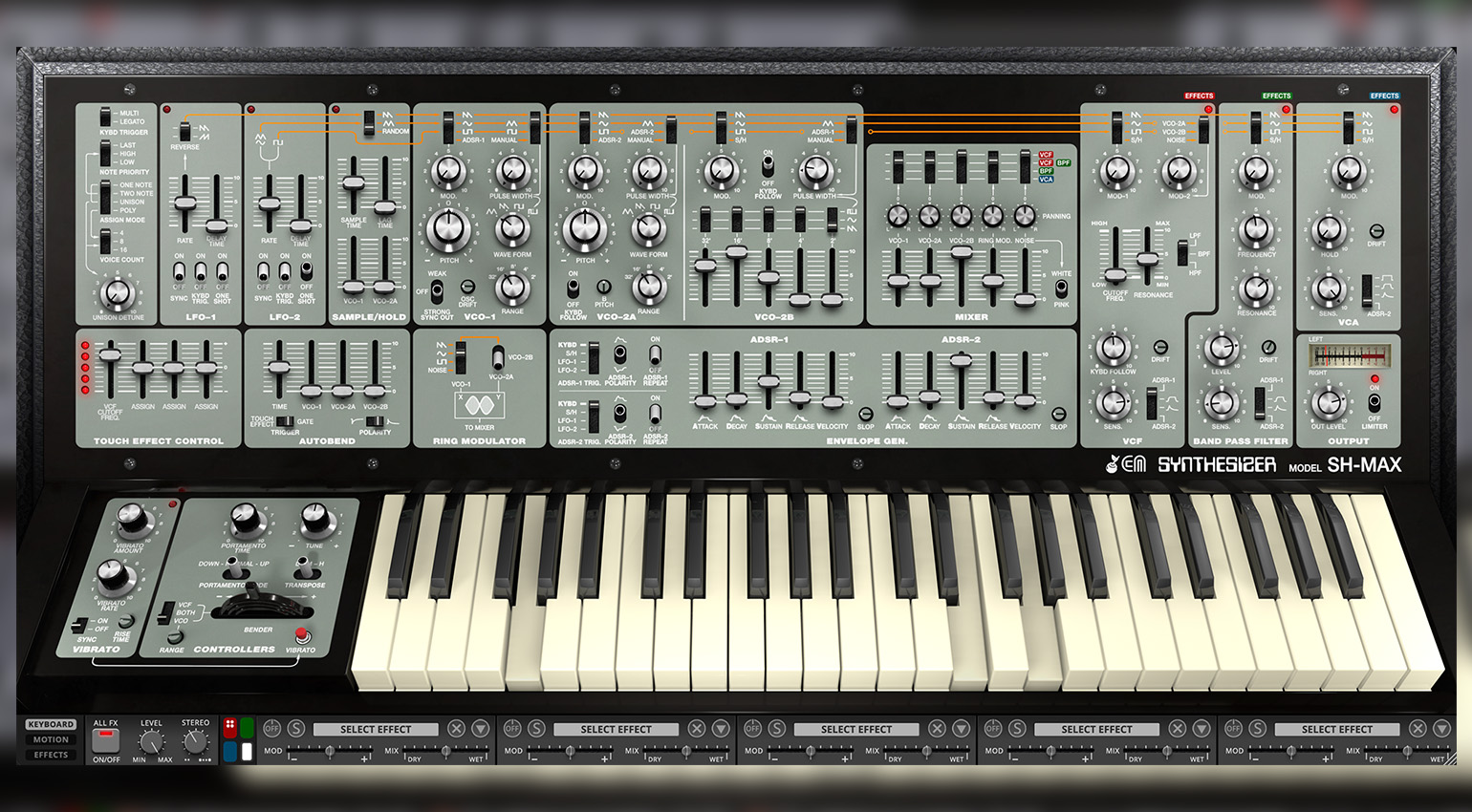
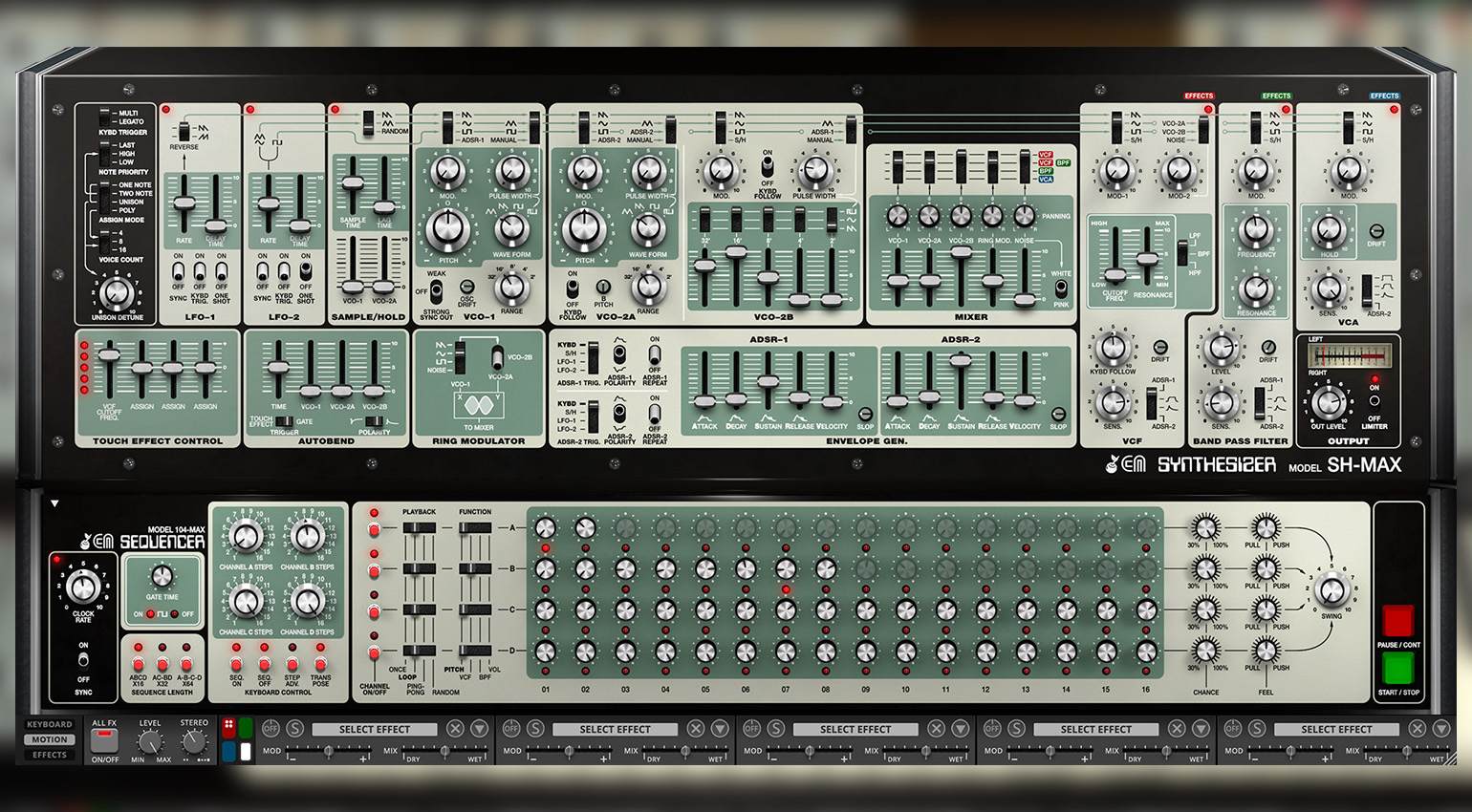
Rather than pick just one of these to emulate, Cherry Audio have blended all three into SH-MAX with the SH-5 being the central focal point, around which the differences found in the 3 and 7 have been added. So SH-MAX benefits from the 5’s dual oscillator, dual LFO set up, along with its much-loved parallel filters, ring modulator and sample and hold.
They’ve thrown in the autobend, filter FM, duophony and syncable VCOs with variable waveforms from the SH-7 and then shoehorned the unique additive-style oscillator from the SH-3 in there, so it really is the best of all worlds.
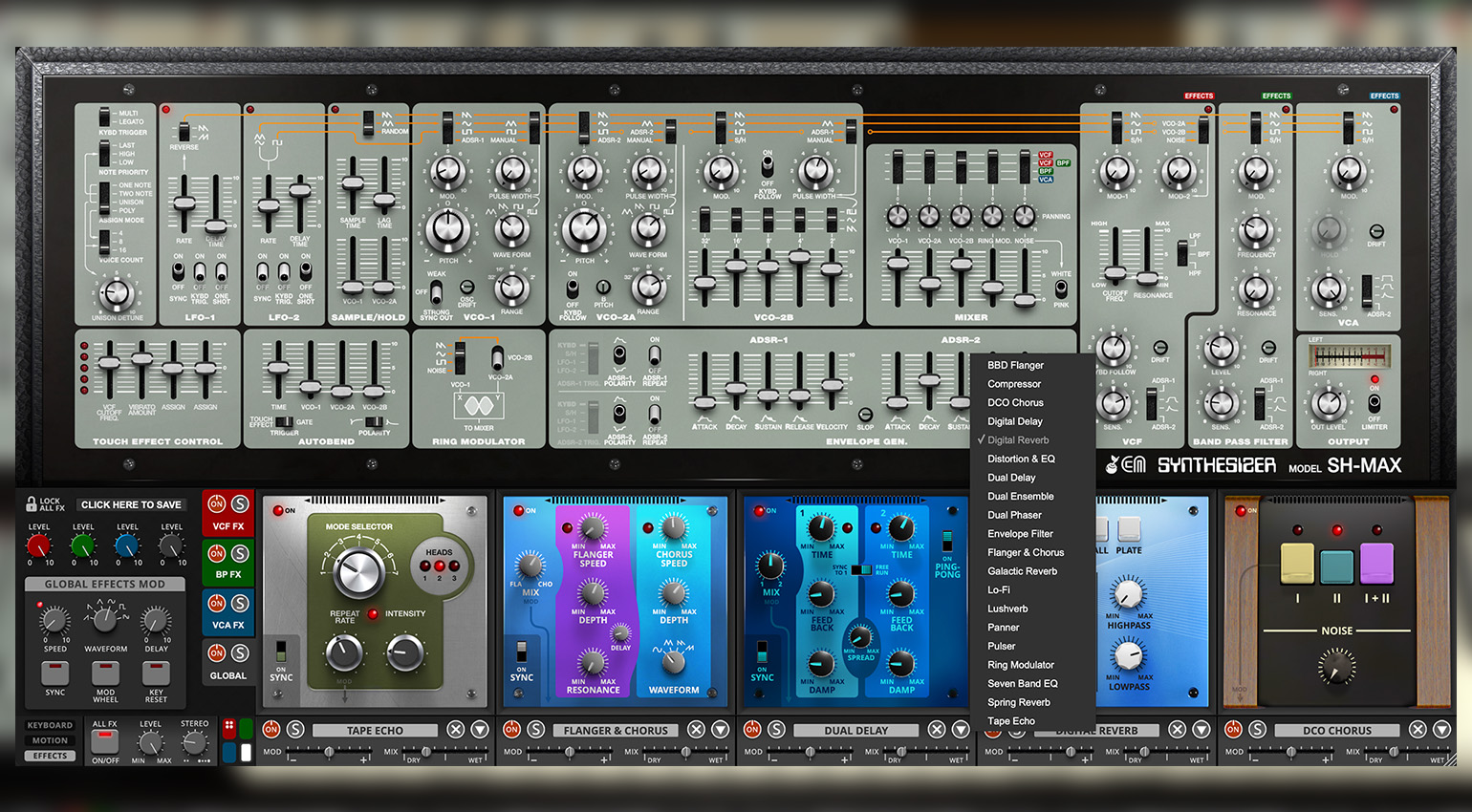
And as if that wasn’t enough, there’s a wealth of FX that share the same ability as those found in their Trident and Mercury-8 to be shared as chains between the synths. Plus there’s a sequencer based on the System 100 Model 104 and some of the SH-2000’s expression capabilities. It really is a ‘greatest hits’ compilation of that incredibly fruitful and inspirational time in Roland’s history.
Maximum Inspiration
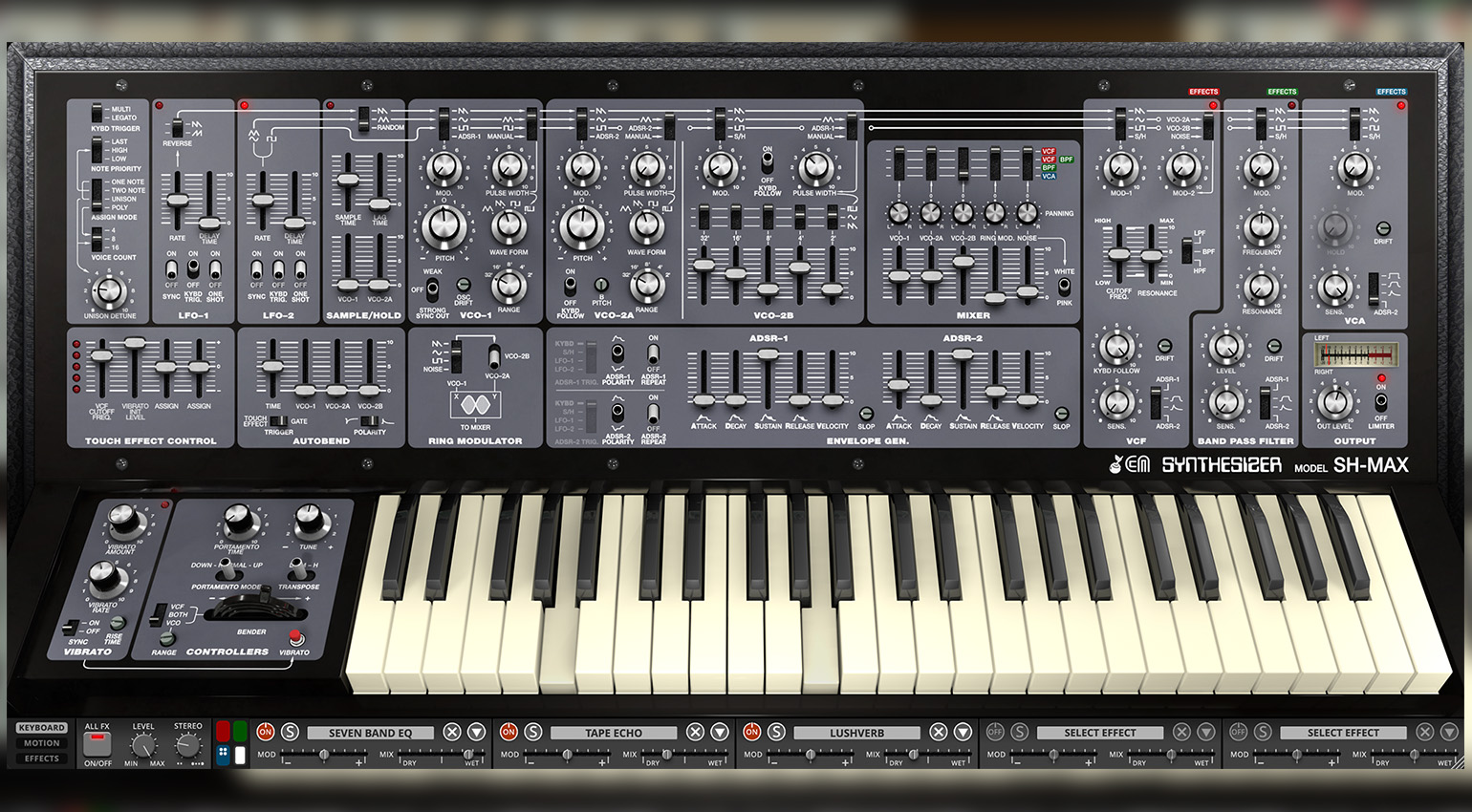
Of course, it wouldn’t be a Cherry Audio synth if it didn’t come with a whole host of present-day features and improvements. For authenticity, all the original mono and duophonic modes are there, but there are now also 16 voices of polyphony plus layers, splits and a speaker-blowing unison mode.
SH-MAX responds to polyphonic aftertouch, which can be assigned to a number of parameters. Almost every aspect of the synth can be assigned to automation, and the synth’s built-in sequencer is syncable as well as having the ability to send MIDI notes to your DAW’s timeline.
If you have a personal favourite of the three instruments emulated here, you can even choose from one of three panel designs that are designed in the style of each of them. SH-MAX comes with over 300 presets built in, and there’s a James Dyson bank available at launch that will give you 100 more for just $9.99.
Does SH-MAX Cut It?
Cherry Audio continue to deliver the unexpected with SH-MAX. They could have easily just focused on one of the instruments represented here, most likely the SH-5, but such is their passion for delivering maximum value, the addition of the key features of the SH-7 and SH-3A really makes this thing stand out.
They’ve very much captured the unique qualities that these particular synths originally delivered, features that make these instruments continue to be desirable to this very day. This period in Roland’s evolution is sometimes skipped over, and that’s a great shame.
So here we are, with a $59 plugin that not only nails those unique qualities of the originals, but goes above and beyond to do something that Roland has failed to do with their own Cloud offering. Cherry Audio are, once again, leading the way. How many more left-field synth options do they have left? I don’t know, but I’m very excited to find out.
Technical Requirements
SH-MAX is provided as a VST/VST3/AU/AAX plugin, as well as a standalone version. Mac users need macOS 10.13 or above, Intel or ARM and Windows users need Windows 7 or above.
More Information
Cherry Audio continues its seemingly relentless pursuit of providing amazing quality plugins at affordable prices, and SH-MAX is no exception. The SH-5/7 sound is really unique and very Roland, and it has not only been captured here, but the addition of elements from the SH-3 and SH-2000 makes this a definitive port of call for that sound.
Cherry Audio’s SH-MAX is available now for €59/$59.
*Note: This article contains advertising links that help us pay for this site. Don’t worry: the price for you will always be the same! If you buy something through these links, we will receive a small commission. Thank you for your support!

This might also interest you
2 responses to “Cherry Audio SH-MAX Celebrates Roland’s 70’s ‘SHuper SHynths’!”
Got an MS-5 (SH-5 clone) and it’s a truly glorious monosynth, but it’s heavy to carry. Might get these CA plugins just to copy the presets! The SH range are nearly all good, but the original synths are very expensive second hand and have no presets. So these 3 from CA are a steal if you’re into vintage mono sounds.
I bought the SH Max but not before trying the demo. On paper it looked great but the videos I saw didnt sit right with me. After an hour trying out patches and creating my own, I understood where my reservations originated. Many of the patches are soaked in FX. Dont get me wrong, the FX are fantastic and the way they can be added to separate components is great. However, the factory patches seemed to be about showcasing the FX, often at the expense of the underlying sound. It felt like overkill or trying too hard. There was no subtlety. I experimented turning down the FX a little, then a lot and instantly the synth sound shined thru. So, I created a couple of patches from scratch, adding small amounts of FX and again, it sounded great. I feel CA are doing themselves a disservice here and should consider dialing back on the FX. But thats just my opinion.