Roland n/vision Review: Vision for the Future or Late to the Party?
Compact Wavetable Synth in the Boutique Series

 4,0 / 5,0 |
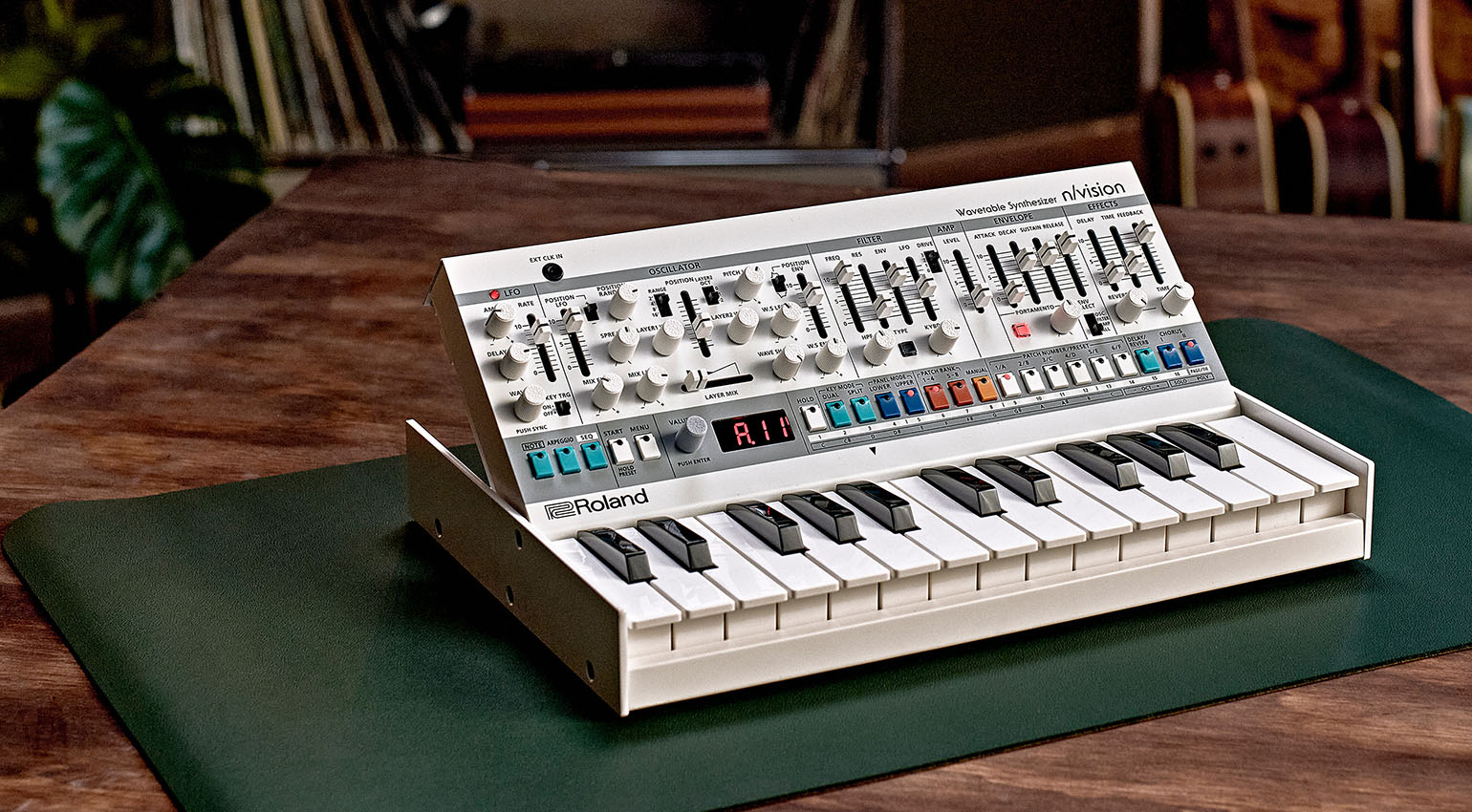


The new Roland n/vision is the company’s first true wavetable synth. Can the latest addition to the Boutique series hold its own against the competition?
Roland n/vision: Key Features at a Glance
- 56-voice wavetable synthesizer
- 2-part multitimbral
- 2 mixable wavetable layers, additional waveshaper
- 9 filter modes
- Versatile modulation options
- Polyphonic sequencer
- Built-in effects
- Includes K-25m keyboard dock
Roland n/vision Review
Roland n/vision in a Nutshell
The n/vision represents Roland’s vision of a compact wavetable synth. A member of the Boutique series, the tiny synth delivers a wide spectrum of unapologetically digital wavetable sounds, which is a very welcome expansion of Roland’s mostly traditionally oriented synth lineup. I liked that the n/vision provides plenty of hands-on control. The built-in effects and the polyphonic step sequencer are also big pluses. Editing extended parameters via the menu, however, is no fun and takes lots of patience. All in all, the price also seems quite ambitious, especially when compared to the competition.
The Roland n/vision is now available from our affiliate partners Thomann* and Sweetwater*.


n/vision: Roland Embraces Wavetables
Roland hasn’t exactly been known as a specialist in wavetable synthesis until now. It was only three years ago that the Japanese company released its first synth featuring wavetables, the GAIA 2. A bit later, the synthesis method also found its way into the versatile SH-4d. In both of those synths, however, wavetables seem more like an afterthought or a nice bonus, while other synthesis methods take center stage.
That said, the continued popularity of wavetable synthesis has, of course, not gone unnoticed by Roland. With the n/vision, the manufacturer now presents its first “true” wavetable synth. And it seems a bit as if they’re testing the waters: the n/vision is part of the compact and (so far) comparatively affordable Boutique Series.
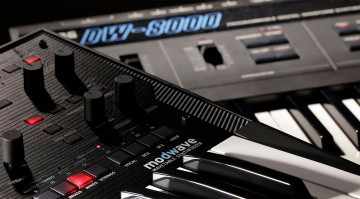
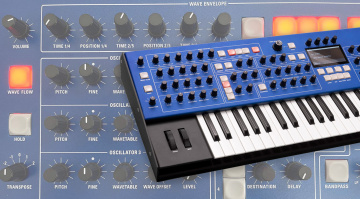
“Affordable”, however, is relative, because the n/vision is quite a bit more expensive than previous Boutique instruments. In this price range, it also faces stiff competition from established synths like the KORG modwave and the Modal Argon8. The Waldorf Protein even costs less than half as much as the n/vision. What has Roland come up with to make the synth worth that much money? That’s the question I had in mind when I started working on this review.
Roland n/vision: Boutique Wavetable Synth
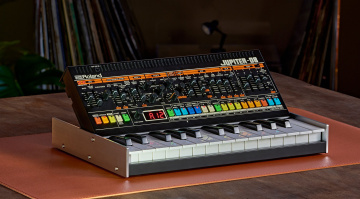
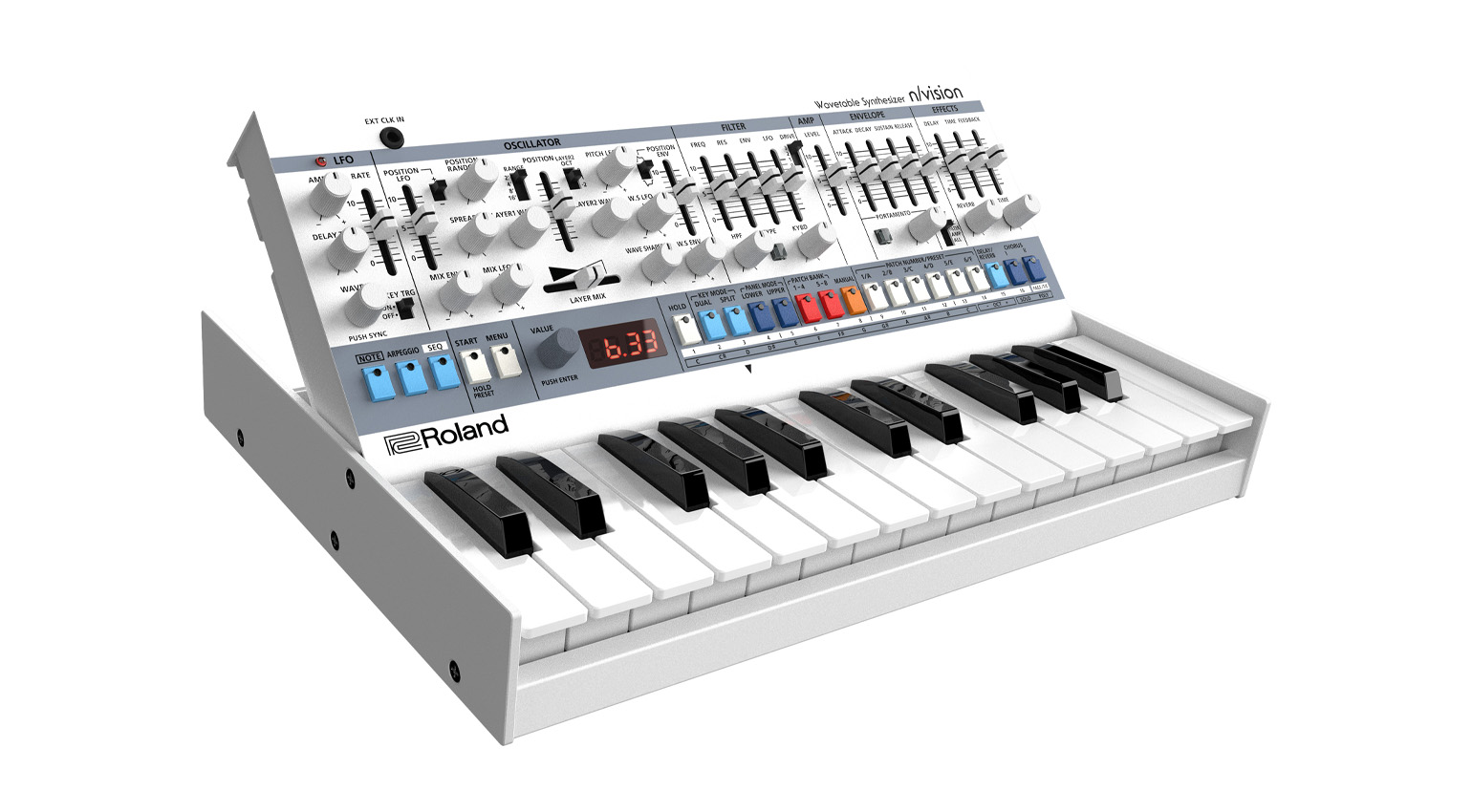
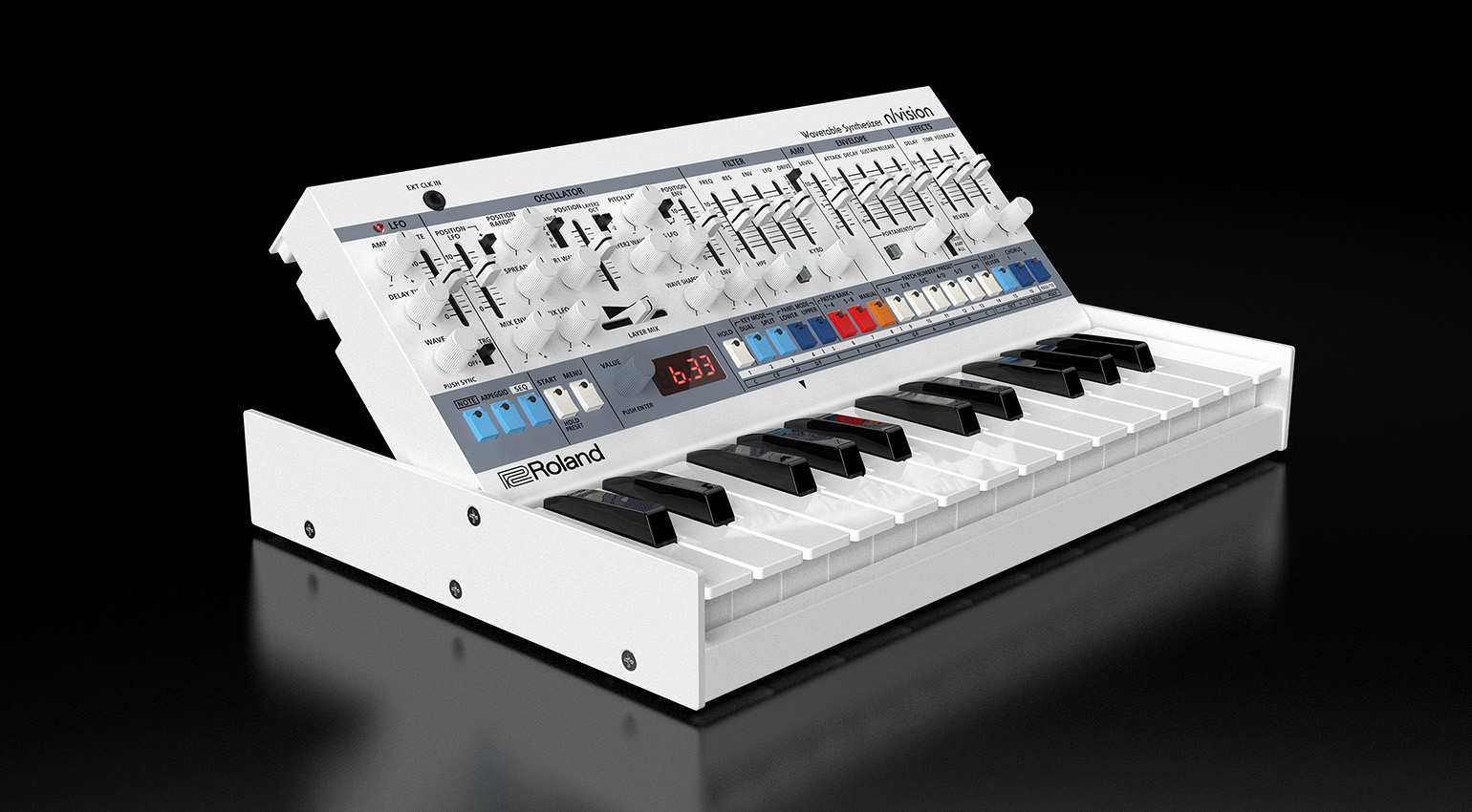
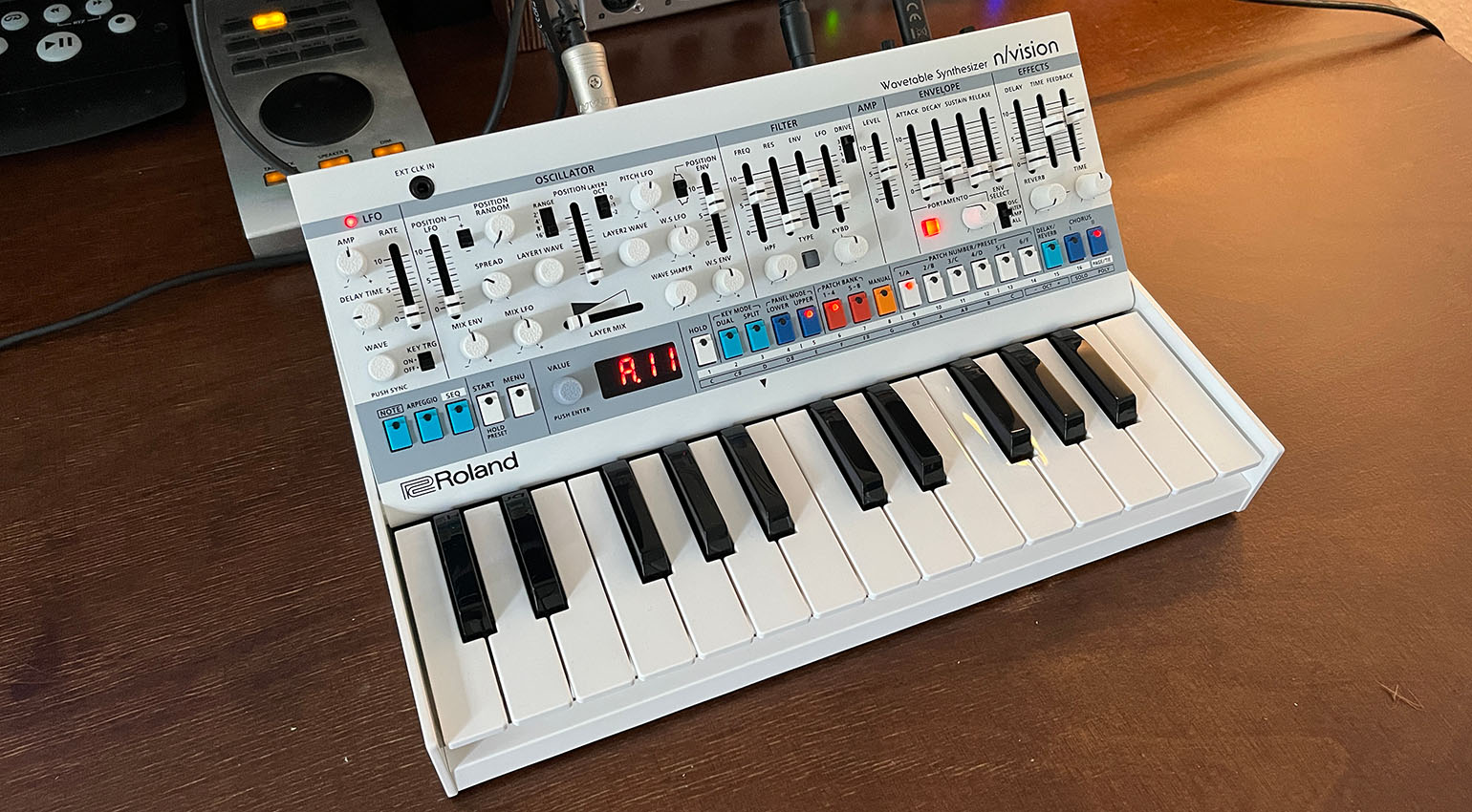
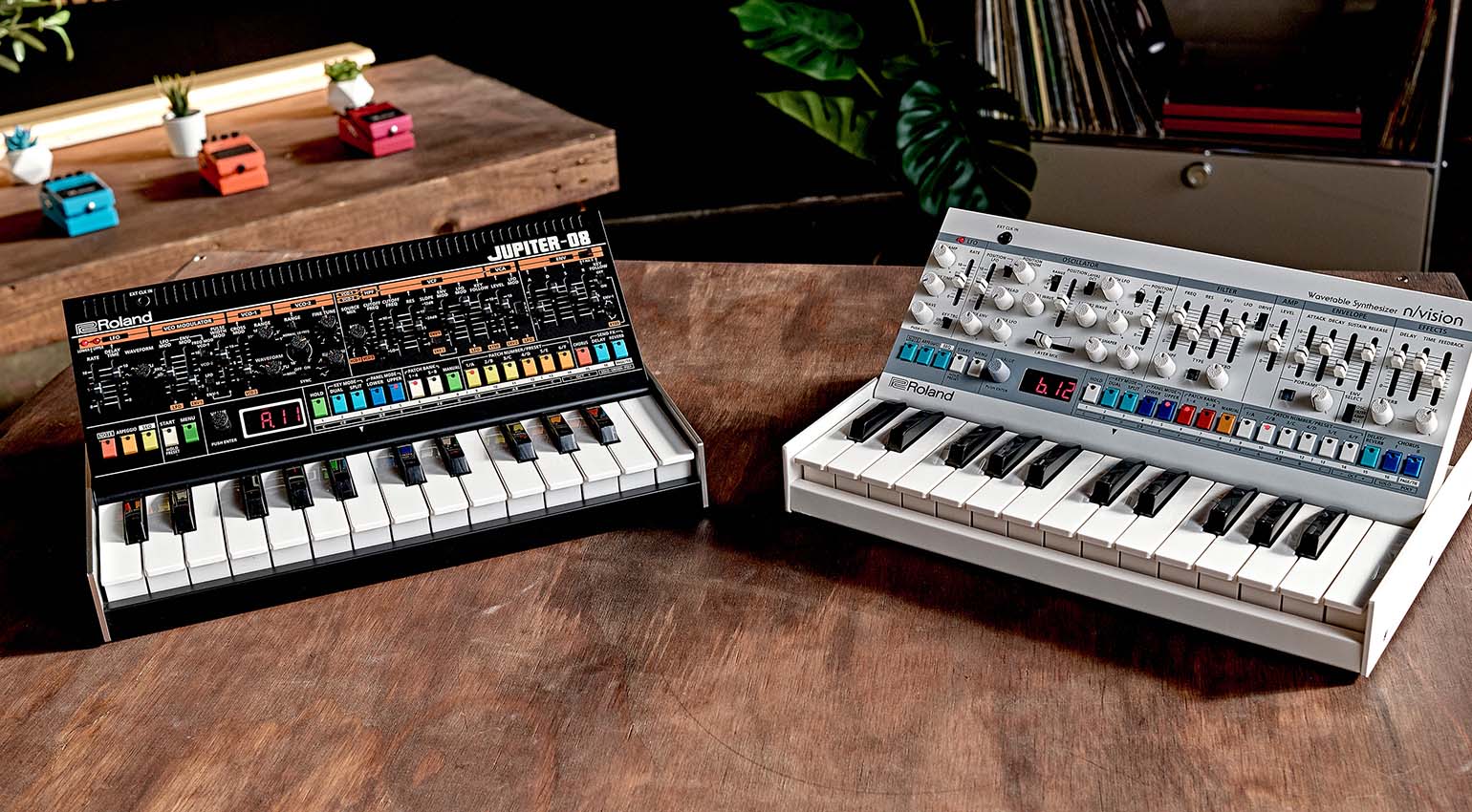
As a member of the Boutique Series, the n/vision shares the cute form factor with the new Jupiter-08 and previous Boutique models. However, its eye-catching bright paint job immediately screams “I’m different!” Rather than being a reissue of an old classic, it’s meant to convey a vision of the future and take the Roland sound into new realms.
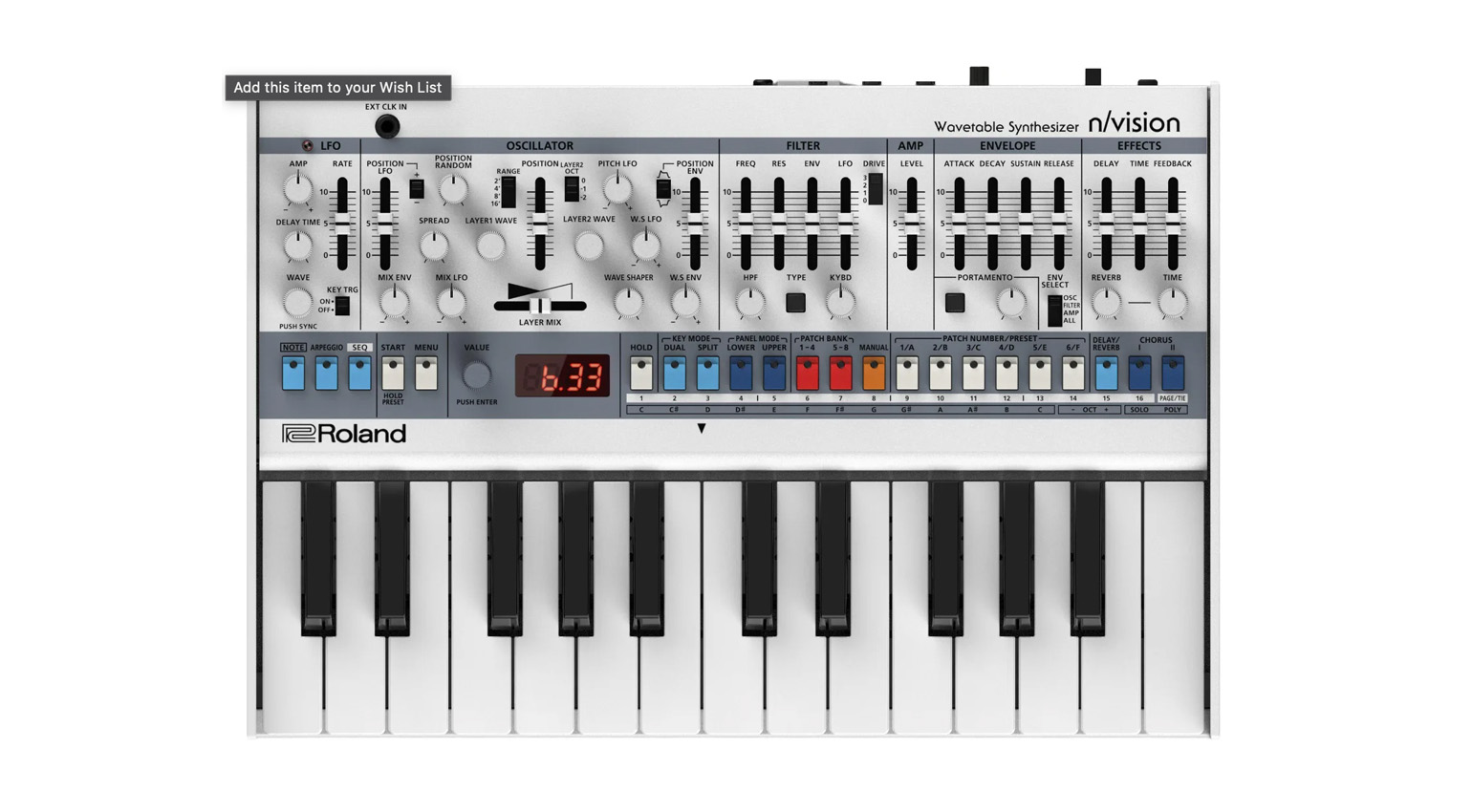
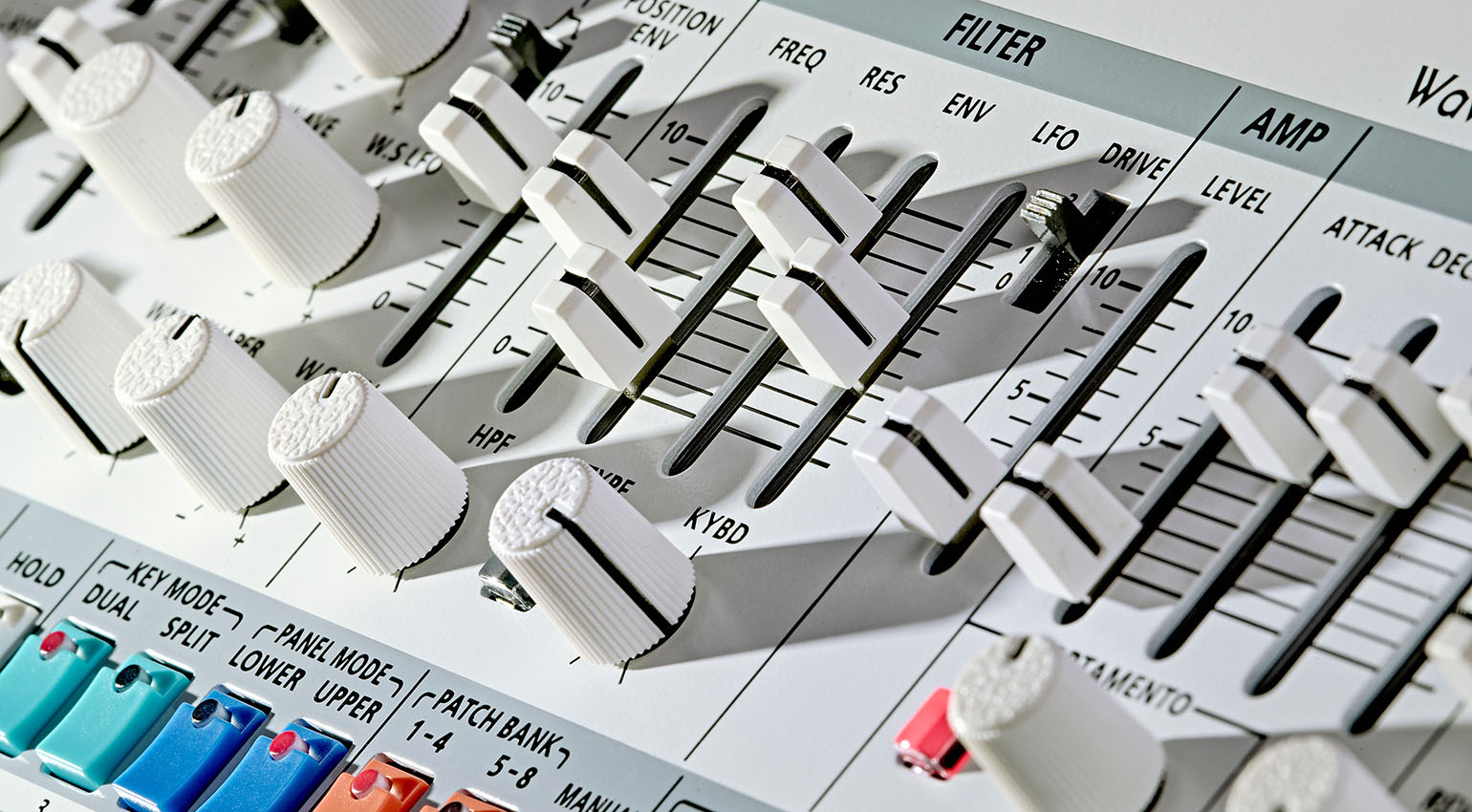
The panel is populated with lots of tiny sliders and knobs that require a good eye and nimble fingers. Personally, I’m not a big fan of tiny synths, but I can also understand those for whom it cannot be compact enough. So I’ll refrain from passing judgment here—either you like the Boutique format, or you don’t.
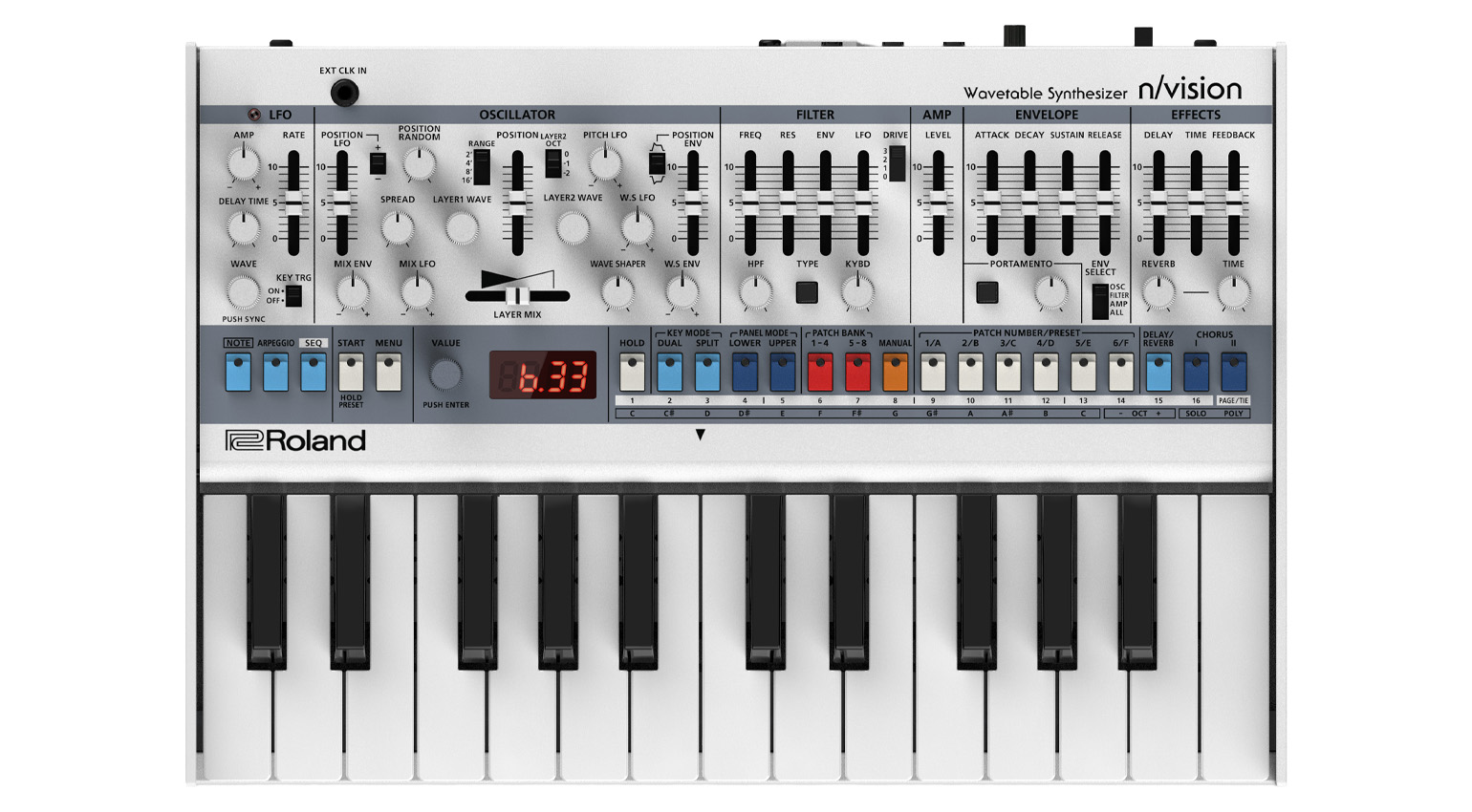
The lower section of the panel, which handles preset management, the menus, the sequencer, and the effects, is nearly identical to that of the Jupiter-08 except for the colors of the buttons. The n/vision has also inherited the Jupiter’s bitimbral design with two parts (Upper/Lower), the polyphonic step sequencer, and the built-in effects.
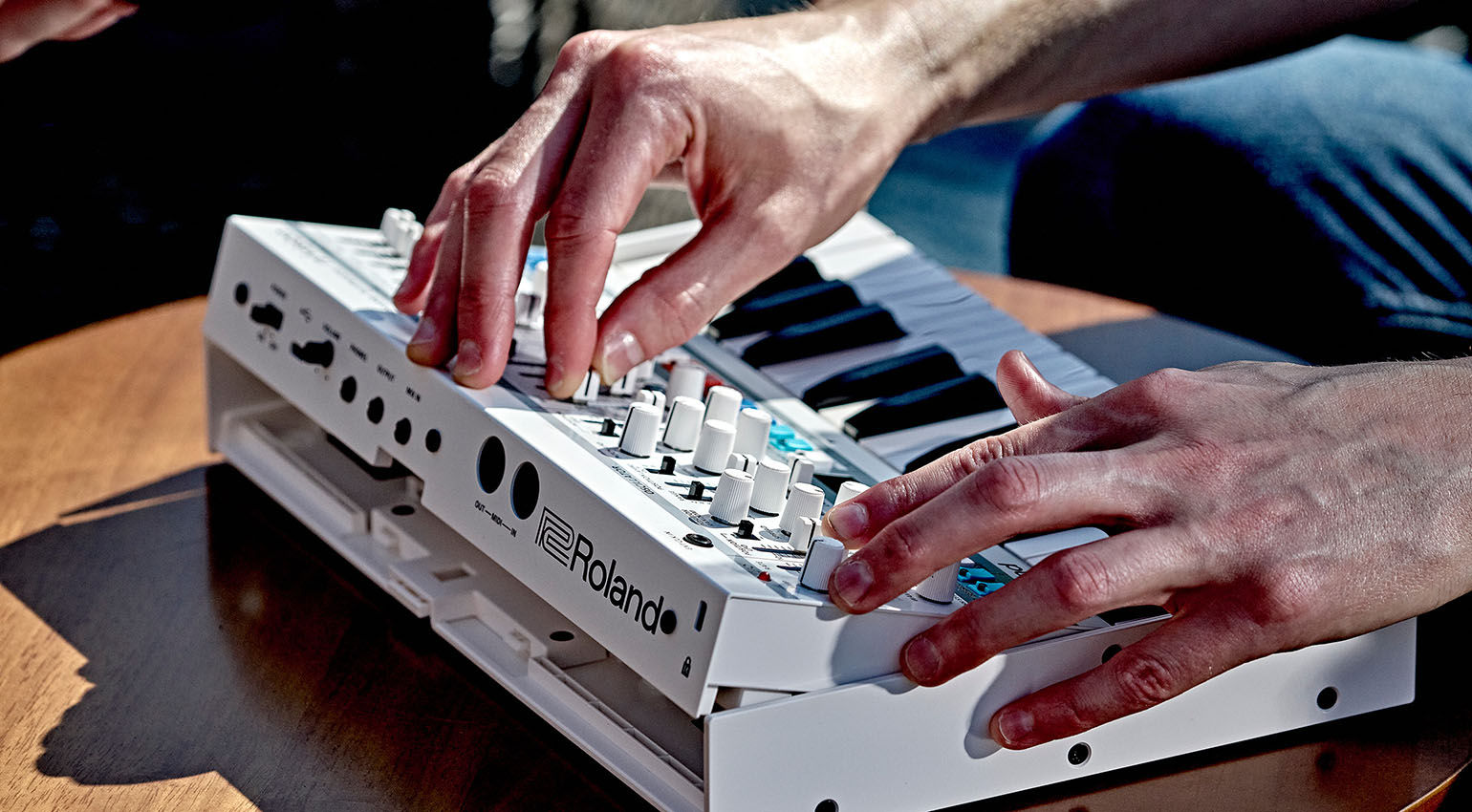
The synth comes with the K-25m keyboard dock, which has also been dipped in a bucket of white paint specifically for the n/vision. Although the small (albeit velocity-sensitive) keys aren’t particularly enjoyable to play, the K-25m still has its uses, as it also serves to tilt the panel. Alternatively, this can be achieved with the optionally available keyless dock, though that one doesn’t match the n/vision’s color.
The box also includes a printed quick start guide, which is indeed very brief and barely goes beyond turning the unit on, selecting presets, and playing the first few notes. To delve deeper, you should definitely download the PDF manual.
Connectivity
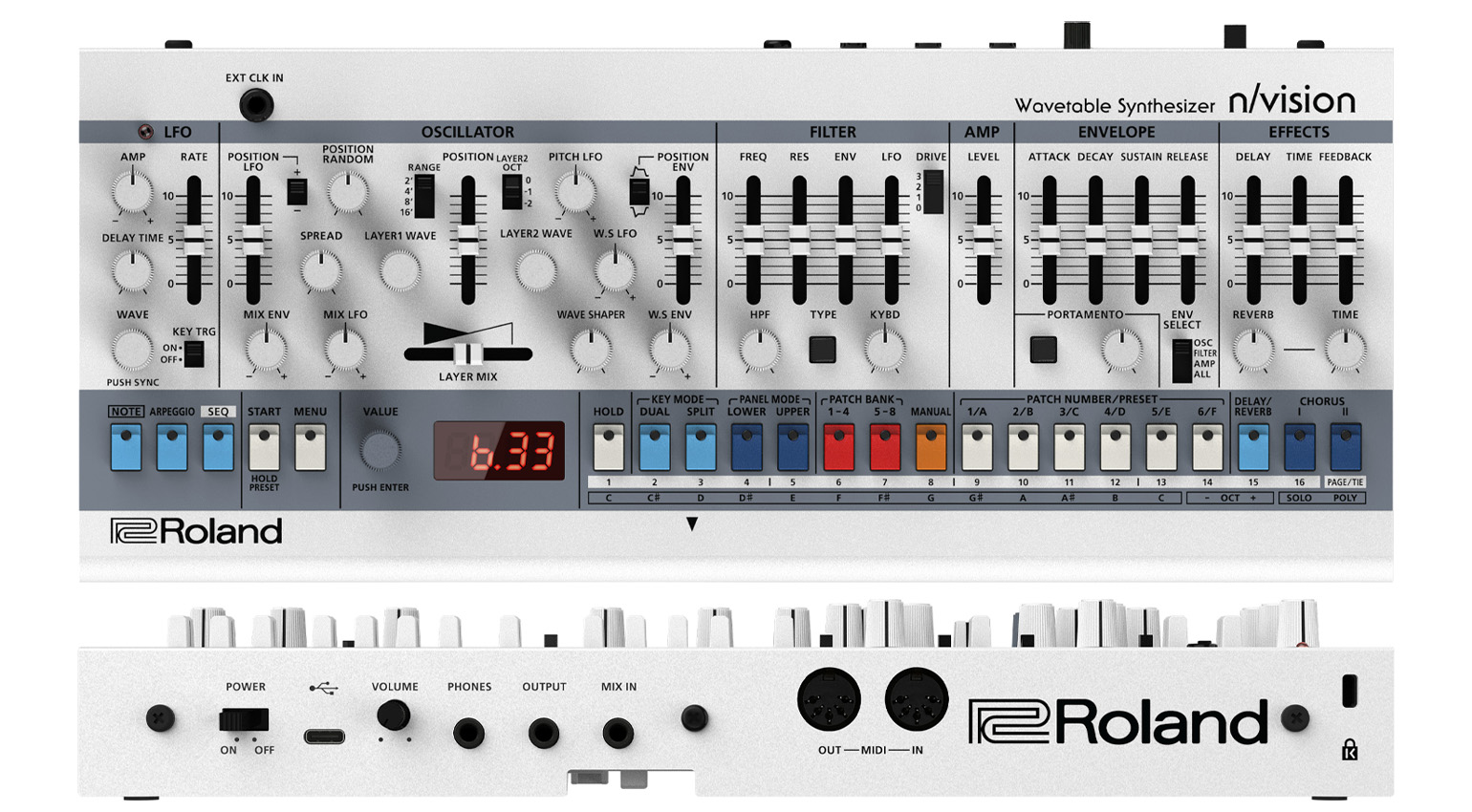
For those familiar with the Boutique series, there’s nothing new to report regarding the back panel of the n/vision. The synth offers a headphone jack and a stereo line output, as well as a mix input for routing in external signals (all on mini-jack sockets). There’s also 5-pin MIDI In/Out, a USB-C port, a small volume knob, and a power switch.
As with the newer Boutique models like the JD-08 and JX-08, the USB-C port transmits both MIDI and audio, meaning you can integrate the n/vision into a DAW studio using only a single cable. Unfortunately, the connection requires a driver, which wasn’t yet available to me at the time of testing, so I was unable to try this out.
Like the Jupiter-08, the n/vision also features an input for an analog clock signal on the panel, allowing you to sync it to analog drum machines, sequencers, and modular systems. Very nice!
Sound Engine
The Roland n/vision offers up to 56 voices of polyphony. Per voice, there are two wavetable generators (layers), each of which can be assigned any wavetable from memory. 63 wavetables are included out of the box, and you can even create an additional one yourself (more on that shortly). At the time of writing, I had no info on whether Roland plans to implement user wavetable import. I certainly hope this will be added in the future, but there’s no official word on this yet.
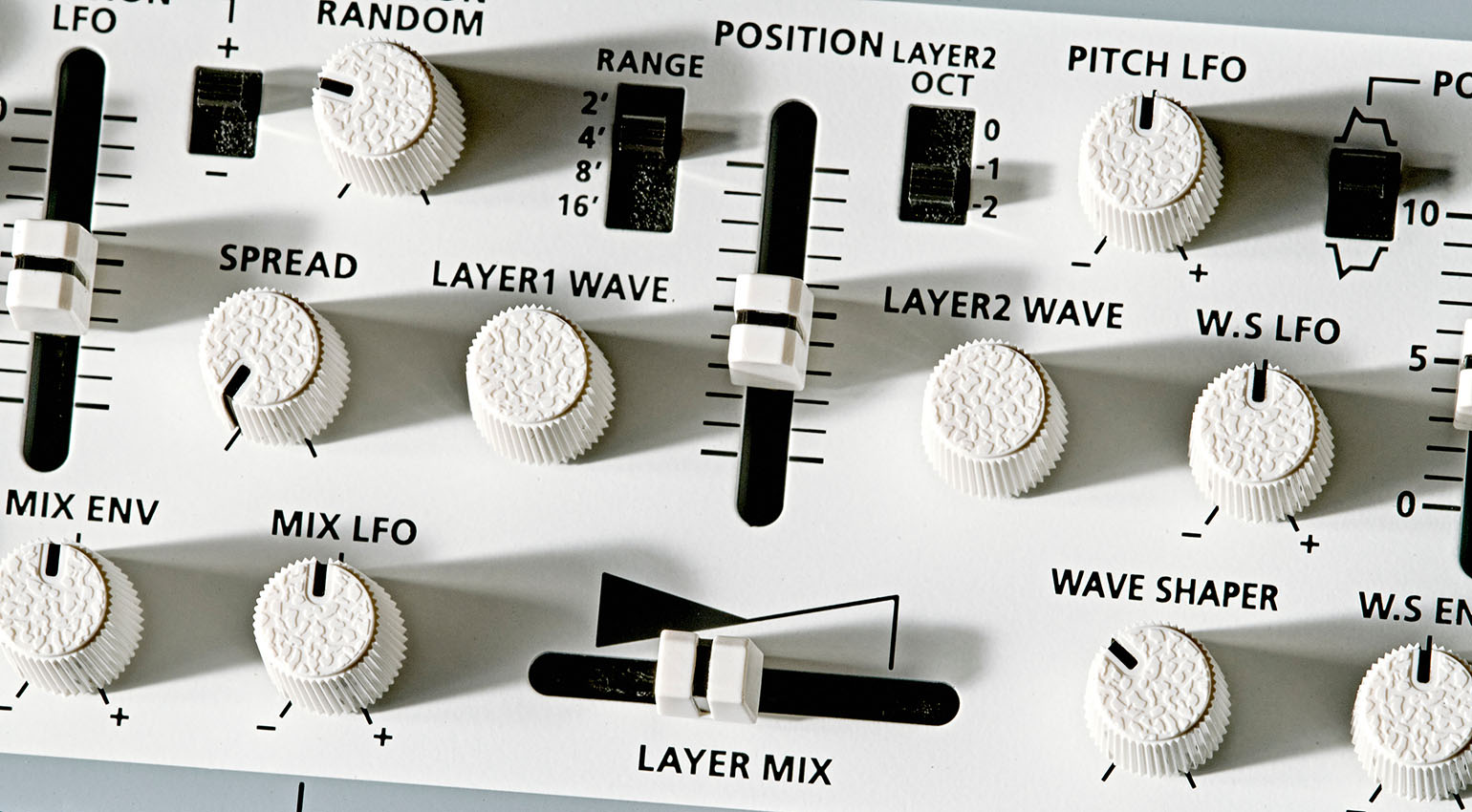
Using the Layer Mix slider, you can crossfade between the two wavetable layers. This blend ratio can also be modulated by an envelope and/or an LFO, even simultaneously. You can also detune Layer 2 relative to Layer 1, though unfortunately only in octaves.
The wavetable position can be adjusted manually and/or modulated via an LFO or envelope. This setting always affects both layers simultaneously. I think it would be even better if this could be adjusted per layer rather than for both together, but hey, let’s not expect too much from such a tiny synth with an already crowded control panel.
In addition, the oscillator section features a surprisingly deep waveshaper that adds another layer of sonic complexity. You can choose from 15 different shaping tables. The shaper is an excellent addition and can completely transform sounds by giving them a unique and interesting harmonic structure.
Hidden deep within the menu, the n/vision also offers phase modulation as another tool for creative sound design. As it involves some menu diving, the function isn’t particularly intuitive to use. But for those willing to dive that deep, it provides another interesting sound-shaping option.
The filter features nine different modes. In addition to low-pass, high-pass, and band-pass filters, all of which are available in 12dB and 24dB variants, there are three low-pass filters inspired by vintage analog synths. Interestingly (and a bit regrettably), selecting one of the 24dB filter modes causes the polyphony to decrease. So it seems like the n/visions’s CPU already runs at near maximum capacity, diminishing the prospects of any major future additions to the synthesis engine.
In true Roland fashion, the n/vision also offers an additional high-pass filter without resonance, which is excellent for cleaning up the low end. Rounding out the filter section is a distortion stage with three selectable styles, which lets you give sounds an extra helping of grit or bite.
For modulation, there are three ADSR envelope generators that share a single set of controls. You can edit them individually or all together. The LFO features six waveforms and an adjustable delay. Unlike the Jupiter-08, the n/vision thankfully offers the option of synchronizing the LFO to the clock. Key sync is also possible.
I was pleasantly surprised by the large number of available modulation targets for the LFO, all of which can be controlled directly from the panel. The LFO can affect the volume, wavetable position, layer mix, pitch, waveshaper, and filter cutoff—even everything at once.
In addition, there’s a Step LFO for programming rhythmic modulation sequences. As with phase modulation, this unfortunately involves some menu diving, so it isn’t much fun to use. I really hope Roland will release a software editor to make these things more accessible.
Additional modulation sources include the mod wheel and velocity, each of which can be assigned to various parameters in the menu. Unfortunately, though, aftertouch has been omitted, which I find a bit of a shame. At a time when many keyboard players are rediscovering the expressive possibilities of aftertouch, this seems like a missed opportunity. I get that the K-25m doesn’t have aftertouch and Roland didn’t want to design an all-new keyboard dock, but they surely could’ve implemented it via external MIDI.
The fairly extensive effects section is the icing on the cake. In addition to reverb and delay—the most important parameters of which have dedicated controls on the panel—the synth features 17 additional effects that can be accessed via the two chorus buttons. ‘Chorus’ is a bit misleading here, because this section also includes additional delays, distortion effects, a ‘Super Filter’, a bitcrusher, a lo-fi compressor, and more. Coming from Roland, the effects sound quite good and offer plenty of possibilities for giving sounds that certain something.
Making Your Own Wavetables on the Roland n/vision
In addition to the 63 included wavetables, you can create your own in what’s called Drawing Mode. You’ll only come across this feature if you read the manual; there’s no indication of it on the panel. The way the feature is implemented on the hardware has nothing to do with drawing, which to me suggests that Roland may be working on a software editor that might actually allow you to draw waveforms. So far, however, we have no official information on this.
Like everything that involves the menu, the feature isn’t much fun to use as it is. I found myself navigating from menu item to menu item and entering random values without having any concept or visual idea of what was actually happening. I certainly didn’t feel like I was “drawing” something. If you’re adventurous and patient enough, you can probably create interesting sounds with it; personally, I’d rather wait for an editor.
How Does the Roland n/vision Sound?
After turning it on for the first time, I naturally had to embark on a quick trip through the presets. And I wasn’t disappointed. The n/vision delivers many sounds that wavetable synthesizers are traditionally good at, including plenty that could be described with adjectives like ‘glassy’, ‘nasal’, ‘hollow’, ‘clear’, ‘sharp’, or ‘piercing’. Like many of its competitors, the n/vision also excels at multi-layered sounds and textures full of movement and modulation. Occasionally, it even reveals a surprisingly warm, gentle side. The sound is unmistakably digital and direct, yet inspiring and definitely very assertive. If your setup mostly consists of analog-style synths, the n/vision adds a refreshingly different dimension. In any case, it’s a very nice addition to Roland’s portfolio.
Polyphonic Step Sequencer
The built-in polyphonic step sequencer is another nice touch. Patterns can be up to 64 steps long; each step can hold up to eight notes. The sequencer has two separate tracks for the two parts (Upper/Lower).
In addition to step mode, in which you enter notes for each step one after another, a real-time recording mode is available. In this mode, you can also record controller movements (motion recording). The gate time and velocity can both be edited per step.
Additional sequencer functions such as playback direction, shuffle (swing), and a pattern randomizer can be found in the menu, which–I know I’m repeating myself–isn’t particularly intuitive to use. And that brings us to the point that caused me a bit of a headache during this review.
Help Me, I’m Lost!
While the n/vision offers direct, hands-on access to all important sound parameters (a big plus!), you have to brace yourself and head for the menu to access many advanced settings. Don’t get me wrong, I wouldn’t have a problem with this at all if the menu spoke my language.
The menu of the n/vision, however, really put my patience to the test. The synth’s biggest weakness is the small four-digit LED display, which can’t display letters properly. Parameters are therefore abbreviated in a very cryptic way. Without constantly referring to the manual, you’ve got almost no chance of deciphering them.
Fortunately, this only affects advanced settings; thanks to the many knobs, you can still tweak sounds on the fly at any time. But as soon as things get a bit more complex and you want to access features like phase modulation, advanced part or sequencer settings, or even Drawing Mode, you can’t avoid a trip into the menu—which is a little adventure every time. I really hope that Roland will follow up with a software editor for the n/vision, because the menu makes the synth much less fun to use than it should be.
Roland n/vision: Conclusion
The Roland n/vision breaks new ground for both the manufacturer and the Boutique series, which has so far mainly consisted of emulations of analog classics. For the first time, Roland has built a synth in which wavetables take center stage. Sonically, the compact synth does a great job of covering the typical wavetable repertoire and delivers clear, at times glassy, and distinctly digital sounds full of movement—an interesting and perhaps long-overdue addition to Roland’s portfolio.
The n/vision scores points for offering plenty of hands-on control and direct access to many parameters (especially for such a compact synth!), a polyphonic step sequencer, and a nice selection of built-in effects. I was less impressed by the menu navigation—which is a real test of patience without a software editor—and the lack of aftertouch.
All in all, the price seems quite ambitious to me. At this price, the n/vision is significantly more expensive than anything else Roland has released in the Boutique series so far (aside from the Jupiter-08, which came out at the same time). Depending on where you are, it also costs more than some of its direct competitors, most notably the very popular KORG modwave. I doubt that the n/vision has what it takes to dethrone the versatile modwave as the preferred wavetable synth in this price range, but then again, you never know.
Roland n/vision: Pros and Cons
Pros
- New sonic territory for a Roland synth
- Many inspiring presets
- 2-part multitimbral
- Direct access to many key sound parameters
- Flexible modulation options
- Additional waveshaper
- Polyphonic step sequencer, arpeggiator
- Decent effects
- Built-in USB-C audio interface
Cons
- Menus are nearly impossible to navigate without a manual or software editor
- Layer 2 can only be detuned in octaves
- Wavetable position can only be adjusted for both layers simultaneously
- No aftertouch
- USB connection requires a driver
- Quite expensive compared to the competition
Price and Availability
The Roland n/vision is now available from our affiliate partners Thomann* and Sweetwater*.
More Information
*This post contains affiliate links and/or widgets. When you buy a product via our affiliate partner, we receive a small commission that helps support what we do. Don’t worry, you pay the same price. Thanks for your support!

This might also interest you