The 7 Best Acoustic Guitar Pedals: Improve your Acoustic’s Piezo-Sound
Enhance your sound and prevent feedback easily!

 5,0 / 5,0 |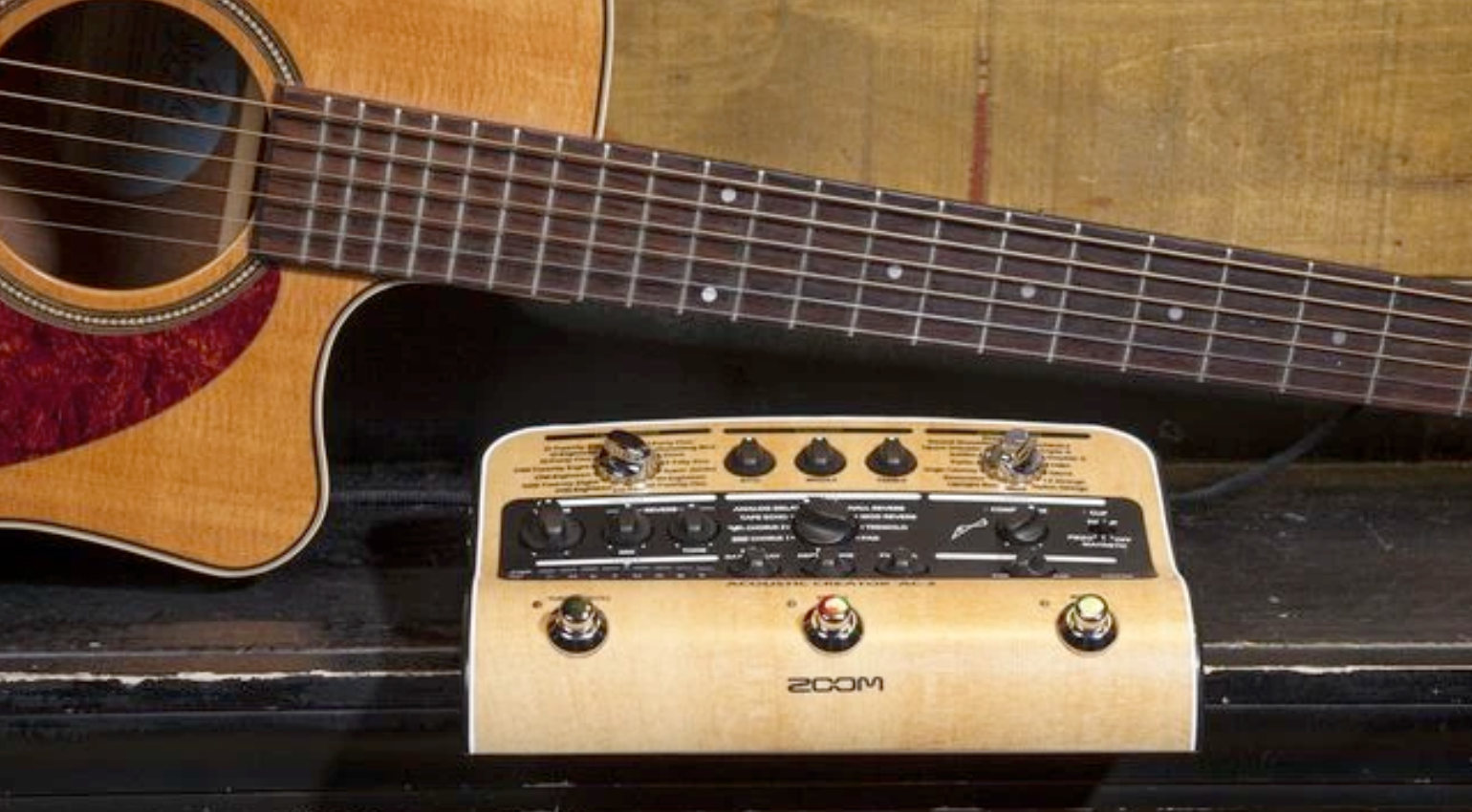

Why would you even need a pedal for your acoustic guitar?! Just plug it in or mic it up, and off you go. It shouldn’t be that hard. But there are a million reasons to use one. That’s why we’ve selected the best acoustic guitar pedals for you to choose from. Because unlike electric rigs, acoustic setups are all about control and realism, tame harsh frequencies, manage unruly dynamics, prevent feedback.
Our Picks
How did we get here?
The first acoustic guitar pedals were developed because early pickup systems, especially piezos, were practical but rather unforgiving. When plugged straight into a mixer or PA, they often produced a thin and overly bright sound.
As acoustic guitars became more commonplace on amplified stages in the ’90s and ’00s, more and more pedals emerged to address these issues. The most notable of these were preamp and DI pedals, which often offered proper gain staging and EQ tailored to acoustic instruments.
As the singer-songwriter scene exploded, manufacturers began adding notch filters to combat feedback, as well as compressors tuned for fingerstyle and strumming dynamics. Even further down the line, they added body-modeling and impulse response (IR) technology to recreate the depth and resonance of mic’d acoustic guitars.
The Best Acoustic Guitar Pedals: What to Look for
The best acoustic guitar pedals solve real-world problems. For home practice or small coffee shop gigs, clarity and simplicity are key. You’ll want to look for acoustic guitar pedals that clean up quacky piezo tones, tame harsh highs, and provide a balanced, natural sound. A basic acoustic preamp/DI with EQ and a little compression will do just fine in these cases.
If you perform frequently or in larger venues, controlling feedback becomes crucial. Look for pedals with notch filters, dedicated feedback suppression, and robust gain staging. That way, you’ll be able to increase your guitar’s volume without producing any squealing sounds. At the higher end of the price range, multifunction units with built-in compression, EQ, and body modeling or impulse response (IR) shaping can replace several individual pedals.
Of course, your available budget also plays a significant role. Entry-level simple preamp/DI pedals and simple EQ and compression pedals can deliver substantial improvements to your tone at a low cost. In the mid-range, you get more precise control, lower noise floors, and features such as blend/mix controls or compression curves designed specifically for guitars.
At the premium end of the market, units aimed at acoustic professionals offer highly musical voicings, advanced feedback tools, stereo outputs, USB/recording integration, and even app-based editing. The key to finding the best acoustic guitar pedals for your rig is matching what you need to where you play and how much control you want.
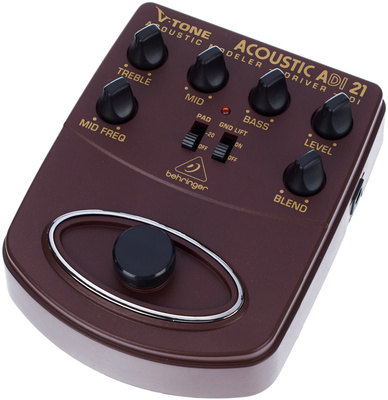
Behringer V-Tone Acoustic ADI21
Starting the list at the affordable end, the Behringer V-Tone Acoustic ADI21 is an analog tube-and-microphone modeling unit designed to soften harsh piezo pickups and add warmth and presence. Its high-impedance input preserves dynamics, while the 3-band EQ with sweepable mids makes it easy to dial out brittle frequencies or control feedback.
What keeps the ADI21 relevant is its practicality: you can use it either as a direct recording preamp with speaker/mic simulation or as a straightforward active DI box. With both a ¼” output and a balanced XLR out plus ground-lift, it integrates smoothly into PA systems, interfaces, or stage rigs. This pedal is a reliable starting point in any list of best acoustic guitar pedals, especially for beginners and gigging players who value function over frills. Check it out at Thomann*.


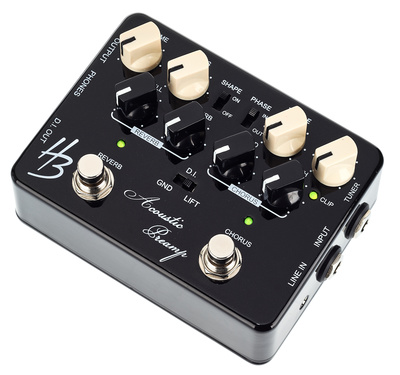
Harley Benton Custom Line Acoustic Preamp
The Harley Benton Custom Line Acoustic Preamp expands on this basic preamp/DI concept by adding onboard ambience. Alongside volume, gain, and a simple but effective EQ, this pedal includes built-in reverb and chorus, two effects especially popular for live acoustic setups.
User feedback often highlights the convenience of having usable effects directly in the preamp, even if they’re not meant to replace high-end studio reverbs. Compared to entry-level DI boxes, it offers a more “finished” live sound straight to the PA, positioning it as a solid mid-budget choice among the best acoustic guitar pedals for gigging musicians. It’s available from Thomann*.

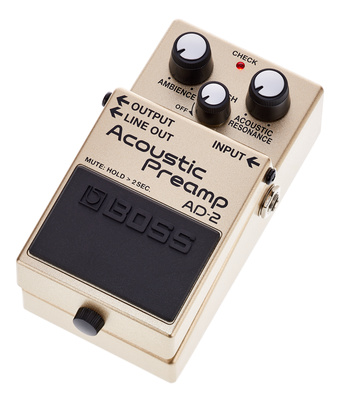
Boss AD-2
Continuing toward a more tone-focused approach, the Boss AD-2 shifts attention from broad EQ shaping to restoring the feel of an unplugged acoustic guitar. Its Acoustic Resonance control recreates the complex body response that piezo pickups often miss. This makes it especially attractive to players hunting for the best acoustic guitar pedals that improve realism without sounding processed.
On the practical side, the built-in notch filter is perfect for live use, allowing quick feedback control without external gear. Reviews frequently praise how easy it is to dial in your desired sound with just three knobs. Compared to more feature-heavy preamp/DI units, the AD-2 is deliberately focused, making it a good choice for players who need a compact tone enhancer rather than a full signal hub. Get it from Thomann*

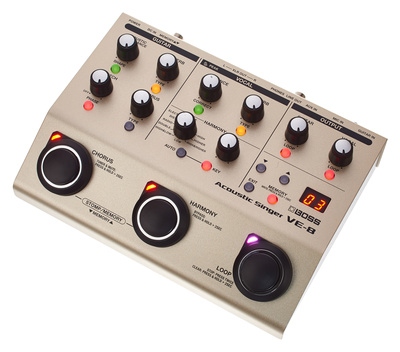
NUX Stageman Floor Preamp
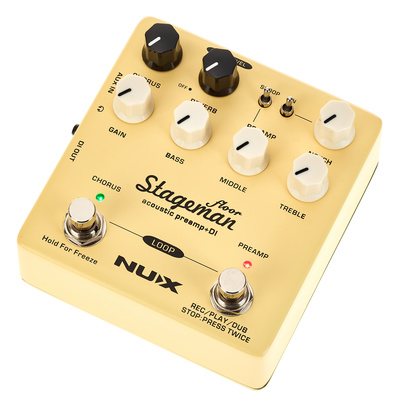
The NUX Stageman Floor Preamp combines preamp and DI duties with chorus, reverb, a looper, and even freeze effects, which make this pedal one of the more feature-rich options among the more affordable best acoustic guitar pedals. Its 3-band EQ, gain control, and dedicated notch filter make the Stageman Floor easy to adapt to different rooms, while switches for piezo or magnetic pickups and ground lift add loads of flexibility.
The pedal’s footswitches let you toggle effects or control the looper hands-free, which is a great thing for solo gigs or acoustic duo performances. User reviews often highlight its versatility and value for money, even if the onboard effects are more practical than boutique-level. It works well as an all-in-one solution for gigging acoustic players who want convenience and control in a single unit. Buy it from Thomann*.

Zoom AC3 Acoustic Guitar FX
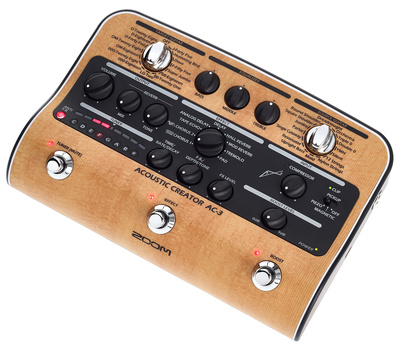
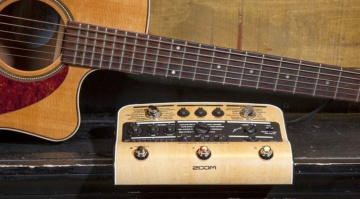
The Zoom AC-3 Acoustic Guitar FX places a strong focus on acoustic guitar body modeling and preset-based tone correction. It’s designed to transform piezo or magnetic pickup signals to sound more like a properly mic’d acoustic. With a built-in compressor, 3-band EQ, anti-feedback control, and a dedicated boost footswitch, the pedal covers most acoustic essentials.
In practice, what makes the AC-3 stand out is its live-friendly workflow, with dual balanced XLR outputs, clear input/output metering, and a clever one-knob gain staging system that simplifies setup on unfamiliar stages. Compared to simpler preamp/DI pedals, the AC-3 offers more tonal shaping and consistency from venue to venue. Take a closer look at Thomann*.

L.R.Baggs Venue DI
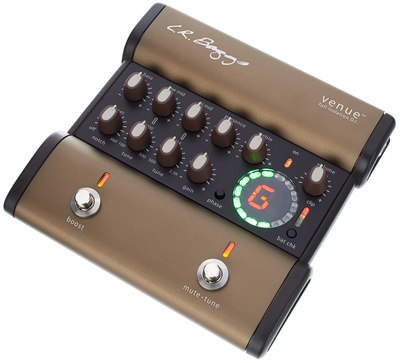
The L.R. Baggs Venue DI puts professional tone shaping and live reliability first. Based on the acclaimed Para DI platform, it combines a high-headroom preamp, 5-band parametric EQ, notch filter for feedback control, and a phase switch in a rugged floor-pedal format. Users frequently praise the Venue DI for its simplicity and effectiveness on stage: the EQ sliders cover a musical range without calling for deep menu diving, the notch filter hunts down feedback with surprising precision, and the bright, easy-to-read tuner (built into the pedal) keeps you grounded between songs.
If your priority is true acoustic tone, direct gigging capability, and maximum control with minimal fuss, the L.R. Baggs Venue DI stands out as one of the most dependable and professionally oriented entries among the best acoustic guitar pedals. You can get it here from Thomann*.

Audio Sprockets ToneDexter II
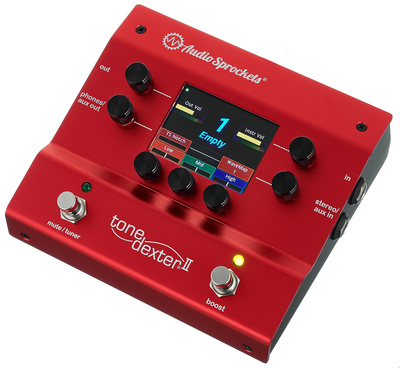
Instead of generic body modeling, the the Audio Sprockets ToneDexter II uses WaveMaps (custom captures of your own instrument recorded with a studio microphone) to rebuild the missing body resonance in real time. That approach puts it in a very different league from typical preamp/DI units, making it a standout among the best acoustic guitar pedals for tone purists.
In practice, players praise the ToneDexter II for its realism and depth, especially when running direct to PA or in-ear monitors. The learning curve might be a bit steeper than with simpler pedals, however, but the payoff is huge: natural dynamics, less piezo “quack,” and a sound that feels closer to a studio recording . With extensive EQ and anti-feedback tools, preset storage, MIDI/control options, and phantom-powered mic input, it’s aimed at professionals. Check it out at Thomann*.

Conclusion
As you can see, there are plenty of options in a variety of price ranges for the best acoustic guitar pedals. Now it’s your turn! What pedals and rigs do you use to enhance your acoustic guitar’s sound? Let us know in the comments!
FAQ – Best Acoustic Guitar Pedals
What does an acoustic guitar pedal actually do?
Acoustic guitar pedals are designed to improve realism and control rather than add obvious effects. They typically handle preamp gain, EQ, feedback suppression, and DI duties.
Do I need a preamp/DI pedal for acoustic guitar?
If you’re playing live, then yes. Piezo pickups often sound harsh when plugged straight into a mixer, and a good preamp/DI pedal is the fastest way to fix that.
What is the difference between body modeling and a standard EQ?
EQ adjusts frequencies that are already there, while body modeling or IR/WaveMap technology recreates the missing resonance of a mic’d acoustic guitar.
*Disclaimer: This post about the best acoustic guitar pedals contains affiliate links and/or widgets. When you buy a product via our affiliate partner, we receive a small commission that helps support what we do. Don’t worry, you pay the same price. Thanks for your support!

This might also interest you