XILS-lab MemoryTone: Is This Memorymoog Plugin the Cherry Audio Killer?

 5,0 / 5,0 |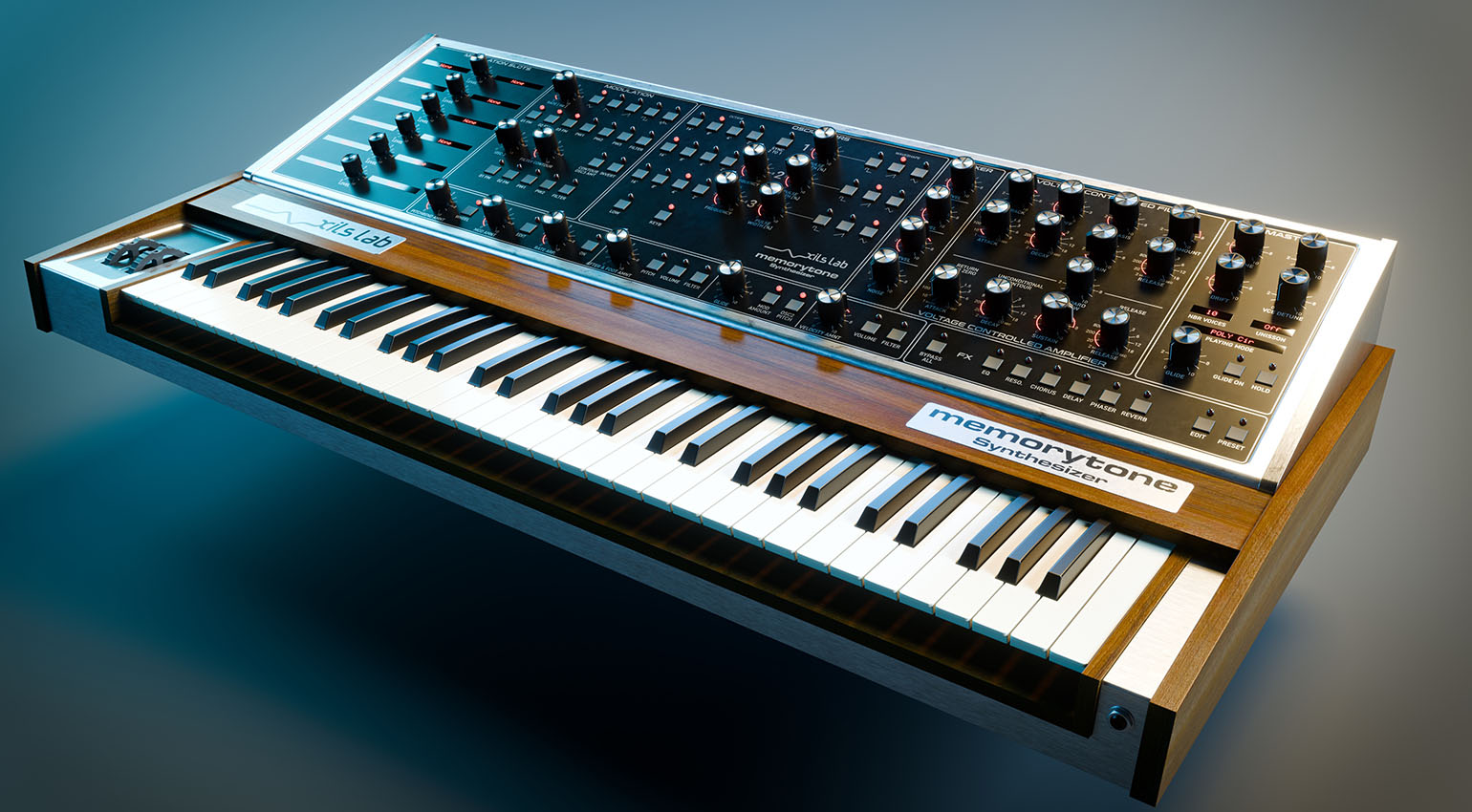

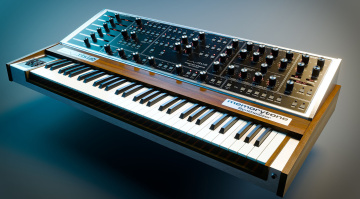
XILS-lab’s MemoryTone marks the third Moog Memorymoog emulation of the year. Is the market already saturated, or does XILS-lab’s take offer enough new to stand out?
XILS-lab MemoryTone: A New Memorymoog Emulation
XILS-lab MemoryTone: Initial Thoughts
I admit that I’ve never played a Moog Memorymoog. But for someone of my generation (I was born the same year David Bowie released Ziggy Stardust), the Memorymoog is kind of an ultimate synthesizer. Three oscillators per voice across six voices equals 18 glorious Moog oscillators all humming together. It’s like the Cadillac of synths: big, American and more luxurious than most can afford. That makes a plugin version superbly welcome, especially when it’s XILS-lab doing the emulating, as this company makes some very good-sounding instruments.
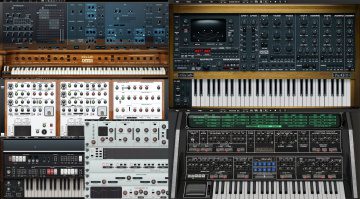
But with Memorymoog remakes already on the market from Arturia (Memory V) and Cherry Audio (Memorymode 2), is there room for one more?
18 Oscillators Power the MemoryTone
XILS-lab’s MemoryTone follows up on the CS-80 remake The Eighty as the company’s latest classic synth emulation. The original Memorymoog is often called magic, and XILS-lab wanted to find out why. As part of that process, the company apparently did a lot of playing and measuring, particularly in the interaction of those 18 oscillators, and “how small variations accumulated between voices, and how level changes affected the signal before it reached the filter.”
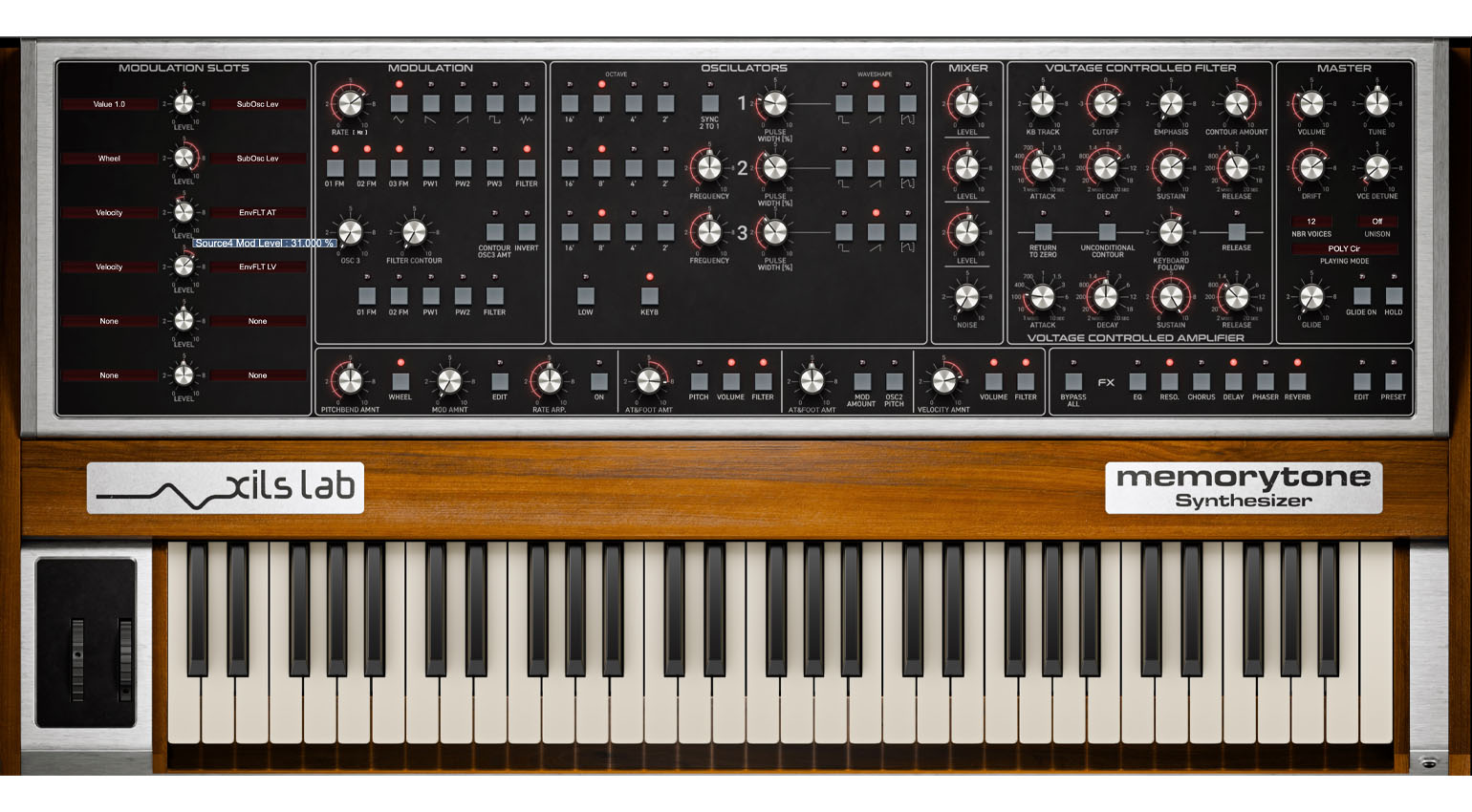
Each of those oscillators – there are three – offer freely combinable pulse, sawtooth, and triangle waveforms plus variable pulse width and hard sync. You can detune oscillators two and three, and even use OSC 3 as an LFO just like the original Minimoog. You can push them hard in the mixer, and take the 24dB/Oct Ladder filter into self-oscillation. Note that MemoryTone has been beefed up from six to 12 voices, though the press release still says it’s three oscillators per voice.
Along with this, there are also “meticulously modeled” Drift and VCE (voice-to-voice) Detune variations along with mono, polyphonic and circular polyphonic (POLY cir) playing modes, a very massive unison, and mono and polyphonic glide.
All Mod(ulation) Cons
In terms of modulation, MemoryTone provides two ADSR envelope generators with advanced contour behavior plus an LFO with 0.1-10Hz rate and triangle, saw up, saw down, square and sample & hold waveforms. As for destinations, we’ve got multiple oscillator (01 FM and 02 FM), pulse width (PW1 and PW2), and the filter, with polyphonic voice modulation possible as well.
XILS-lab have also provided six assignable modulation slots, plus expression options in the form of velocity, aftertouch, expression, and MPE support.
Making New Memories
For all of its traditional leanings, MemoryTone is very much a 21st-century instrument, with modern additions that take it beyond what was possible when the original machine debuted in 1982. These include an advanced arpeggiator with mono and polyphonic operation, octave extension, broken chord behavior, random patterns as well as gate and swing, plus a sequencer.
There is also an effects section, with chorus, phaser, delay, reverb, EQ and a resonator on board.
Lastly, the preset section includes the original factory patches as programmed by Wendy Carlos, Herbert Deutsch and Jan Hammer.
Price and Availability
XILS-lab’s MemoryTone is available now from Thomann* for the introductory price of $77 / £68 / €79, rising to €199 on November 1. The plugin is available in AAX, VST, VST3 and AU formats for Mac and PC.

XILS-lab MemoryTone: Do You Need Another Memorymoog?
So, the 18-oscillator question: do you really need another Memorymoog plugin? If you already have Arturia’s or Cherry Audio’s versions (or both even), you may not need one. However, if you’ve yet to pick one up, you should very much download all three demos and see how they compare. XILS-lab is famous for its sound quality, and that may be the deciding factor. Just do it before the end of October, as the introductory price is pretty nice, but that regular €199 is pretty eye-watering.
More Information
- XILS-lab MemoryTone product page
- More about XILS-lab
- More about synthesizers
- Buy synthesizers at Thomann*
*Note: This article contains advertising links that help us pay for this site. Don’t worry: the price for you will always be the same! If you buy something through these links, we will receive a small commission. Thank you for your support!

This might also interest you