Your Browser is Your New Best Friend – Synth Journal

 4,2 / 5,0 |
Your browser might just be your new musical best friend with more and more clever tools appearing every week!
Browser-based musical tools are nothing new, but in recent months, there has been a raft of increasingly powerful and incredibly useful tools emerging that reside in an instance of your favourite browser and make your music-making just that little bit easier.
The emergence and surge of interest in so-called vibe coding seems to have enabled many more people to realise their dreams of creating the tools they need to get the job done, and then share those tools with the wider synth community.
And it’s not just instruments. Editors, librarians, compositional tools and even tools that resurrect the dusty inhabitants of the dark corner of your studio for whom time and the developer had forgotten or forsaken! Here are a few of my recent favourites, plus a new software clone of a classic drum machine.
Synth Journal
Codophonics DARKGREEN – A DX11/TX81z in Your Browser
It’s unfortunate, but sometimes, an instrument can be defined by just one of its sounds. For many people, the Yamaha DX11, and its rack-mounted sibling, the TX81z, have been inextricably linked to one of the most iconic synth bass sounds in history, Lately Bass.
Derived from a patch that first appeared on the DX21/27/100 family of keyboards, Solid Bass, Lately Bass upped the game by making use of the DX11/TX81z’s extra waveforms to inject a bit more fizz and a punchy transient.
What made the DX11/TX81z stand out from previous 4-Operator DX synths was the addition of extra waveforms in each operator. Up until this point, all of Yamaha’s FM synths used sine waves exclusively, even the Mk.II DX7 was just sine waves. The introduction of other waveforms gave the DX11/TX81z a real sonic edge, so much so that many people started to prefer these synths over the bigger DX7.
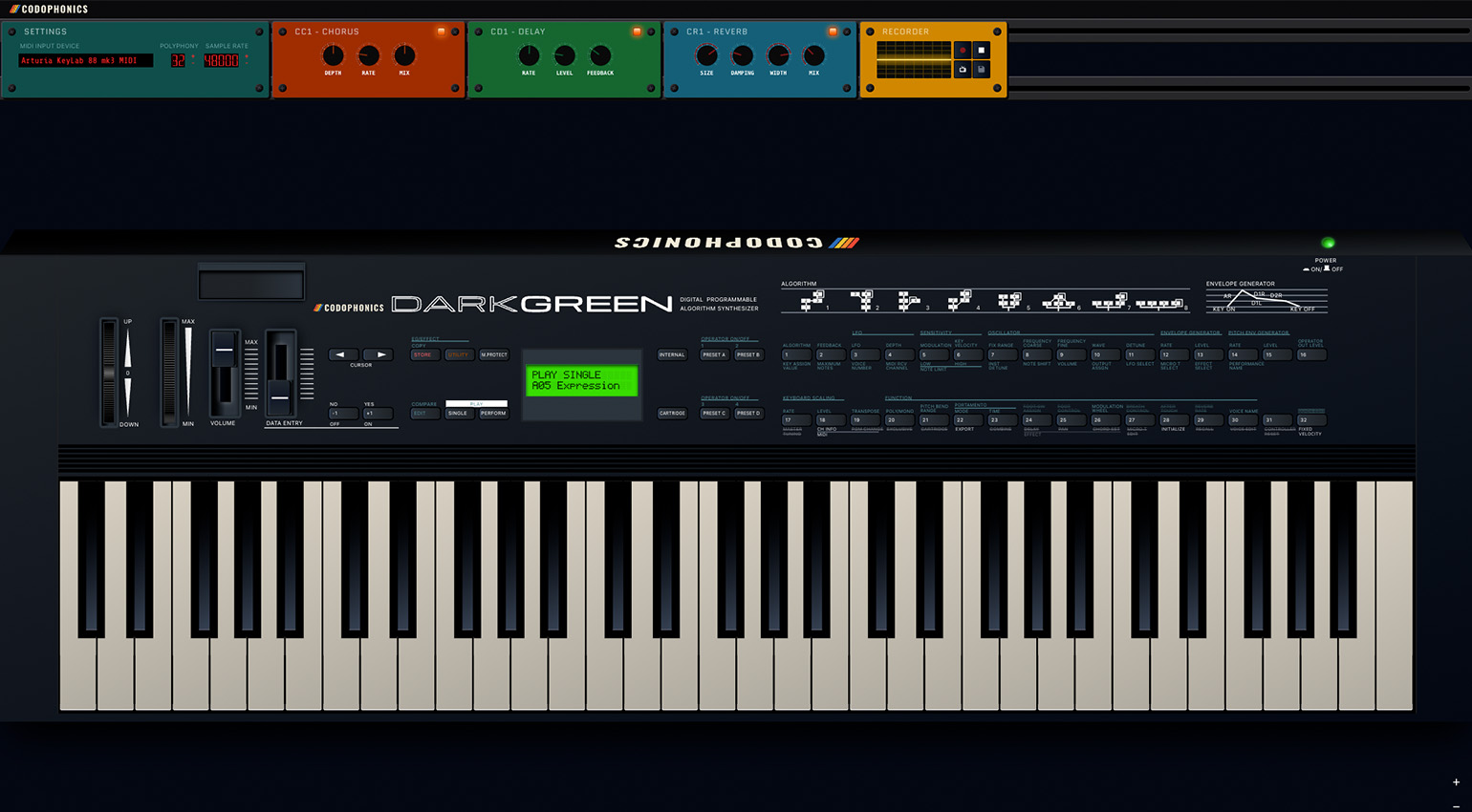
Until now, there have only been a very small number of clones of these instruments, but now, Codophonics have launched DARKGREEN, a browser-based clone of the DX11 with some useful additions in the form of dedicated effects.
DARKGREEN claims to be a bit-perfect recreation and comes supplied with 128 new presets, but it also features the ability to load up original Yamaha and 3rd part patches. Better still, it ups the original’s polyphony from 8 to 32. This was always the biggest downside of the hardware, and saw people like me buy a TX81z to polychain and get me a decent 16 voices.
Codophonics claim that DARKGREEN will eventually escape the browser and become a proper plugin, so we await that with bated breath! But until then, have fun with this free browser instrument and rediscover the joy of 4-Op FM!
DXcompanion – A DX/FM Editor/Librarian
Continuing along a them of Yamaha and FM synthesis, something I’m very passionate about, this next browser-based tool is something of a revelation and of huge use to me and my collection of such synths. DXcompanion runs best in Chromium-based browsers, such as Chrome and Edge and is an editor and librarian for a wide range of FM synths. Check this list out!
- DX7 Mk.I
- TX7
- TX816 (one module at a time)
- DX7 Mk.II (C/D/FD/S)
- TX802
- DX11
- TX81z
- V50
- DX21
- DX27
- DX100
- SEQTRAK
- Korg 707 (in beta)
- M-VAVE FM-1
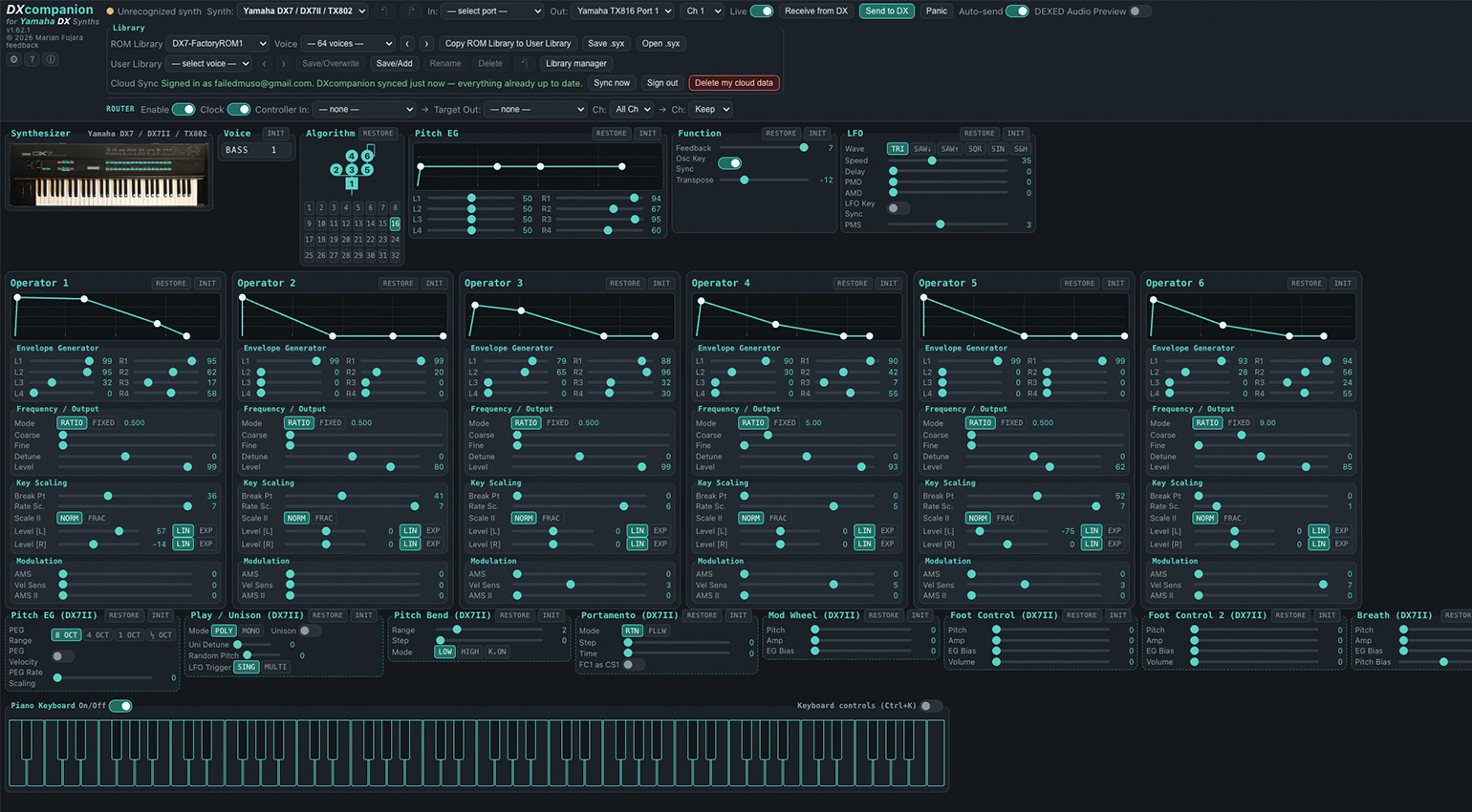
What impressed me most about this free browser-based tool was not only the wide scope of instruments it covers, but also the visualisation and layout of the editor. But that’s not all. The developer, Marian Fujara, has included extensive MIDI connectivity, a generous collection of built-in sound banks to get you started, and this is the best bit, has built in DEXED so you can audition stuff when not connected to your DX7!
And once you’ve created or curated your sounds, you can back them all up to your Google account in the cloud for easy access on any device, any time, any place! I’ve always maintained that FM programming is so much less daunting when you can see what you’re doing and DXcompanion gives you exactly that experience.
Check it out for yourself here.



M-VAVE FM-1 Patch Librarian
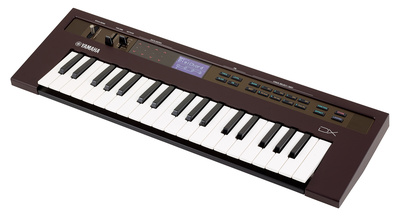
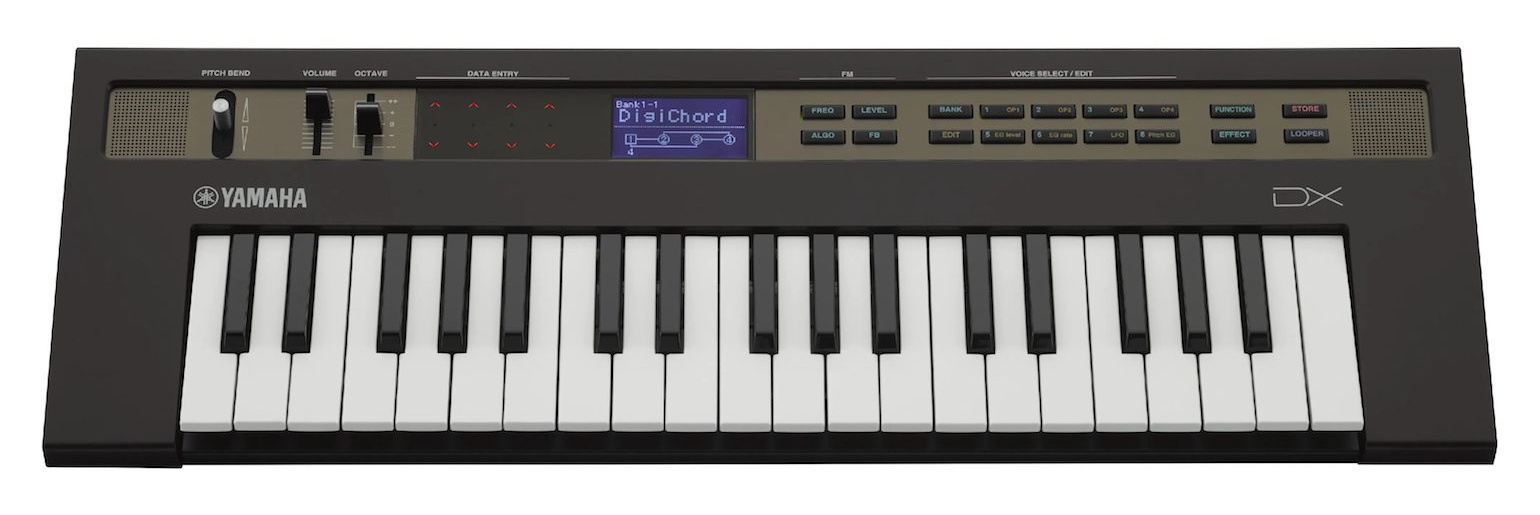
One of the revelations of the year for me, so far, has been a small little box from China called the FM-1. Made by M-VAVE, it is essentially a DX7 in your pocket, but on steroids! Smaller than a paperback book and just a little larger than a Pro Max iPhone, the FM-1 is a DX7-compatible, 6-Operator, 32 Algorithm FM synth that also comes with FX, patch storage for 128 sounds and, remarkably, Bluetooth MIDI.
And if you’re not a fan of Bluetooth MIDI, there’s also USB MIDI and Audio, as well as MIDI over TRS. It also includes a simple sequencer and arpeggiator, multi-mode filter, envelope generator and LFO. All of this comes for an approximate price of around £65 GBP. It’s quite remarkable.
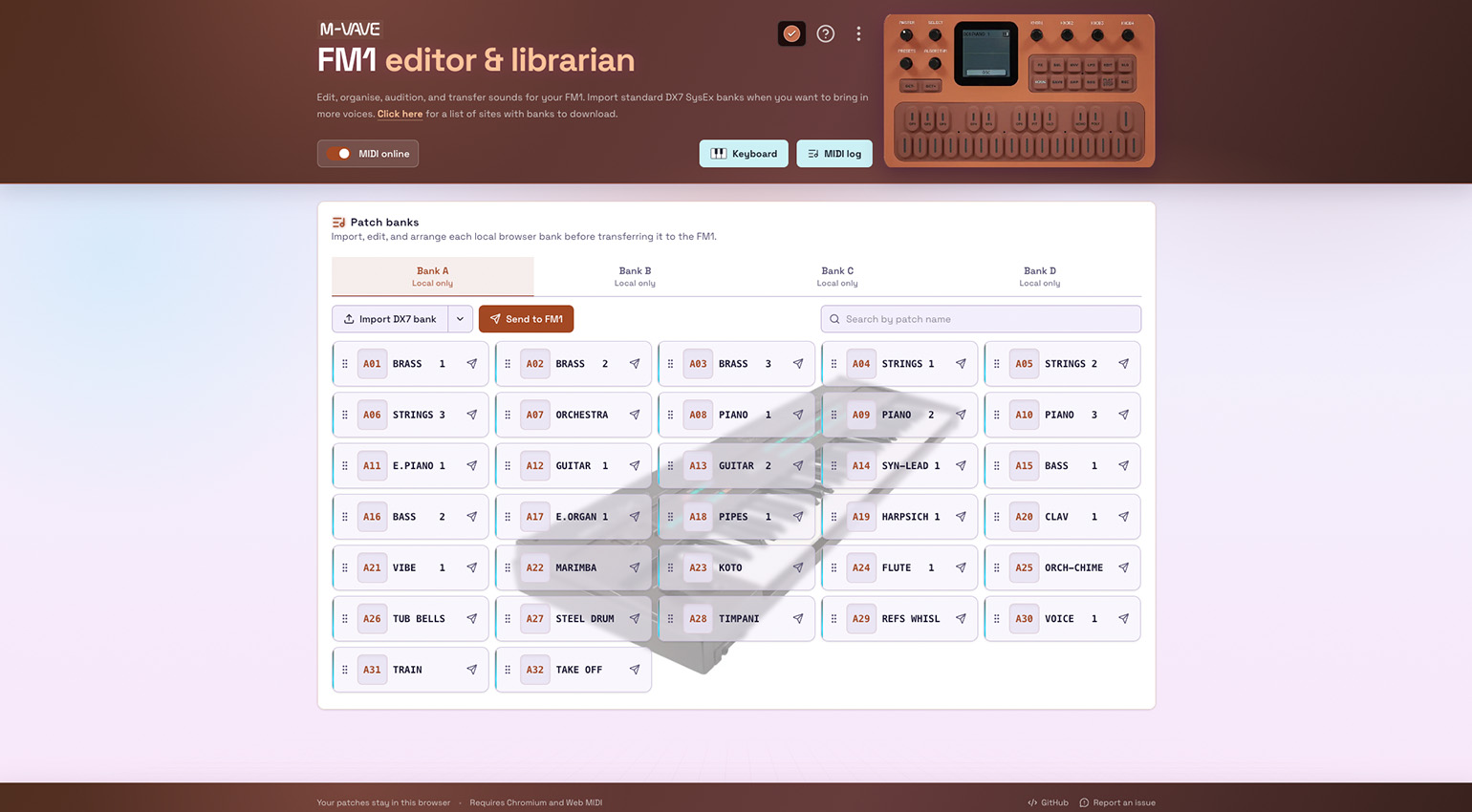
Given its compact nature and the fact that its LCD screen, as welcome as it is, is fairly small, this little powerhouse could do with some help in the patch editing and storage departments. Enter a brilliant 3rd party browser-based editor and librarian from Benny Sparra.
Hook up your FM-1 and the editor should see the unit immediately in your browser. The editor comes with the FM-1’s patches installed but it is very easy to load up DX7-compatible libraries into each of the 4 banks of 32 slots. You can then send these blocks, one at a time, to the FM-1.
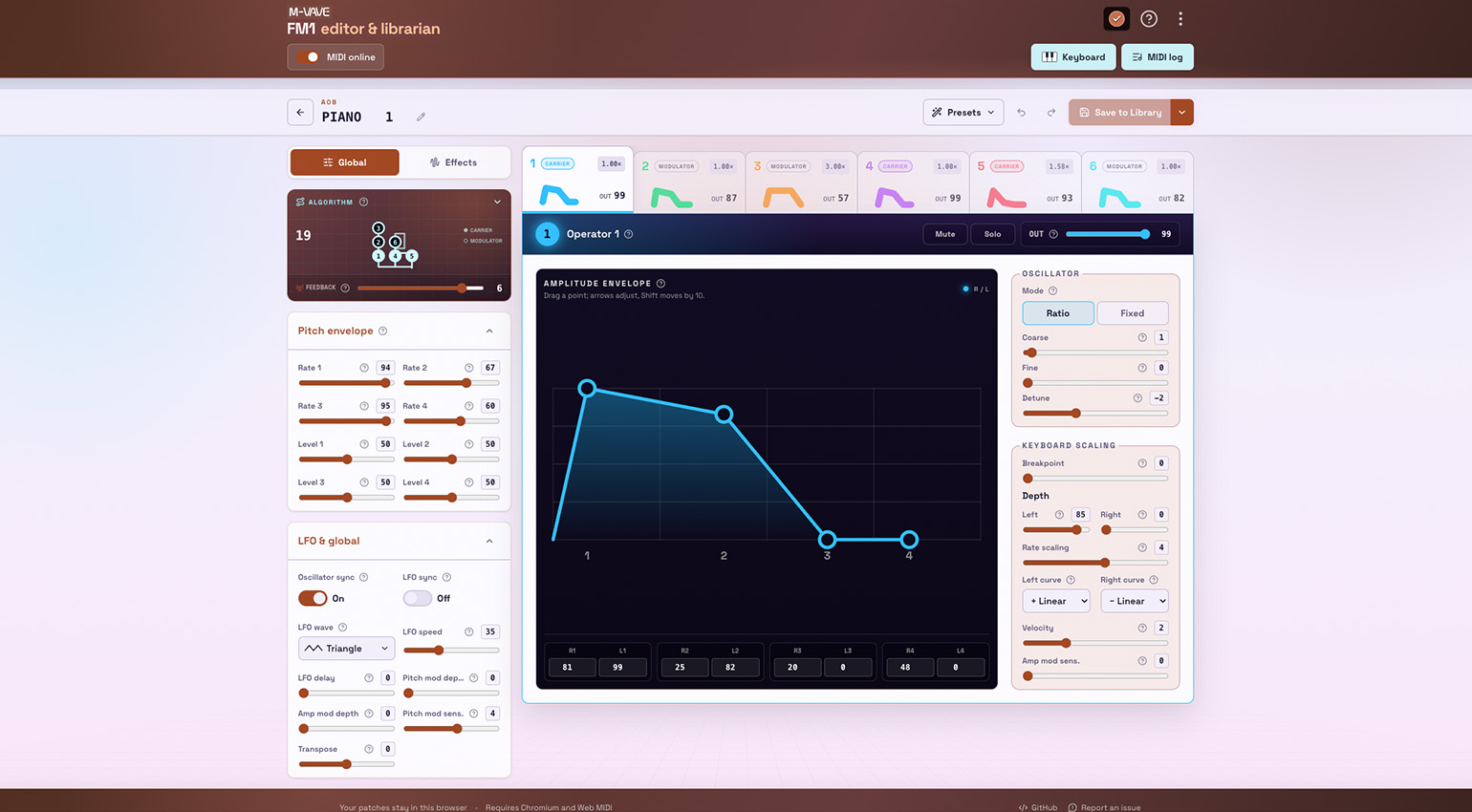
When you want to edit a patch, simply click on it, and the editor page opens a lovely graphical representation of the patch with most elements exposed for your tweaking pleasure. Apparently, M-VAVE have been making more of the CC parameters public, which has made this browser-based tool possible.
If you’ve managed to snag an FM-1, this is a real boon, and you can even customise the interface to match the colour of your FM-1! Check the FM-1 Editor and Librarian here.
Akai S5000/S6000 Editor
My first pro hardware sampler was an Akai S6000. I still own it today, and it does still get occasional use now and again. I still maintain that it was the king of the hardware samplers, and you can still see them in use both in the studio and on stage to this day.
It became the backbone of many live shows, with its built-in Set List feature and MIDI playback capability. Robbie Williams’ MD requested the aforementioned Set List feature as they used two of these beasts to run backing tracks on Robbie’s live shows back in the day. If you ever see me in person, be sure to ask me about the hilarious tale of how that feature came to be.
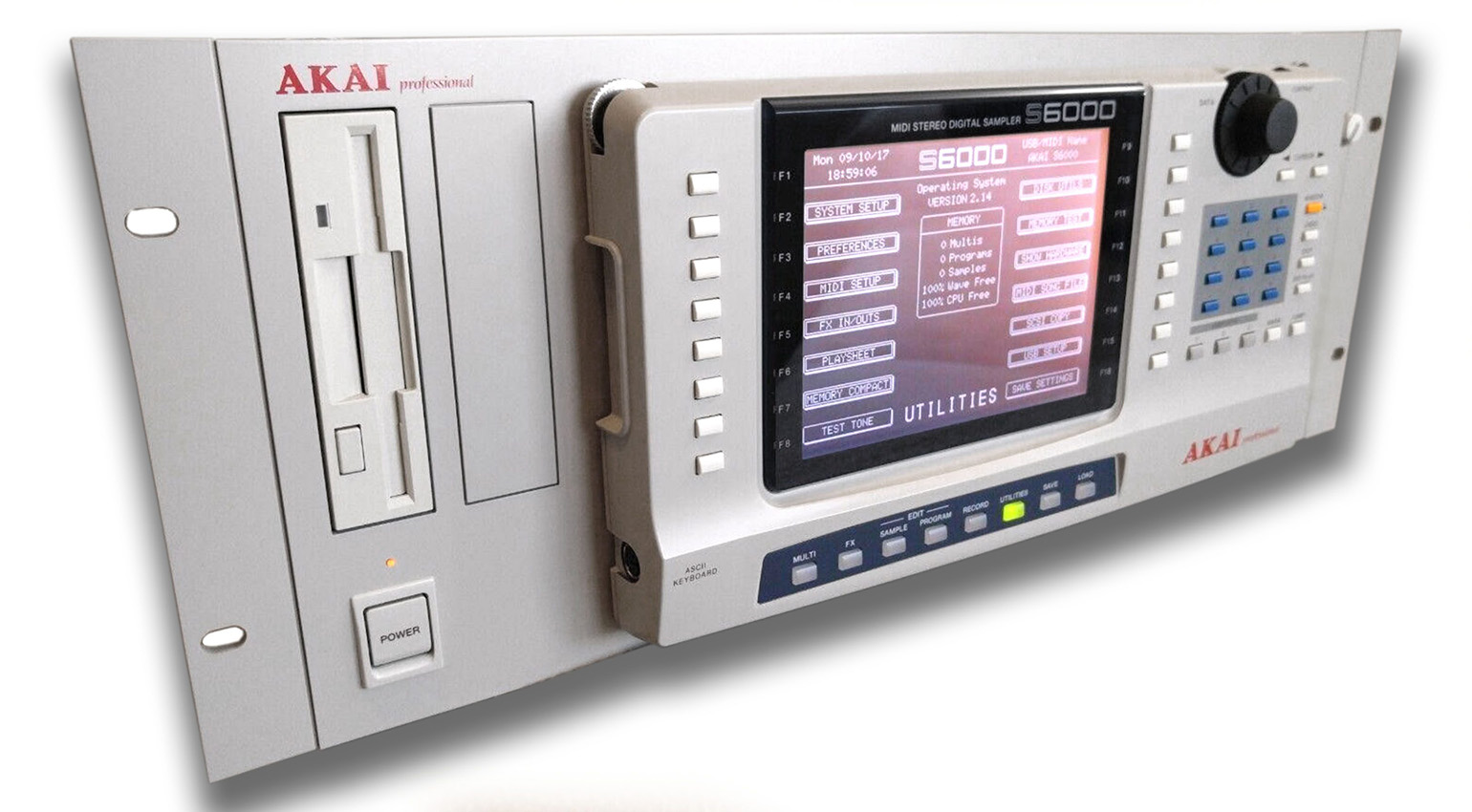
Pet Shop Boys were another group who used multiple units in their live rigs. When bands and artists of this stature rely on bits of kit like this for their live shows, you know it has to be good. Another great feature of the S6000 is that it finally adopted WAV as the sample format, and you could buy a USB card to use their brilliant editor and librarian, Ak.Sys.
Sadly, Ak.Sys has been left behind since every computer OS went 64bit, so you either have to run an old computer or a 32bit Virtual Machine to use it. There have been a few attempts at creating something new, but there’s a new kid in town that allows you to do it all in a browser!
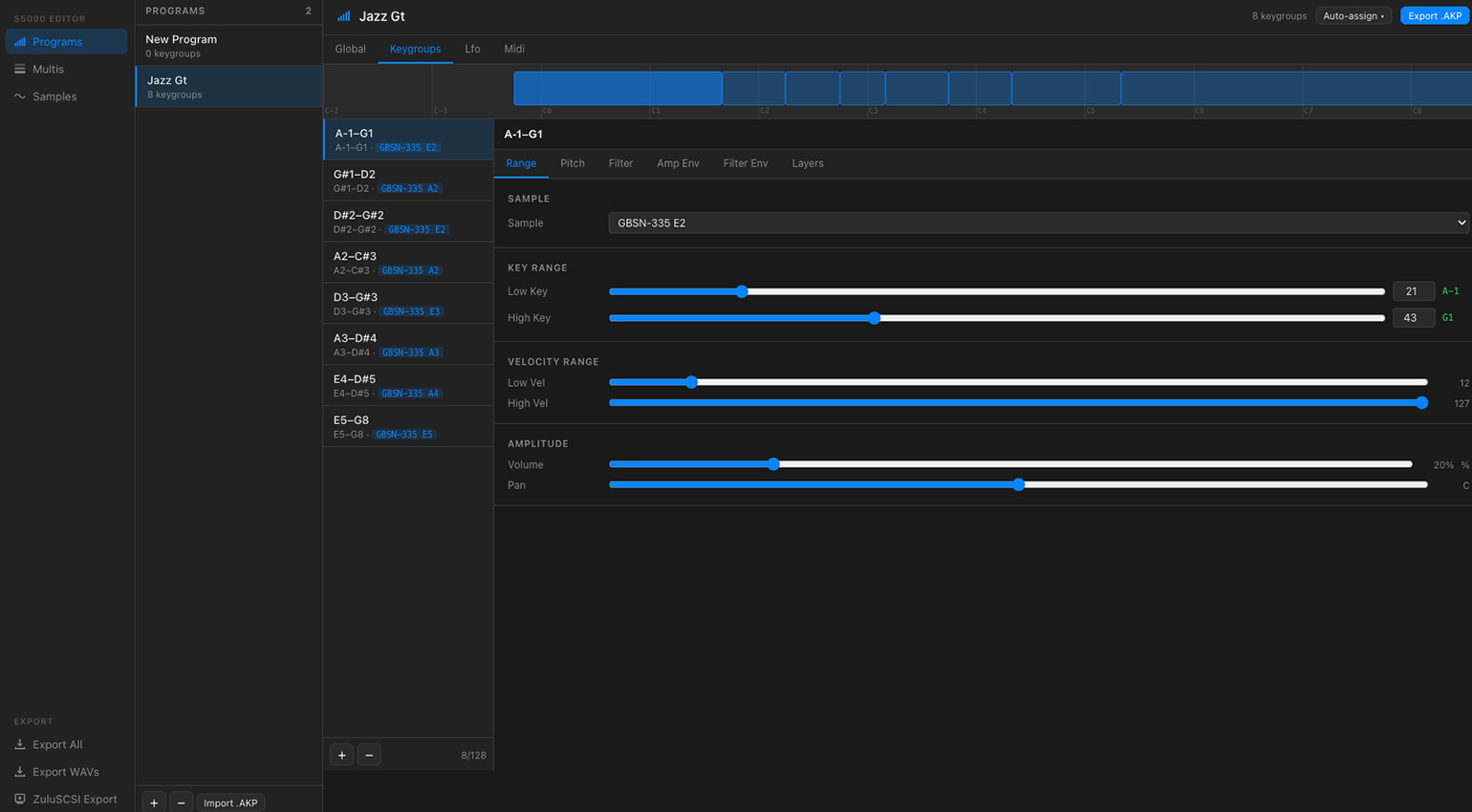
This project on Github deliver a simple but very useful front end in your Chrome browser and requires no internet connection as you download the HTML file and run it natively on your computer. It’s not quite a replacement for Ak.Sys, but it definitely allows for some useful editing and exporting, including to Zulu SCSI format. Check it out for yourself here.
Kepra – A KPR-77 Recreation in Software
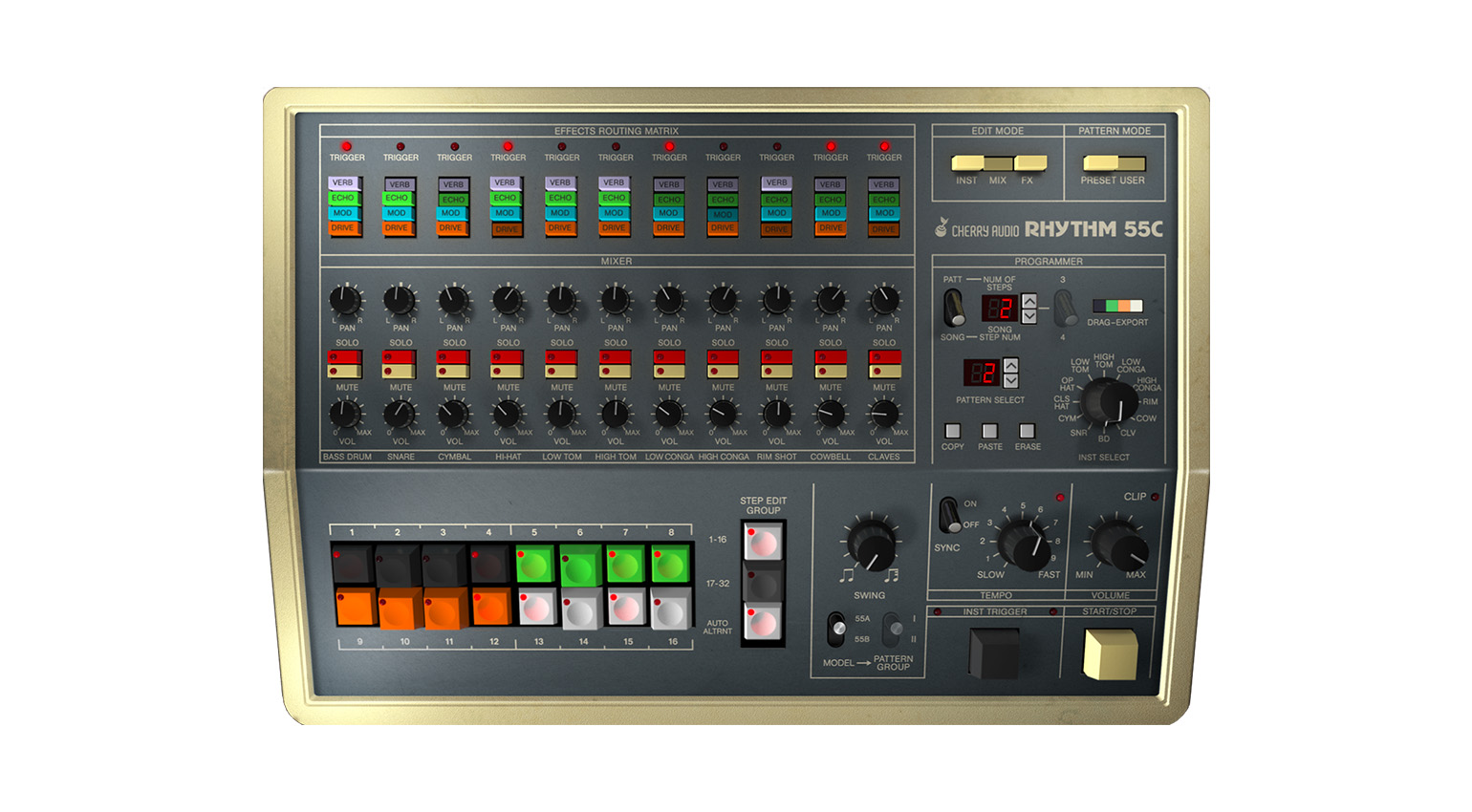
Bucking the theme here this week, we have a new drum machine recreation that definitely isn’t browser-based, but it’s pretty cool and incredibly affordable! We’ve recently seen both software and hardware recreations of the KPR-55, like Cherry Audio’s KR-55, but this one is of the KPR-77.
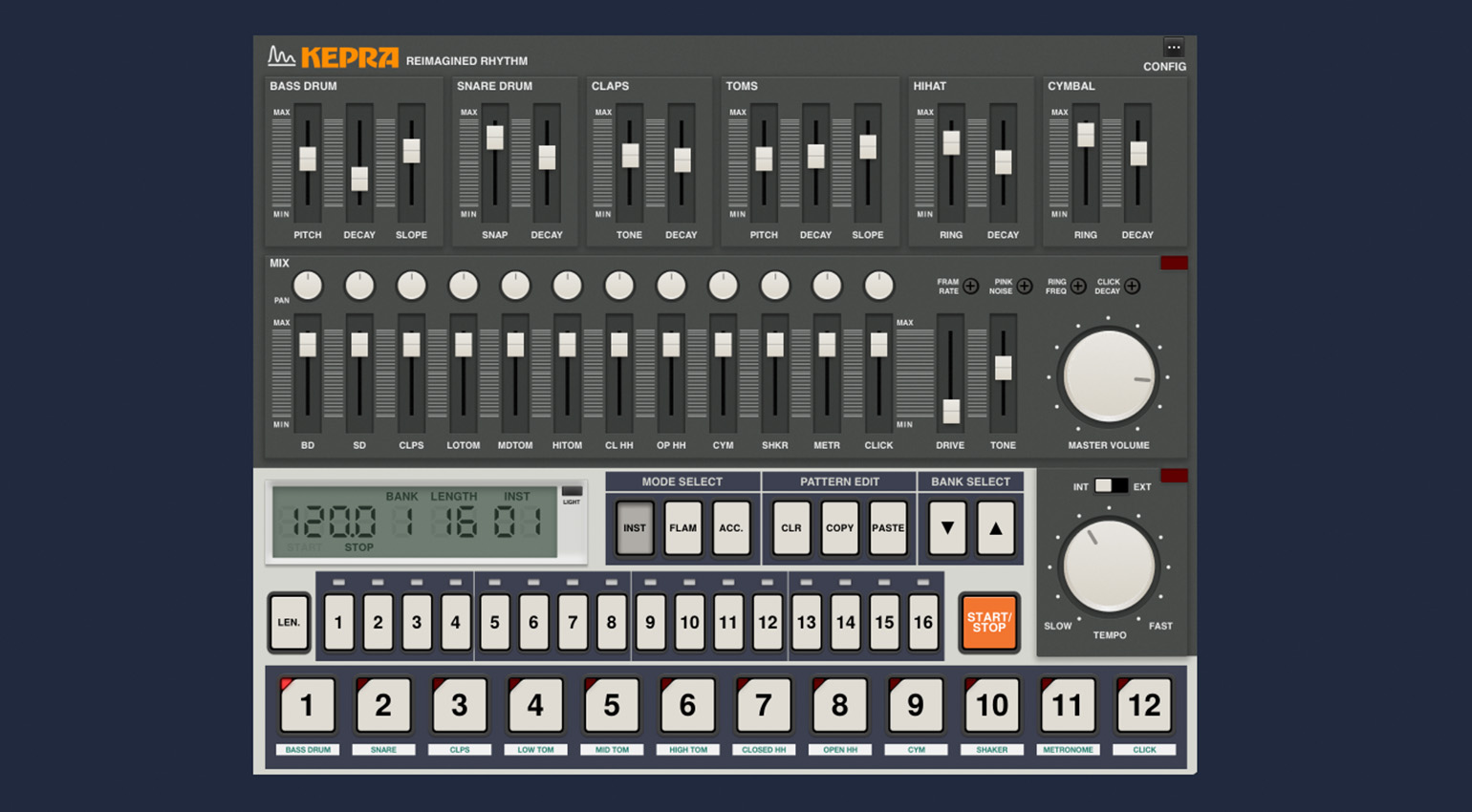
KORG’s drum machines have always been a bit hit and miss, in my humble opinion. Their early attempts are often lauded simply because of a certain Frenchman using them in his most famous recordings, but whilst they don’t ordinarily stand up to the likes of Roland and Yamaha, that very fact kind of makes them desirable and endearing.
Kepra does an excellent job of recreating the KPR-77, through analog modelling rather than sampling, and then expanding beyond its original spec to fit in nicely in today’s world of music recording. It has more faders and sound shaping capabilities, and the drum pads have been separated from the 16 steps of the sequencer, making it easier to navigate.
And whilst it retains the authentic sound, it can go some way beyond that on its own, and of course, you don’t have to worry about the batteries running out and losing all your carefully programmed patterns. It also introduces a new shaker sound, created using the same modelling as if the original designers had made it. Better still is the price. The developer, Hügleton Instruments, is only asking a minimum of $1, which is a steal!

*Note: This article contains advertising links that help us pay for this site. Don’t worry: the price for you will always be the same! If you buy something through these links, we will receive a small commission. Thank you for your support!

This might also interest you